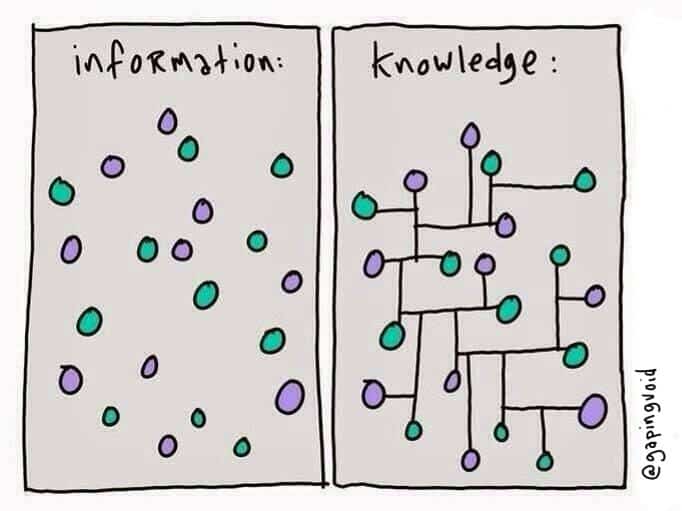
Ted Nelson launches Project Xanadu, and he said, "Well, what if it wasn't just limited to the things that I have? What if I could connect ideas across a larger body of work?"
- for: Ted Nelson, Xanadu, knowledge federation
Ted Nelson launches Project Xanadu, and he said, "Well, what if it wasn't just limited to the things that I have? What if I could connect ideas across a larger body of work?"
BookmarkTypes and uses of PKM
Almost every well known writer/composer/creative throughout history had some sort of note taking or knowledge system of one sort or another (florilegium, commonplace books, notebooks, diaries, journals, zettelkasten, waste books, mnemonic techniques, etc.), which would put them into your "active" category. I think you'd be hard put to come up with evidence of a "sudden" emergence of an "active" PKM system beyond the choice of individual users to actively do something with their collections or not.
If you want to go more distant than Eminem, try looking closely at Ramon Llull's practice in the 11th century, or Homer in the c. 8th century BCE. Or to go much, much farther back, there's solid evidence that indigenous peoples in Australia had what you call both passive and active PKM systems as far back as 65,000 years ago. These are still in use today. Naturally these were not written, but used what anthropologists call orality. (See Walter Ong, Milman Parry, Lynne Kelly, Margo Neale, Duane Hamacher, et al.)
Loet Leydesdorff. The Evolutionary Dynamics of Discursive Knowledge Communication-Theoretical Perspectives on an Empirical Philosophy of Science
The basic settings allow users to quickly configure a subset of KB features and colors accessible on the left sidebar on this page.
设置
Add Articles and Categories
wiki 2
Setup Knowledge Base
wiki学习 1
I have been using the Outline of Knowledge (OoK) which Adler developed for the Propædia volume of the 15th edition of the Encyclopedia Britannica (orig. publ. 1974) as my way of indexing knowledge (there is a blog series describing this). I am now working on Part 7 of the series, which is concerned with porting from a card-based analogue system to a digital computer-based form, using the insights gained from having done so via the analogue approach initially.It appears as though the final version of the OoK which ever appeared was in 2010, and is archived at The Internet Archive.I am interested in whether anyone has continued using the OoK or has expanded upon it in any formalised or systematic way. I have made my own mods to it, of course, as it is several decades old and could bear with some revision. But I am not aware of any organisation or group that may already be doing this, including the Britannica itself (which seems a shame, if it is the case).Does anyone know of any such efforts?
reply to u/TheVoroscope at https://www.reddit.com/r/antinet/comments/va2s09/comment/jtwqhd7/?utm_source=reddit&utm_medium=web2x&context=3
u/TheVoroscope, the only things I've seen on it are the original and what you've written. I suspect anything current will be quite niche and would require searching in the areas of academic journal articles or at the level of graduate studies within the library sciences where you might find something. Simon Winchester had a section on the rise and downfall of the Encyclopedia Britannica in his most recent book Knowing What We Know (2023) which has a brief mention of the Propædia, but it was broadly described as a $32 million dollar bomb that ended the Encyclopedia. I would suspect that the last printings in 2010 and 2012 were probably the last more as a result of the rise of internet usage than they were the form and function of the Propædia itself though.
The concept of the purity of science should be abandoned.
specific uses of the technology help develop what we call “relational confidence,” or the confidence that one has a close enough relationship to a colleague to ask and get needed knowledge. With greater relational confidence, knowledge sharing is more successful.
Wikimedia is a global movement whose mission is to bring free educational content to the world.
This is great!
(1:21:20-1:39:40) Chris Aldrich describes his hypothes.is to Zettelkasten workflow. Prevents Collector's Fallacy, still allows to collect a lot. Open Bucket vs. Closed Bucket. Aldrich mentions he uses a common place book using hypothes.is which is where all his interesting highlights and annotations go to, unfiltered, but adequately tagged. This allows him to easily find his material whenever necessary in the future. These are digital. Then the best of the best material that he's interested in and works with (in a project or writing sense?) will go into his Zettelkasten and become fully fledged. This allows to maintain a high gold to mud (signal to noise) ratio for the Zettelkasten. In addition, Aldrich mentions that his ZK is more of his own thoughts and reflections whilst the commonplace book is more of other people's thoughts.
BookmarkNew book - Personal Knowledge Graphs, by Ivo Velitchkov
For some additional context the work can be found through https://personalknowledgegraphs.com/#/page/pkg. It also has portions of the building of the book which exist as a knowledge graph, though it doesn't appear that they put up the entirety of the book as a linked knowledge graph the way they had initially planned. I've read a few parts in draft form, including Flancian's chapter whose ideas are tremendous, but I have yet to read the remainder of the published work.
[Disclosure: I had submitted and had been accepted to write an early, historical-flavored chapter for this volume, but ultimately fell out, as did many others, over disagreements regarding their editing and/or publishing process. I'm close with Flancian and appreciate his experimental programming work on https://anagora.org/index, which one might call a multi-layered wiki of personal wikis, commonplace books, zettelkasten, diaries, notes, and other similar forms of personal knowledge. If you've got a public, digitally available version of a zettelkasten you'd like to add to his project, do reach out to him to interconnect it with the Agora and others' work there.]
knowledge mapping to analyze the changes in the number of published papers as time goes on, in terms of country and geographic area, research topics, research methods, funding sources, hot research spots, and research trends.
And because libraries generally do not take possession of the ebook files they rent from publishers, their crucial role as long-term preservers of culture has been severed from their role as institutions that provide democratic access—a striking change.
E-books have caused the missions of many libraries to shift away from institutions that provide democratic access to a preserved culture.
I’ve also found that Tailwind works extremely well as an extension of my memory. I’ve uploaded my “spark file” of personal notes that date back almost twenty years, and using that as a source, I can ask remarkably open-ended questions—“did I ever write anything about 19th-century urban planning” or “what was the deal with that story about Houdini and Conan Doyle?”—and Tailwind will give me a cogent summary weaving together information from multiple notes. And it’s all accompanied by citations if I want to refer to the original direct quotes for whatever reason.
This sounds like the sort of personalized AI tool I've been wishing for since the early ChatGPT models if not from even earlier dreams that predate that....
This analysis will result in the form of a new knowledge-based multilingual terminological resource which is designed in order to meet the FAIR principles for Open Science and will serve, in the future, as a prototype for the development of a new software for the simplified rewriting of international legal texts relating to human rights.
software to rewrite international legal texts relating to human rights, a well written prompt and a few examples, including the FAIR principles will let openAI's chatGPT do it effectively.
https://random-blather.com/2014/04/28/information-isnt-power/
Illustration by David Somerville based on the original by Hugh McLeod.
Link to: https://hypothes.is/a/ysRBGgACEe6UNPvIvmWBkQ
This diagram is roughly a cartoon of the zettelkasten process, especially if the panels are labeled: reading, excerpting/synopsis, linking, serendipity, writing.
I am an academic, so a critic might say that intellectual masturbation is kind of my job description.
Stephen Davies, Javier Velez-Morales, & Roger King (2005), "Building the memex sixty years later: trends and directions in personal knowledge bases", Department of Computer Science, University of Colorado at Boulder. The Wikipedia article on personal knowledge bases (PKBs) is basically a summary of the technical report. The report defined personal knowledge base systems, described their benefits, reviewed relevant fields of research, and compared systems in terms of several aspects of their data models: structural framework, knowledge elements, schema, and the role of transclusion. This report is the most comprehensive publication I've read that compares PKB systems according to their key features.
How To Use The ACE Framework This Week
ACE Framework - Add - Connect - Express
yet another acronym
hmmm... because... as a tool for building/developing thoughts
Asking a computer to create a glossary for you doesn’t make you any smarter than having a book that comes with a glossary.
https://www.reddit.com/r/ObsidianMD/comments/zkefis/is_the_concept_of_personal_knowledge_management/
Writing permanent notes was time consuming as f***.
The framing of "permanent notes" or "evergreen notes" has probably hurt a large portion of the personal knowledge management space. Too many people are approaching these as some sort of gold standard without understanding their goal or purpose. Why are you writing such permanent/evergreen notes? Unless you have an active goal to reuse a particular note for a specific purpose, you're probably wasting your time. The work you put into the permanent note is to solidify an idea which you firmly intend to reuse again in one or more contexts. The whole point of "evergreen" as an idea is that it can actively be reused multiple times in multiple places. If you've spent time refining it to the nth degree and writing it well, then you had better be doing so to reuse it.
Of course many writers will end up (or should end up) properly contextualizing individual ideas and example directly into their finished writing. As a result, one's notes can certainly be rough and ready and don't need to be highly polished because the raw idea will be encapsulated somewhere else and then refined and rewritten directly into that context.
Certainly there's some benefit for refining and shaping ideas down to individual atomic cores so that they might be used and reused in combination with other ideas, but I get the impression that some think that their notes need to be highly polished gems. Even worse, they feel that every note should be this way. This is a dreadful perspective.
For context I may make 40 - 60 highlights and annotations on an average day of reading. Of these, I'll review most and refine or combine a few into better rougher shape. Of this group maybe 3 - 6 will be interesting enough to turn into permanent/evergreen notes of some sort that might be reused. And even at this probably only one is interesting enough to be placed permanently into my zettelkasten. This one will likely be an aggregation of many smaller ideas combined with other pre-existing ideas in my collection; my goal is to have the most interesting and unique of my own ideas in my permanent collection. The other 2 or 3 may still be useful later when I get to the creation/writing stage when I'll primarily focus on my own ideas, but I'll use those other rougher notes and the writing in them to help frame and recontextualize the bigger ideas so that the reader will be in a better place to understand my idea, where it comes from, and why it might be something they should find interesting.
Thus some of my notes made while learning can be reused in my own ultimate work to help others learn and understand my more permanent/evergreen notes.
If you think that every note you're making should be highly polished, refined, and heavily linked, then you're definitely doing this wrong. Hopefully a few days of attempting this will disabuse you of the notion and you'll slow down to figure out what's really worth keeping and maintaining. You can always refer back to rough notes if you need to later, but polishing turds is often thankless work. Sadly too many misread or misunderstand articles and books on the general theory of note taking and overshoot the mark thinking that the theory needs to be applied to every note. It does not.
If you find that you're tiring of making notes and not getting anything out of the process, it's almost an assured sign that you're doing something wrong. Are you collecting thousands of ideas (bookmarking behavior) and not doing anything with them? Are you refining and linking low level ideas of easy understanding and little value? Take a step back and focus on the important and the new. What are you trying to do? What are you trying to create?
It is difficult to see interdependencies This is especially true in the context of learning something complex, say economics. We can’t read about economics in a silo without understanding psychology, sociology and politics, at the very least. But we treat each subject as though they are independent of each other.
Where are the tools for graphing inter-dependencies of areas of study? When entering a new area it would be interesting to have visual mappings of ideas and thoughts.
If ideas in an area were chunked into atomic ideas, then perhaps either a Markov monkey or a similar actor could find the shortest learning path from a basic idea to more complex ideas.
Example: what is the shortest distance from an understanding of linear algebra to learn and master Lie algebras?
Link to Garden of Forking Paths
Link to tools like Research Rabbit, Open Knowledge Maps and Connected Papers, but for ideas instead of papers, authors, and subject headings.
It has long been useful for us to simplify our thought models for topics like economics to get rid of extraneous ideas to come to basic understandings within such a space. But over time, we need to branch out into related and even distant subjects like mathematics, psychology, engineering, sociology, anthropology, politics, physics, computer science, etc. to be able to delve deeper and come up with more complex and realistic models of thought.Our early ideas like the rational actor within economics are fine and lovely, but we now know from the overlap of psychology and sociology which have given birth to behavioral economics that those mythical rational actors are quaint and never truly existed. To some extent, to move forward as a culture and a society we need to rid ourselves of these quaint ideas to move on to more complex and sophisticated ones.
Want to read: How Romantics and Victorians Organized Information by Jillian M. Hess 📚
https://kimberlyhirsh.com/2023/04/28/want-to-read.html
👀 How did I not see this?!?? 😍 Looks like a good follow up to Ann Blair's Too Much to Know (Yale, 2010) and the aperitif of Simon Winchester's Knowing What We Know (Harper) which just came out on Tuesday. 📚 Thanks for the recommendation Kimberly!
To buy or not to buy a course? And, if the latter, which one? .t3_12fowjy._2FCtq-QzlfuN-SwVMUZMM3 { --postTitle-VisitedLinkColor: #9b9b9b; --postTitleLink-VisitedLinkColor: #9b9b9b; --postBodyLink-VisitedLinkColor: #989898; } questionSo, I've been considering buying an online course for Zettelkasten (in Obsidian). Thing is... There are a bunch of them. Two (maybe three) questions:Is it worth it? Has anyone gone down that path and care to share their experience?Any recommendations? I've seen a bunch of options and really don't have any hints on how to evaluate them.
reply to u/Accomplished-Tip-597 at https://www.reddit.com/r/Zettelkasten/comments/12fowjy/to_buy_or_not_to_buy_a_course_and_if_the_latter/
Which "industry", though? Productivity? Personal Knowledge Management? Neither of these are focused on the idea of a Luhmann-esque specific zettelkastenare they?
For the original poster, what is your goal in taking a course? What do you want to get out of it? What are you going to use such a system for? The advice you're looking for will hinge on these.
Everyone's use is going to be reasonably idiosyncratic, so not knowing anything else, my general recommendation (to minimize time, effort, and expense) would be to read one of the following (for free), practice at some of it for a few weeks before you do anything else. Then if you need it, talk u/taurusnoises into a few consultations based on what you'd like to accomplish. He's one of the few who does this who's got experience in the widest variety of traditions in addition to expertise in the platform you want (though I'd still recommend him if you were using something else.)
Oakeshott saw educationas part of the ‘conversation of mankind’, wherein teachers induct their studentsinto that conversation by teaching them how to participate in the dialogue—howto hear the ‘voices’ of previous generations while cultivating their own uniquevoices.
How did Michael Oakeshott's philosophy overlap with the idea of the 'Great Conversation' or 20th century movement of Adler's Great Books of the Western World.
How does it influence the idea of "having conversations with the text" in the annotation space?
We could saythat he was the first progressive educator not simply because he encouraged hiscontemporaries and successors to think about the child as a special kind oflearner, but also because of his views on education’s role in helping to developan open, liberal polity. A political system, he said, needs people who are fair,open-minded, and think for themselves; it doesn’t want people who aresubservient to authority.
We could say first, though I highly suspect that his ideas came from somewhere else...
Hypothesis Animated Intro, 2013. https://www.youtube.com/watch?v=QCkm0lL-6lc.
This was an early animation for Hypothes.is as a tool. It was on one of their early homepages and is (still) a pretty good encapsulation of what they do and who they are as a tool for thought.
In the fall of 2015, she assigned students to write chapter introductions and translate some texts into modern English.
continuing from https://hypothes.is/a/ddn4qs8mEe2gkq_1T7i3_Q
Potential assignments:
Students could be tasked with finding new material or working off of a pre-existing list.
They could individually be responsible for indexing each individual sub-text within a corpus by: - providing a full bibliography; - identifying free areas of access for various versions (websites, Archive.org, Gutenberg, other OER corpora, etc.); Which is best, why? If not already digitized, then find a copy and create a digital version for inclusion into an appropriate repository. - summarizing the source in general and providing links to how it fits into the broader potential corpus for the class. - tagging it with relevant taxonomies to make it more easily searchable/selectable within its area of study - editing a definitive version of the text or providing better (digital/sharable) versions for archiving into OER repositories, Project Gutenberg, Archive.org, https://standardebooks.org/, etc. - identifying interesting/appropriate tangential texts which either support/refute their current text - annotating their specific text and providing links and cross references to other related texts either within their classes' choices or exterior to them for potential future uses by both students and teachers.
Some of this is already with DeRosa's framework, but emphasis could be on building additional runway and framing for helping professors and students to do this sort of work in the future. How might we create repositories that allow one a smörgåsbord of indexed data to relatively easily/quickly allow a classroom to pick and choose texts to make up their textbook in a first meeting and be able to modify it as they go? Or perhaps a teacher could create an outline of topics to cover along with a handful of required ones and then allow students to pick and choose from options in between along the way. This might also help students have options within a course to make the class more interesting and relevant to their own interests, lives, and futures.
Don't allow students to just "build their own major", but allow them to build their own textbooks and syllabi with some appropriate and reasonable scaffolding.
The ability to intentionally and strategically allocateour attention is a competitive advantage in a distracted world. Wehave to jealously guard it like a valuable treasure.
It would seem that the word treasure here is being used to modify one's attention. Historically in books about "knowledge work" or commonplacing, the word was used with respect to one's storehouse of knowledge itself and not one's attention. Some of the effect is the result of the break in historical tradition being passed down from one generation to another. It's also an indication that the shift in value has moved not from what one knows or has, but that the attention itself is more valued now, even in a book about excerpting, thinking, and keeping knowledge!
Oh how far we have fallen!
It's also an indication of the extremes of information overload we're facing that the treasure is attention and not the small tidbits of knowledge and understanding we're able to glean from the massive volumes we face on a daily basis.
By looking at practices of note-taking for their ownsake we can get a better idea of how people performed intellectual work in the past, what caughttheir attention and how they moved from reading to producing a finished work, often via note-taking.
Other PKM forums, places to discuss?
reply to u/deafpolygon at https://www.reddit.com/r/PKMS/comments/121ihrj/other_pkm_forums_places_to_discuss/
The space is fragmented broadly by both tools (some with specific workflows) and philosophies, so you may have to hunt/peck (or subscribe/filter) for the types of pieces you're searching for. Here's some resources you might appreciate. In the fora section things are ordered roughly by relation to the topic as well as frequency of posting/activity.
Fora
Sites
Discord
For some communities like Obsidian, Logseq, etc. you're also likely to find discord servers with some reasonable sub-channels and activity as well. A good non-product specific Discord with related material is The Productivists at https://discord.gg/m2bP2hh3. There's also one for Zettelkasten https://discord.gg/bYrVm9sr.
And of course as you visit all these locales, be sure to mention r/PKMS and maybe more will learn that this location is a better catch-all for in-depth conversations and questions.
Universities are factories of human knowledge. They’re also monuments to individual ignorance.
https://www.nytimes.com/2023/01/03/opinion/college-learning-students-success.html
"Personal Knowledge Management Is Bullshit"
reply to jameslongley at https://forum.zettelkasten.de/discussion/2532/personal-knowledge-management-is-bullshit
I find that these sorts of articles against the variety of practices have one thing in common: the writer fails to state a solid and realistic reason for why they got into it in the first place. They either have no reason "why" or, perhaps, just as often have all-the-reasons "why", which may be worse. Much of this is bound up in the sort of signaling and consumption which @Sascha outlines in point C (above).
Perhaps of interest, there are a large number of Hypothes.is annotations on that original article written by a variety of sense-makers with whom I am familiar. See: https://via.hypothes.is/https://www.otherlife.co/pkm/ Of note, many come from various note making traditions including: commonplace books, bloggers, writers, wiki creators, zettelkasten, digital gardening, writers, thinkers, etc., so they give a broader and relatively diverse perspective. If I were pressed to say what most of them have in common philosophically, I'd say it was ownership of their thought.
Perhaps it's just a point of anecdotal evidence, but I've been noticing that who write about or use the phrase "personal knowledge management" are ones who come at the space without an actual practice or point of view on what they're doing and why—they are either (trying to be) influencers or influencees.
Fortunately it is entirely possible to "fake it until you make it" here, but it helps to have an idea of what you're trying to make.
“increased knowledge tends to strengthen our position on climate change, regardless of what that position is” (Hoffman 2015:5)
If the facts don’t fit the frames in your brain, the frames in your brain stay and the facts are ignored or challenged or belittled” (Lakoff 2014: xiv).
//Quote - If the facts don’t fit the frames in your brain, the frames in your brain stay and the facts are ignored or challenged or belittled - (Lakoff 2014: xiv).
“increased knowledge tends to strengthen our position on climate change, regardless of what that position is” (Hoffman 2015:5).
// quote - increased knowledge tends to strengthen our position on climate change, regardless of what that position is” - (Hoffman 2015:5). - The wealth of information available on the internet and through social media does not make us better informed, but simply makes us more certain that we are right - (Hoffman 2015:45)
The knowledge deficit hypothesis is closely tied to the idea of Homo economicus, an ontological model of the human as rationally self-interested. Historically in Western philosophy “ontology” refers to the study of being, the nature of human being, subjectivity, or what it means to be a self, epitomized in Descartes cogito. This individualized ontology has been extensively critiqued in philosophy and anthropology, but people keep arguing against it because these critiques have had little impact on the material world of economics and politics in which people are still routinely assumed to be rationally self-interested individuals. Edmund Husserl, and later Maurice Merleau-Ponty (1962) developed a highly influential phenomenological critique of the Cartesian subject and the modern self, which influenced Gregory Bateson’s Steps to an Ecology of Mind (1972), and subsequent models of the self in deep ecology, ecofeminism, and ecopsychology (see Roszak et al. 1995 for an overview). Phenomenology also inspired work in intersubjectivity such as Martin Buber’s (1970) I-Thou relations, and Emmanuel Levinas’ (1969, 1998) understanding of ethical subjectivity, as well as Bruno Latour’s (2005) development of actor network theory. Latour’s writings have stimulated fruitful dialogues with anthropologies of Indigenous ontologies. Much of this literature is well known within the environmental humanities, but has had little impact more broadly in environment studies and environmental science, and less still in in politics and economics.
// Interconnecting many thinkers and ideas throughout modern history related to knowledge deficit - knowledge deficit model is closely related to homo economicus, which is based on human beings a rational, self-interested agents - all these inter-relationships are new knowledge to me - this individualized ontology has its roots at least in Descartes and has been extensively critiqued - Edmond Husserl and Maurice Merleau-Ponty critiqued it - Their critique influenced Gregory Bateson, as reflected in his book "Steps in an Ecological Mind" - It also influenced Emmanuel Levinas' understanding of ethical subjectivity and Bruno Latour's actor network theory - Latour's work influenced anthropologies of Indigenous people - This knowledge is well known with field of environmental humanities, but little known in the world of politics and economics
Abstract
// abstract - summary - Rationalist approaches to environmental problems such as climate change - apply an information deficit model, - assuming that if people understand what needs to be done they will act rationally. - However, applying a knowledge deficit hypothesis often fails to recognize unconscious motivations revealed by: - social psychology, - cognitive science, - behavioral economics.
Learning has to be knowledge. 00:10:07 And learning has to be based on understanding. And what you understand you can absorb, internalize and it becomes knowledge. What you know, you don't forget. You can block something that you know, but not forget.
The Agora: a Knowledge Commons By: Eduardo Ivanec a.k.a. @flancian Go link: https://anagora.org/go/agora-chapter
Ithaka - C. P. Cavafy, "The City" from C.P. Cavafy: Collected Poems. Translated by Edmund Keeley and Philip Sherrard.
The first version of "Ithaka" was probably written in 1894. Cavafy revised the poem in 1910, and it was first published in 1911. The first English translation was published in 1924, and there have been a number of different translations since then. The poem can be found in Cavafy's Collected Poems, translated by Edmund Keeley and Philip Sherrard, edited by George Savidis, Princeton University Press, 1980.
Stop Procrastinating With Note-Taking Apps Like Obsidian, Roam, Logseq https://www.youtube.com/watch?v=baKCC2uTbRc by Sam Matla
sophisticated procrastination - tweaking one's system(s) or workflow with the anticipation it will help them in the long run when it is generally almost always make-work which helps them feel smart and/or productive. Having measurable results which can be used against specific goals will help weed this problem out.
optimization-procrastination trap is related to shiny object syndrome - the idea of tweaking one's system constantly
perfect tool trap - guess what? there isn't one
"Personal knowledge management is an aid to your work, not the work itself." —Sam Matla #
This is entirely dependent on what and how you're doing it. If you're actively reading and annotating, and placing it somewhere, then that is the work, just in small progressive steps.
He needs to be more specific about what he means by "personal knowledge management" as a definition of something.
PKM Weekly Feb 19 2023 – Issue 057 – Curtis McHale<br /> by Curtis McHale
Certainly, computerizationmight seem to resolve some of the limitations of systems like Deutsch’s, allowing forfull-text search or multiple tagging of individual data points, but an exchange of cardsfor bits only changes the method of recording, leaving behind the reality that one muststill determine what to catalogue, how to relate it to the whole, and the overarchingsystem.
Despite the affordances of recording, searching, tagging made by computerized note taking systems, the problem still remains what to search for or collect and how to relate the smaller parts to the whole.
customer relationship management vs. personal knowledge management (or perhaps more important knowledge relationship management, the relationship between individual facts to the overall whole) suggested by autocomplete on "knowl..."
As a result, hisindex is simultaneously a relic of research and a reminder of the pitfalls of all such effortsto create systematic knowledge, regardless of the underlying technology – paper, digitalor otherwise.
Beyond the realm of historians, advocates called card indexes ‘the only portable,elastic, simple, orderly and self-indexing way of keeping records’, and the practice wascommon enough that Gustave Flaubert parodied the unending and ultimately futilepursuit of all knowledge in his 1881 satire Bouvard et Pe ́cuchet (Dickinson, 1894).
Deutsch’s close friendJoseph Stolz, writing of the Chicago rabbi Bernard Felsenthal (1822–1908) who hadpenned a history of that city’s Jews and was instrumental in the 1892 formation of theAmerican Jewish Historical Society, noted that Felsenthal ‘was not the systematic orga-nizer who worked with a stenographer and card-index’ (Stolz, 1922: 259).
Great example of a historian implying the benefit of not only a card index, but of potentially how commonplace it was to not only have one, but to have stenographers or secretaries to help manage them.
Link this to the reference in Heyde about historians and others who were pushed to employ stenographers or copyists to keep their card indexes in order.
Given the cost of employing secretaries to manage our information, one of the affordances that computers might focus on as tools for thought is lowering the barrier for management and maintenance. If they can't make this easier/simpler, then what are they really doing beyond their shininess? Search is obviously important in this context.
What was the reference to employing one person full time to manage every 11 or 12 filing cabinets' worth of documents? Perhaps Duguid in the paper piece?
one finds in Deutsch’s catalogue one implementation of what LorraineDaston would later term ‘mechanical objectivity’, an ideal of removing the scholar’s selffrom the process of research and especially historical and scientific representation (Das-ton and Galison, 2007: 115-90).
In contrast to the sort of mixing of personal life and professional life suggested by C. Wright Mills' On Intellectual Craftsmanship (1952), a half century earlier Gotthard Deutsch's zettelkasten method showed what Lorraine Datson would term 'mechanical objectivity'. This is an interesting shift in philosophical perspective of note taking practice. It can also be compared and contrasted with a 21st century perspective of "personal" knowledge management.
Today’s students carry access to boundlessinformation that Eco’s students could not have begun tofathom, but Eco’s students owned every word they carried.
This is a key difference in knowledge mastery...
Aesopian language is a means of communication with the intent to convey a concealed meaning to informed members of a conspiracy or underground movement, whilst simultaneously maintaining the guise of an innocent meaning to outsiders.
https://en.wikipedia.org/wiki/Aesopian_language
Parents often use variations of double entendre to communicate between each other with out children understanding while present.
It's also likely that Indigenous elders may use this sort of communication with uninitiated members nearby.
at a time when anything that takes more than a few minutes to skim is called a “longread”—it’s understandable that devoting a small chunk of one’s frisky twenties to writing a thesis can seem a waste of time, outlandishly quaint, maybe even selfish. And, as higher education continues to bend to the logic of consumption and marketable skills, platitudes about pursuing knowledge for its own sake can seem certifiably bananas.
cancer can be insidious
Categories mean determination of internal structure less flexibility, especially “in the long run“ of knowledgemanagement and storage
The fact that Luhmann changed the structure of his zettelkasten with respect to the longer history of note taking and note accumulation allowed him several useful affordances.
In older commonplacing and slip box methods, one would often store their notes by topic category or perhaps by project. This mean that after collection one had to do additional work of laying them out into some sort of outline to create arguments and then write them out for publication. This also meant that one was faced with the problem of multiple storage or copying out notes multiple times to file under various different subject headings.
Luhmann overcame both of these problems by eliminating categories and placing ideas closest to their most relevant neighbor and numbering them in a branching fashion. Doing this front loads some of the thinking and outlining work which would often be done later, though it's likely easier to do when one has the fullest context of a note after they've made it when it is still freshest in their mind. It also means that each note is linked to at least one other note in the system. This helps notes from being lost and allows a simpler indexing structure whereby one only needs to use a few index entries to get close to the neighborhood of an idea as most other related ideas are likely to be nearby within a handful or more of index cards.
Going from index to branches on the tree is relatively easy and also serves the function of reminding one of interesting prior reading and ideas as one either searches for specific notes or searches for placing future notes.
When it comes to ultimately producing papers, one's notes already have a pre-arranged sort of outline which can then be more easily copied over for publication, though one can certainly still use other cross-links and further rearranging if one wishes.
Older methods focused on broad accretion of materials into subject ordered piles while Luhmann's practice not only aggregated them, but slowly and assuredly grew them into more orderly trains of thought as he collected.
Link to: The description in Technik des wissenschaftlichen Arbeitens (section 1.2 Die Kartei) at https://hypothes.is/a/-qiwyiNbEe2yPmPOIojH1g which heavily highlights all the downsides, though it doesn't frame them that way.
“multiple storage”
Within the history of personal knowledge management, one was often faced with where to store their notes so that it would be easy to find and use them again. Often this was done using slip methods by means of "multiple storage" by making multiple copies and filing them under various headings. This copying process was onerous and breaks the modern database principle "don't repeat yourself" (DRY).
Alternate means of doing this include storing it in one place and then linking that location to multiple subject headings in an index, though this may cause issues of remembering which subject heading when there are many appropriate potential synonyms.
Modern digital methods allow one to store a note in one location and refer to it in multiple ways electronically as well as with aliases.
Digital gardening is the Domestic Cozy response to the professional personal blog; it's both intimate and public, weird and welcoming.
If you ask an elder about the work’s meaning, you may quickly find yourself enrolledin what Wardaman law man Yidumduma Bill Harney calls “Bush University”.
Art is often focused on aesthetic, but more importantly, it is avisual embodiment of knowledge.
link to: Eddington quote https://hypothes.is/a/TNV2WqfpEe2Z24NgnWsZCg
Hamacher, Duane W. “The Art of Star Knowledge.” In 65,000 Years: A Short History of Australian Art, edited by Judith Ryan and Marcia Langton. Melbourne, Australia: University of Melbourne Press, 2023. https://www.academia.edu/96537139/The_Art_of_Star_Knowledge.
A Global Knowledge Commons
= Global Knowledge Commons
This was recommended in the Obsidian Members Group Discord for teaching someone how to setup an Obsidian vault with a GitHub repo for version control. Kamil claimed it was more clear than an intro article by [[Bryan Jenks]] on how to setup GitHub with Obsidian. Jenks eventually made a video about the process.
Basil Lanneau Gildersleeve, "Brief Mention," American Journal of Philology 20.1 (1899) 108-113 (at 108): With all our advance in scientific astronomy, the average modern man is not so familiar with the sky as was his antique brother, and some of the blunders in modern works of fiction that are scored from time to time in scientific journals would hardly have been possible for a ploughman of antiquity, not to say a sailor. The world needs every now and then a reminder that the modern head holds different things from the ancient brain-pan, not necessarily more.
How painfully true this may have been in 1899, it's now much worse in 2023!
Specialization of knowledge tends to fit the lifeways of the people who hold and maintain it. Changing lifeways means one must lose one or more domains and begin using or curating different domains of knowledge.
In a global world of specialization, humans who specialize are forced to rely more heavily on the experience and veracity of those around them who have also specialized. One may be able to have a Ph.D. in astrophysics, but their knowledge of the state of the art in anthropology or economic policy may be therefore utterly undeveloped. As a result they will need to rely on the knowledge and help of others in maintaining those domains.
This knowledge specialization means that politicians will need to be more open about what they think and say, yet instead politicians seem to be some of the least knowledge about almost anything.
This is just the start of a somewhat well-formed thesis I've developed elsewhere, but not previously written out... more to come...
I’m back at the box.
This is a great euphemism for the fun "work" of maintaining a zettelkasten.
via u/A_Dull_Significance at https://www.reddit.com/r/antinet/comments/10gnh3u/box_update/
May 19, 2004 #1 Hello everyone here at the forum. I want to thank everyone here for all of the helpful and informative advice on GTD. I am a beginner in the field of GTD and wish to give back some of what I have received. What is posted below is not much of tips-and-tricks I found it very helpful in understanding GTD. The paragraphs posted below are from the book Lila, by Robert Pirsig. Some of you may have read the book and some may have not. It’s an outstanding read on philosophy. Robert Pirsig wrote his philosophy using what David Allen does, basically getting everything out of his head. I found Robert Pirsigs writing on it fascinating and it gave me a wider perspective in using GTD. I hope you all enjoy it, and by all means check out the book, Lila: An Inquiry Into Morals. Thanks everyone. arthur
Arthur introduces the topic of Robert Pirsig and slips into the GTD conversation on 2004-05-19.
Was this a precursor link to the Pile of Index Cards in 2006?
Note that there doesn't seem to be any discussion of any of the methods with respect to direct knowledge management until the very end in which arthur returns almost four months later to describe a 4 x 6" card index with various topics he's using for filing away his knowledge on cards. He's essentially recreated the index card based commonplace book suggested by Robert Pirsig in Lila.
Love these PKM-guru wars: lobbing strawman arguments at people in lengthy, rambling articles. Don't take the bait, Tiago!
"PKM-guru wars"!! 🤣
As someone new to the PKM scene the jargon I see in many posts here is driving me nuts lol.
--alcibiad on 2023-01-15 https://www.reddit.com/r/Zettelkasten/comments/10bv20v/progressive_summarization_justintime_vs_active/
But you should also be aware that current PKM theory has a hard-on for writing all your notes in your own words which, to me, seems like a limitation of "knowledge management" as compared to "information management". I'm fine excerpting and citing because some texts have better phrasing I could ever have.
"current PKM theory"? There is such a thing beyond zeitgeist?!
Ryan Randall @ryanrandall@hcommons.socialEarnest but still solidifying #pkm take:The ever-rising popularity of personal knowledge management tools indexes the need for liberal arts approaches. Particularly, but not exclusively, in STEM education.When people widely reinvent the concept/practice of commonplace books without building on centuries of prior knowledge (currently institutionalized in fields like library & information studies, English, rhetoric & composition, or media & communication studies), that's not "innovation."Instead, we're seeing some unfortunate combination of lost knowledge, missed opportunities, and capitalism selectively forgetting in order to manufacture a market.
https://hcommons.social/@ryanrandall/109677171177320098
If it interests you, GPC lists phrases like dysgu ar gof. This page then gives the example, "Yn yr hen ddyddiau byddai pobl yn dysgu cerddi ar gof" - like saying "to learn by heart" in English.
https://www.reddit.com/r/learnwelsh/comments/10acr9j/sut_i_ddweud_i_memorized_yn_gymraeg/
Fascinating that the Welsh language doesn't seem to have a direct translatable word/verb for "to memorize". The closest are dysgu (to learn, to teach) and cofio (to remember).
Related phrase: yn dysgu cerddi ar gof (to learn poems by heart), though this last is likely a more direct translation of an English concept back into Welsh.
Is this lack of a seemingly basic word for such a practice a hidden indicator of the anthropology of their way of knowing?
If to learn something means that one fully memorizes it from the start, then one needn't sub-specify, right?
There is an add on called "Spaced Repetition" that you may find useful. It can do both flashcards and full notes.
Look into plugin "Spaced Repetition" for Obsidian
Bacon, Bennett, Azadeh Khatiri, James Palmer, Tony Freeth, Paul Pettitt, and Robert Kentridge. “An Upper Palaeolithic Proto-Writing System and Phenological Calendar.” Cambridge Archaeological Journal, January 5, 2023, 1–19. https://doi.org/10.1017/S0959774322000415.
There may be questions as to whether or not this represents written language, but, if true, this certainly represents one of the oldest examples of annotation in human history!
cc: @remikalir
Finally, statistics should reinforce the fact that any patterning found cannot be explained as accidental.
It is possible that the variations in patterning may tell us about the relative timing of the data. Perhaps the earliest data points may have been anecdotal evidence that was improved over time.
Of course it could be the case that migrations, births, etc. may have shifted somewhat over time.
What does the general climate data from these areas and this time period show? Is there variability in this time period?
We appreciate this is a long span of time, and were concerned why any specific artificial memory system should last for so long.
I suspect that artificial memory systems, particularly those that make some sort of logical sense, will indeed be long lasting ones.
Given the long, unchanging history of the Acheulean hand axe, as an example, these sorts of ideas and practices were handed down from generation to generation.
Given their ties to human survival, they're even more likely to persist.
Indigenous memory systems in Aboriginal settings date to 65,000 years and also provide an example of long-lived systems.
These may occur on rock walls, but were commonly engraved onto robust bones since at least the beginning of the European Upper Palaeolithic and African Late Stone Age, where it is obvious they served as artificial memory systems (AMS) or external memory systems (EMS) to coin the terms used in Palaeolithic archaeology and cognitive science respectively, exosomatic devices in which number sense is clearly evident (for definitions see d’Errico Reference d'Errico1989; Reference d'Errico1995a,Reference d'Erricob; d'Errico & Cacho Reference d'Errico and Cacho1994; d'Errico et al. Reference d'Errico, Doyon and Colage2017; Hayden Reference Hayden2021).
Abstract marks have appeared on rock walls and engraved into robust bones as artificial memory systems (AMS) and external memory systems (EMS).
https://diggingthedigital.com/hoe-werkt-het-maken-van-een-idee-notitie/
Frank calls out what he considers a good example of actual note taking practice rather than the more often seen talk about note taking theory. The example in question is Forrest Perry's YouTube video #9 Zettelkasten: from source card to idea card.
I think the point is somewhat different. Luhmann was an academic writing for other academics and wrote technically due to fears of misunderstanding by those with a different educational background, as was a quite reasonable fear at the time.
Was Luhmann's obtuse style, in part, a means of publicly sharing content, but doing so in a way as to restrict the knowledge to those who had an increased level of context for understanding it? How similar is this to the pattern of restricted knowledge in some Indigenous cultures where people passed along knowledge in restricted ways?
Is there a word or phrase to synopsize this sort of hard to understand academic-speak?
It consists of two key components: The ‘Declarative Processing Environment’, which allows processes to be assembled goal-driven from a pool of process building blocks and the ‘Autopoietic Framework’ that mimics natural organisms to adapt to environmental changes, new capabilities and new technology.
Books and Presentations Are Playlists, so let's create a NeoBook this way.
https://wiki.rel8.dev/co-write_a_neobook
A playlist of related index cards from a Luhmann-esque zettelkasten could be considered a playlist that comprises an article or a longer work like a book.
Just as one can create a list of all the paths through a Choose Your Own Adventure book, one could do something similar with linked notes. Ward Cunningham has done something similar to this programmatically with the idea of a Markov monkey.
Hi Chris Aldrich, thank you for sharing your great collection of hypothes.is annotations with the world. This is truly a great source of wisdom and insights. I noticed that you use tags quite a lot there. Are you tagging the notes inside your PKM (Obsidian?) as much as in Hypothes.is or are you more restrictive? Do you have any suggestions or further reading advice on the question of tagging? Thanks a lot in advance! Warmly, Jan
Sorry, I'm only just seeing this now Jan. I tag a lot in Hypothes.is to help make things a bit more searchable/findable in the future. Everything in Hypothes.is gets pulled into my Obsidian vault where it's turned into [[WikiLinks]] rather than tags. (I rarely use tags in Obsidian.) Really I find tagging is better for broad generic labels (perhaps the way many people might use folders) though I tend to tag things as specifically as I can as broad generic tags for things you work with frequently become unusable over time. I recommend trying it out for yourself and seeing what works best for you and the way you think. If you find that tagging doesn't give you anything in return for the work, then don't do it. Everyone can be different in these respects.
But Thamus replied, " Most ingenious Theuth, oneman has the ability to beget arts, but the ability tojudge of their usefulness or harmfulness to their usersbelongs to another ; and now you, who are the fatherof letters, have been led by your affection to ascribeto them a power the opposite of that which theyreally possess. For this invention will produce for-getfulness in the minds of those who learn to use it,because they will not practise their memory. Theirtrust in writing, produced by external characterswhich are no part of themselves, will discourage theuse of their own memory within them. You haveinvented an elixir not of memory, but of reminding ;and you offer your pupils the appearance of wisdom,not true wisdom, for they will read many thingswithout instruction and will therefore seem to knowmany things, when they are for the most part ignorant
and hard to get along with, since they are not wise, but only appear wise." pp 563-564
With medicine, the story was slightly different because of theconstant and urgent need for it. Medical knowledge was alwaysuseful, always relevant, so books on medicine were constantly indemand, and would have been available in the majority of libraries inlate antiquity.
Transmission of medical knowledge has a more immediate and direct application for people; as a result it may tend to be transmitted more faithfully either in written or oral forms. The written record of medical scrolls from antiquity were in constant demand.
If we narrow the process oftransmission down to a single, hypothetical strand, it is feasible thatPtolemy originally wrote The Almagest on a papyrus scroll insecond-century Alexandria. That scroll would have had to berecopied at least twice for it to survive until the sixth century, at whichpoint it might well have been copied onto parchment and bound intoa book. This, too, would need to be recopied every few hundredyears to ensure that it survived (again assuming that it escaped theusual pests, damage and disasters) and was available to scholars in1500. It is therefore likely that The Almagest had to be recopied atthe very least five times during the period 150–1500.
Moller, Violet. The Map of Knowledge: A Thousand-Year History of How Classical Ideas Were Lost and Found. 1st ed. New York: Doubleday, 2019. https://www.penguinrandomhouse.com/books/546484/the-map-of-knowledge-by-violet-moller/.
The limitations of commonplacebooks centers around the following: they only enable short-term knowledgedevelopment. They do not cater to allowing thoughts to evolve over time,infinitely. They do not allow for the infinite internal branching and expansionof ideas.
sigh
This is untrue in practice. They can evolve, they just do so in different ways. Prior to Luhmann's example, they have done so for centuries.
Life is too short to spend it on personal knowledge management.Tl;dr: I think personal knowledge management, in many cases, is a fruitless effort and there are generally only very few cases (see above) in which note taking actually makes sense.
How was this tl;dr not obvious from before the start of their journey?
To Zotero or not to Zotero?
reply to: https://www.reddit.com/r/PersonalKnowledgeMgmt/comments/zgvbg4/to_zotero_or_not_to_zotero/
I don't often add in web pages, but for books and journal articles I love Zotero for quickly bookmarking, tagging, and saving material I want to read. It's worth it's weight in gold just for this functionality even if you're not using it for writing citations in publications.
Beyond this, because of it's openness and ubiquity it's got additional useful plugins for various functions you may want to play around with and a relatively large number of tools are able to dovetail with it to provide additional functionality. As an example, the ability to dump groups of material from Zotero into ResearchRabbit to discover other literature I ought to consider is a fantastically useful feature one is unlikely to find elsewhere (yet).
The concept of a knowledge vacuum refers to an organizational condition in which the pushing force of innovation and the pulling force of organizational inertia both at the structural and behavioral levels such as political pressure, pro-innovation bias, and employee frustration, interact to create a negative spiral that hampers organizational and policy learning.
coupling and decoupling or learning dynamic of innovation
a knowledge vacuum, which is an organizational condition in which excessive exploration and organizational inertia interact to create a vicious cycle of low performance.
La gente se enfocó mas en el brillo que en la substancia.
People focused more on the shine than the substance.
This is an excellent summary of the space since broadly 2018ish, especially from my observations of those online.
Dr James Ravenscroft @jamesravey@fosstodon.orgFollowing on from my first week with hypothes.is I decided to integrate my annotations into #Joplin so that I have tighter integration of my literature + permanent notes. I've built a VERY alpha Joplin plugin that auto-imports hypothes.is annotations + tags to joplin by following your user atom feed https://brainsteam.co.uk/2022/12/04/joplin-hypothesis/ #PKM #ToolsForThought #hypothesis
I continued to use this analog method right up through my Ph.D. dissertation and first monograph. After a scare in the early stages of researching my second monograph, when I thought all of my index cards had been lost in a flood, I switched to an electronic version: a Word doc containing a table with four cells that I can type or paste information into (and easily back up).
Those inherent physical attributes were not what defines star athletes. The great ones, be it Jordan or Ohtani or Messi or Williams, possess superior knowledge, said the neuro. Tom Brady isn’t a great quarterback because he’s big or has a strong arm. Thousands of men are big with strong arms. Brady is great because he knows more about football, and what he has to do to play it better, than anyone else. His brain has an extraordinary store of football knowledge and the ability to process it at lightning speed.
two-way links
🌟 Highlight words as they are spoken (karaoke anybody?). 🌟 Navigate video by clicking on words. 🌟 Share snippets of text (with video attached!). 🌟 Repurpose by remixing using the text as a base and reference.
If I understand it correctly, with hyperaudio, one can also create transcription to somebody else's video or audio when embedded.
In that case, if you add to hyperaudio the annotation capablity of hypothes.is or docdrop, the vision outlined in the article on Global Knowledge Graph is already a reality.
One of the first things that was discovered about building complicated technical hypertext is that you don’t know what the structure will be in advance. And as you’re adding information, you know you want to keep the information, but you frequently don’t know what the information you’re adding is. You can’t describe its type or its nature or its importance in advance. You just suspect that it’s going to be pertinent somehow. Or you see a terrific quotation that you know will be great to use, but you don’t know when that quotation will fit or even if it’ll fit in this book, or if you’ll have to save it for something else. Finding ways to say, “I think these two things are related somehow, but I don’t want to commit myself yet as to exactly how,” turns out to be quite an interesting design problem. Hypertext people started out, in fact, by inventing the outliner very early — 1968. And outliners are terrific if you already know the structure of your information space. But hierarchies are not good if you’re just guessing about how things fit together because you tend to build great elaborate structures that turn out to be wrong, and you have to unbuild them, and then you’ve got a terrible pile on your desk.
Connecting ideas across space and time when you don't know how they'll fully relate in advance is a tough design problem.
Outliner programs, first developed for computers in 1968, are great if you know the structure of a space in advance, but creating hierarchies by guessing about relationships in advance often turn out wrong or create other problems as one progresses.
Article recommended by @wfinck. Based on backlinks, look like the author may be using Obsidian or Notion and syncing into Dropbox to create free published version of notes
https://micro.blog/jean/12885227
Micro.blog users who are into pkm, note taking, and the like.
https://medium.com/@ben_fry/tracing-the-origin-65011dc20877
Could be interesting to apply this sort of process to a variety of texts over time. A draft of Mary Shelley's Frankenstein comes to mind.
How to view this through the lens of Thomas Kuhn's The Structure of Scientific Revolutions? particularly as this was the evolution of an idea by the same author over time...
Paul M mentioned Tilium having a shared aspect that Obsidian doesn't. Seems to be like a GitHubish approach to Obsidian.
https://pkm.social/about
Run by Nicole van der Hoeven
Info Select was on this list of DEVONthink Windows alternatives. Looks like "personal information management" preceded the boom of "personal knowledge management"
Paper by Gyuri Lajos and Andras Benedek. Gyuri's context was recommended by @wfinck. Looks like it pertains to knowledge graphs. Gyuri's own annotation calls it a "meta-knowledge graph"
What would a secure Federated PMK / archive network backed by a minimal blockchain look like?
Possibly like Holochain (which is distinct from the blockchain architecture). Blockchain only seems helpful if you need all of the following: - a database - immutability - distributed data - decentralized & totally trustless - append only - cryptographically secure assurance
Confer Brandon Enright's provocative talk "Blockchain is Bullshit" for an elaboration of these features. The first 10 or so minutes is mostly uninsightful trolling, so the link takes one to his argument about the key features of blockchain.
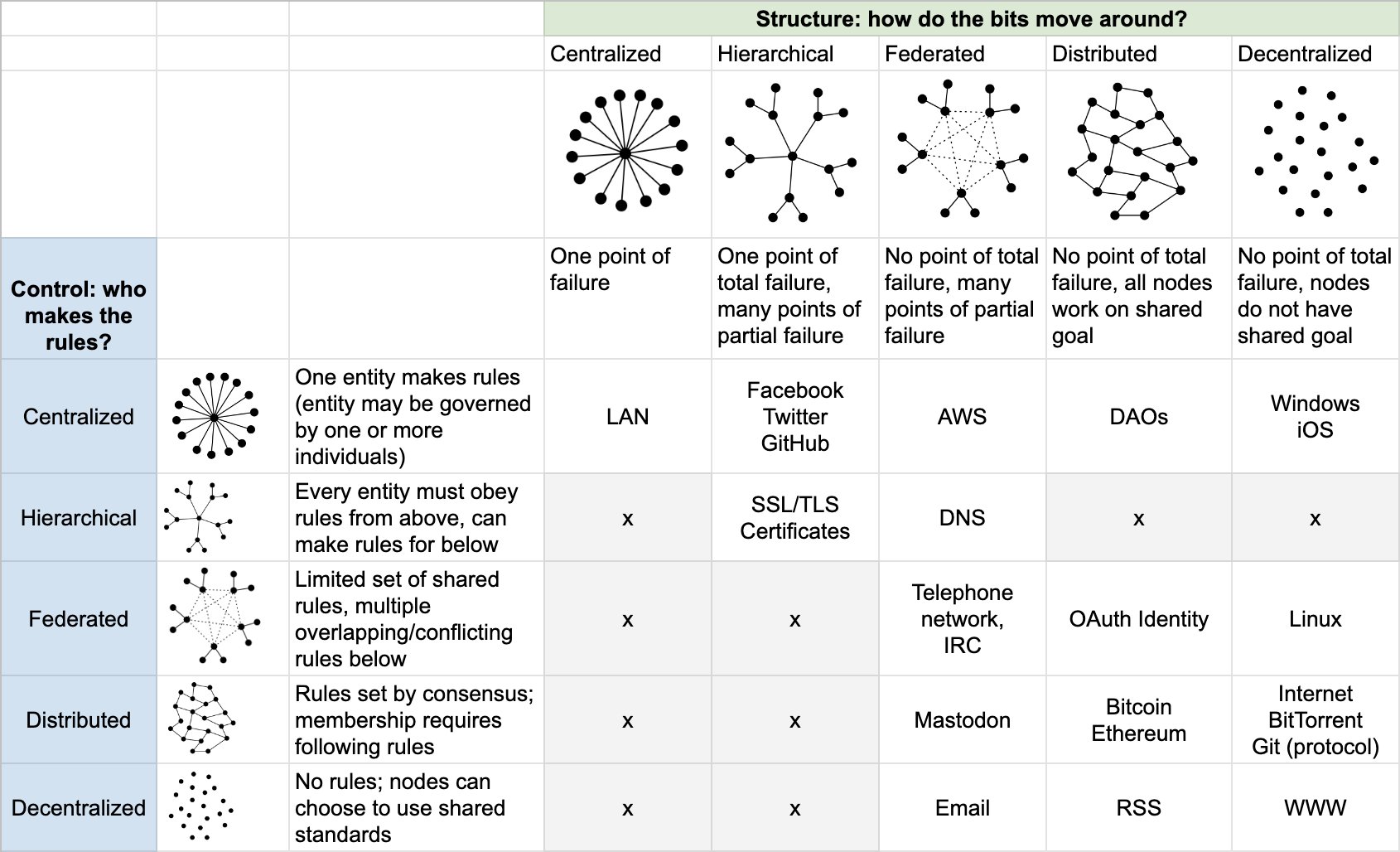
AFAICT, Holochain eases the feature of "decentralized", although Laurie Voss suggests that it's better to think of Bitcoin & Ethereum as "distributed" (in both the structure & control).
In Voss' taxonomy, I suspect that Holochain's structure would be "distributed" (ie, "No total point of failure, all nodes work on shared goal") and control would be "federated" (ie, "Limited set of shared rules, multiple overlapping/conflicting rules below")
The GitHub repository for source code that generates the knowledge garden by @wfinck (which he calls a "digital garden"
A template used by @wfinck to make this note in his public knowledge garden (ie, Zettelkasten notes with a displayed graph view of them)
My highlights are littered with notes to self and action items - it's not all pure knowledge.
this is a good example of the personal side of note taking that isn't always outwardly seen
each person's notes will be personal to them
CEO, Mike Tung was on Data science podcast. Seems to be solving problem that Google search doesn't; how seriously should you take the results that come up? What confidence do you have in their truth or falsity?
You cannot followrules you do not know. Nor can you acquire an artistic habitany craft or skill-without following rules. The art as something that can be taught consists of rules to be followed inoperation. The art as something learned and possessed consists of the habit that results from operating according to therules.
This is why one has some broad general rules for keeping and maintaining a zettelkasten. It helps to have some rules to practice and make a habit.
Unmentioned here is that true artists known all the rules and can then more profitably break those rules for expanding and improving upon their own practice. This is dramatically different from what is seen by some of those who want to have a commonplace or zettelkasten practice, but begin without any clear rules. They often begin breaking the rules to their detriment without having the benefit of long practice to see and know the affordances of such systems before going out of their way to break those rules.
By breaking the rules before they've even practiced them, many get confused or lost and quit their practice before they see any of the benefits or affordances of them.
Of course one should have some clear cut end reasons which answer the "why" question for having such practices, or else they'll also lose the motivation to stick with the practice, particularly when they don't see any light at the end of the tunnel. Pure hope may not be enough for most.
. Full ownership of a bookonly comes when you have made it a part of yourself, and thebest way to make yourself a part of it-which comes to thesame thing-is by writing in it.
I'm pretty much done thinking about "tools for thought". It quickly becomes an infinity of navel gazing and a complete waste of time. It's an easy topic for budding "influencers" because you don't actually need to know anything. All they need is to spend some time with a new bit of software and tell people how they should use it and the next thing you know they're selling an online course via their budding YouTube channel.
scathing, but broadly true...
He has a warehouse of notecards with ideas and stories and quotes and facts and bits of research, which get pulled and pieced together then proofread and revised and trimmed and inspected and packaged and then shipped.
While the ancients thought of the commonplace as a storehouse of value or a treasury, modern knowledge workers and content creators might analogize it to a factory where one stores up ideas in a warehouse space where they can be easily accessed, put into a production line where those ideas can be assembled, revised, proofread, and then package and distributed to consumers (readers).
(summary)
The Zettelkasten Method is based on this experience: One cannot think without writing - at least not in demanding contexts that anticipate selective access to memory. This also means: without notching differences one cannot think.
Sönke Ahrens roughly quoted this passage or one like it (check the reference), but I criticized it for not being inclusive of indigenous people or oral methods. Luhmann, however, went further and was at least passively more inclusive by saying that one needs to be able to "notch differences" to be able to think, and this is a much better framing.
“To attain knowledge, add things everyday. To attain wisdom, remove things every day.” ― Lao Tse
original source??
Artykuł przedstawia w głównej mierze ogólne założenia Second Brain, próbuje przedstawić je w odniesieniu do zawodu programisty. Tekst nie jest szczególnie odkrywczy.
Out of our cleverness has emerged something almost more importantthan the cleverness itself. Out of it has come learning about how to share ideasand pass down skills and knowledge. Out of it has come education.
Gary Thomas posits that it's our cleverness which birthed education. Isn't it more likely our extreme ability to mimic others which is more likely from a cognitive and evolutionary perspective?
Were early peoples really "teaching" each other how to make primitive hand axes? Or did we first start out by closely mimicking our neighbors?
https://cosma.graphlab.fr/<br /> https://cosma.graphlab.fr/en/
When did this come out?
Appears to be a visualization tool for knowledge work. They recommend it for use with Zettlr, but it looks like it would work with other text based tools. Point it at markdown files to create graphs apparently.
This looks like the sort of standards based tool that would allow greater flexibility when using various data stores that we talk about in Friends of the Link.
<small><cite class='h-cite via'>ᔥ <span class='p-author h-card'>Arthur Perret </span> in And you, what are you doing? (<time class='dt-published'>08/31/2022 02:40:03</time>)</cite></small>
@flancian
Tinderbox
Tinderbox really is a fantastic name for a note taking / personal knowledge management system. Just the idea makes me want to paint flames on the sides of my physical card index. https://www.eastgate.com/Tinderbox/
A much more effective approach is to give them a meaningful problem to struggle with first and then provide them with the knowledge they need to figure it out.99. D. L. Schwartz, T. Martin, Cogn. Instr. 22, 129 (2004). https://doi.org/10.1207/s1532690xci2202_1 When information is presented as useful for solving certain kinds of problems, the brain stores that information so that it is readily accessed and applied when needed to solve novel related problems.
Rather than teaching broad knowledge first and then presenting problems for practice, teachers may be better off presenting the problems first so that the student might struggle with them and then present the knowledge they need to figure it out. This provides better motivation for the student to understand and absorb that knowledge, seeing that it has value for the current problem as well as related problems.
certainly surrounding oneself with acircle of people who will listen and t a l k - - a n d at times theyhave to be imaginary characters--is one of them
Intellectual work requires "surfaces" to work against, almost as an exact analogy to substrates in chemistry which help to catalyze reactions. The surfaces may include: - articles, books, or other writing against which one can think and write - colleagues, friends, family, other thinkers, or even imaginary characters (as suggested by C. Wright Mills) - one's past self as instantiated by their (imperfect) memory or by their notes about excerpted ideas or their own thoughts
Are there any other surfaces we're missing?
nd the way in which these cate-gories changed, some being dropped out and others beingadded, was an index of my own intellectual progress andbreadth. Eventually, the file came to be arranged accord-ing to several larger projects, having many subprojects,which changed from year to year.
In his section on "Arrangement of File", C. Wright Mills describes some of the evolution of his "file". Knowing that the form and function of one's notes may change over time (Luhmann's certainly changed over time too, a fact which is underlined by his having created a separate ZK II) one should take some comfort and solace that theirs certainly will as well.
The system designer might also consider the variety of shapes and forms to potentially create a better long term design of their (or others') system(s) for their ultimate needs and use cases. How can one avoid constant change, constant rearrangement, which takes work? How can one minimize the amount of work that goes into creating their system?
The individual knowledge worker or researcher should have some idea about the various user interfaces and potential arrangements that are available to them before choosing a tool or system for maintaining their work. What are the affordances they might be looking for? What will minimize their overall work, particularly on a lifetime project?
The reason theytreasure their smallest experiences is because, in thecourse of a lifetime, a modem man has so very littlepersonal experience, and yet experience is so important asa source of good intellectual work.
The antecedent for "they" here is "accomplished thinkers".
whether he knows it or not, the intellec-tual workman forms his own self as he works towards theperfection of his craft.
Here Mills seems to be defining (in 1952) an "intellectual workman" as an academic, but he doesn't go as broad as a more modern "knowledge worker" (2022) which includes those who broadly do thinking in industry as well as in academia. His older phrase also has a more gendered flavor to it that knowledge worker doesn't have now.
I had readBalzac off and on during the forties, and been much takenwith his self-appointed task of " c o v e r i n g " all the majorclasses and types in the society of the era he wished tomake his own.
We write to understand, to learn, to make knowledge our own.
She was a librarian. They were really well organized. The books held all the knowledge that Adam's grandmother wanted to access. It was arranged by topic and author, complete with important search tools, notes and tabs stuck into all the various volumes that she could reference when looking to pull up some tidbit of information.
This has hints of a printed-on-cards Zettelkasten index. And [[Roman Mars]] is comparing the forgetting of the structure to how leaning on digital search systems has decreased our ability to find stuff.
You go from zero you hero in data analysis and data science and will become data fluent and learn major skills that you can use in your academic and business career.
This course is designed for absolute beginners who have a fundamental understanding of R and statistics. No worries, you will get it from the coursework if you do not have any prior knowledge. It starts with a basic understanding of data sets and processes and continues till advanced steps.
Of course, training and supervisionhelped users learning the general techniques for hypermedia authoring, but they tended to avoid(or lose interest in) the more sophisticated formalisms
What affordances were they given in exchange for the formalisms?
Many times he struggled to create a title for his note; heoften claimed that the most difficult aspect of this task was thinking of good titles
Avoid requiring canonical naming
This level of formalization enablesthe system to apply knowledge-based reasoning techniques to support users by performing taskssuch as automated diagnosis, configuration, or planning.
What I'm getting so far is that the formalization is what gives the users affordances to certain features. I'd imagine sophisticated data mining techniques (such as text-search, classification, etc) can alleviate this partially but is always going to be useful. It would be beneficial to opt into the formalism explicitly for the affordances and maintain bidirectional linking between non-formalized representations. In other words, you want the ability to create a formalized view.
L'objectif principal est de tirer le meilleur parti des connaissances existantes.
في كثير من الأحيان، أصادف عبارة أقرأ كثيرا لكن لا أستفيد مما أقرأ، ربما في هذه العبارة جزء من الجواب، غياب نظام لإدارة المعرفة
https://www.youtube.com/watch?v=P2HegcwDRnU
Makes the argument that note taking is an information system, and if it is, then we can use the research from the corpus of information system (IS) theory to examine how to take better notes.
He looks at the Wang and Wang 2006 research and applies their framework of "complete, meaningful, unambiguous, and correct" dimensions of data quality to example note areas of study notes, project management notes (or to do lists) and recipes.
Looks at dimensions of data quality from Mahanti, 2019.
What is the difference between notes and annotations?
this medium that we're inventing the dynamic medium 00:25:10 has three very interesting properties
!- antidote : inhumane knowledge work - dynamic medium
this is the cage that we have trapped ourselves in this is the way in which we have constrained our range of experience which we have created a tiny 00:23:03 subset of our intellectual capabilities and restrict ourselves to this tiny subset and have forbidden ourselves to use our full intellect
!- inhumane : knowledge work - this is the cage which constrains us - we have lost many modalities
I mean something very precise by that so I'm going to try to explain with an analogy imagined imagine you adopt a puppy so 00:15:01 your Duff is puppy and your name um puddles you take puddles home and you give them a little snack and you stick puddles in the cage and you lock the door forever and never open it again and 00:15:14 puddle slips out the rest of his poor life trapped inside this little cage so that's wrong I think most of us would agree that's sadistic that obviously inhumane so well let's ask what exactly 00:15:27 is wrong about that you know what what is inhuman about sticking puddles in the cage well you know we kind of have a notion of what it means to live a full doggy life right dogs have to run around dogs run 00:15:40 around and they sniff other dogs and they pee on things and that's kind of what it means to be a dog they've inherited this the set of capabilities capabilities and traits from their wolf ancestors and we recognize that a dog 00:15:53 has to be allowed the full free expression of its entire range of capabilities by sticking the cage or constraining his range of experience you're not letting him do all the things that dogs can do and this is exactly 00:16:07 what we've done to ourselves we've invented media that severely constrained our range of intellectual experience that of all the many capabilities that 00:16:19 we have all the many ways of thinking that we have we have constrained ourselves to a tiny subset we're not allowed to use our full intellect
!- analogy : inhumanity of knowledge work - compared to a dog stuck in a cage
you can think about the invention of powerful representations and the invention of powerful media to host powerful 00:11:27 representations as being one of the big drivers of last 2,000 years of the intellectual progress of humanity because each representation allows us to think thoughts that we couldn't think before we kind of 00:11:39 continuously expand our think about territory so you can think of this as tied to you know the grand meta-narrative of the scent of humanity moving away from myth and superstition 00:11:51 and ignorance and towards a deeper understanding of ourselves in the world around us I bring this up explicitly because I think it's good for people to acknowledge the motivation for their 00:12:02 work and this is this story of the intellectual progress of humanity is something that I find very motivating inspiring and is something that I feel like I want to contribute to but I think 00:12:16 that if this if you take this as your motivation you kind of have to be honest with yourself that that there definitely has been ascent we have improved in many 00:12:27 ways but there are also other ways in which our history has not been ascent so we invent technology we media technology 00:12:39 to kind of help us make this this climb but every technology is a double-edged sword every technology enables us has a potential de navels in certain ways while debilitating us in other ways and 00:12:51 that's especially true for representations because the way the reputations work is they draw on certain capabilities that we have so if we go all in in a particular medium like we 00:13:03 did with print so the capabilities that are not well supported in that medium they get neglected in they atrophy and we atrophy I wish I knew who drew the picture 00:13:20 because it's it's a wonderful depiction of what I'm trying to express here and even a little misleading because the person the last stage they're kind of hunched over is tiny rectangle we reach 00:13:31 that stage accomplish that stage with the printing press and cheap paper book based knowledge the invention of paper-based bureaucracy paper-based 00:13:44 working we invented this lifestyle this way of working where to do knowledge work meant to sit at a desk and stare at your little tiny rectangle make a little motions of your hand you know started 00:13:56 out as sitting at a desk staring at papers or books and making little motions with a pen and now it's sitting at a desk staring at a computer screen making a little motions with your on a keyboard but it's basically the same 00:14:08 thing we've this is what it means to do knowledge work nowadays this is what it means to be a thinker it means to be sitting and working with symbols on a little tiny rectangle to the extent that 00:14:20 again it almost seems inseparable you can't separate the representation for what it actually is and and this is basically just an accident of history this is just the way that our media 00:14:32 technology happen to evolve and then we kind of designed a way of knowledge work for that media that we happen to have and I think so I'm going to make the claim that this style of knowledge work 00:14:47 this lifestyle is inhumane
!- for : symbolic representation - language - the representation is closely tied to the media - a knowledge worker sits at a desk and plays with symbols in a small area all day! - This is actually inhumane when you think about it
wissenschaft
roughly translated as the systematic pursuit of knowledge, learning, and scholarship (especially in contrast with application).
It was roughly similar to our current "science" but retains a broader meaning which includes the humanities.
Yolanda Gibb: How a mindset of Ambidextrous Creativity can get you generating AND exploiting your ideas?
Ambidextrous creativity is having a balance between exploration and subsequent exploitation of those explorations.
Small companies and individuals are good at exploration, but often less good at exploitation.
Triple loop learning<br /> this would visually form a spiral (versus overlap)<br /> - Single loop learning: doing things right (correcting mistakes)<br /> - double loop learning: doing the right things (causality)<br /> - triple loop learning: why these systems and processes (learning to learn)
Assets<br /> Relational capital * Structural capital - pkm is part of this<br /> there's value in a well structured PKM for a particualr thing as it's been used and tested over time; this is one of the issues with LYT or Second Brain (PARA, et al.) how well-tested are these? How well designed?<br /> * Structural capital is the part that stays at the office when all the people have gone home * Human Capital
Eleanor Konik
4 Es of cognition<br /> * embodied * embedded * enacted * extended<br /> by way of extra-cranial processes
see: https://www.ncbi.nlm.nih.gov/pmc/articles/PMC7250653/
Yolanda Gibb's book<br /> Entrepreneurship, Neurodiversity & Gender: Exploring Opportunities for Enterprise and Self-employment As Pathways to Fulfilling Lives https://www.amazon.com/Entrepreneurship-Neurodiversity-Gender-Opportunities-Self-employment/dp/1800430582
Tools: - Ryyan - for literature searches - NVIVO - Obsidian - many others including getting out into one's environment
NVIVO<br /> https://www.qsrinternational.com/nvivo-qualitative-data-analysis-software/home
a software program used for qualitative and mixed-methods research. Specifically, it is used for the analysis of unstructured text, audio, video, and image data, including (but not limited to) interviews, focus groups, surveys, social media, and journal articles.
Ryyan<br /> https://www.rayyan.ai/<br /> for organizing, managing, and accelerating collaborative literature reviews
Compare to earlier archived draft from 2016: https://web.archive.org/web/20160629004859/https://wordsinspace.net/wordpress/2016/06/28/small-moving-intelligent-parts/
https://twitter.com/Extended_Brain/status/1563703042125340680
<script async src="https://platform.twitter.com/widgets.js" charset="utf-8"></script>Replying to @DannyHatcher. 1. Competition among apps makes them add unnecessary bells and whistles. 2. Trying to be all: GTD, ZK, Sticky Notes, proj mgmt, collaboration, workflow 3. Plugins are good for developers, bad for users https://t.co/4fbQ2nwdYd
— Extended Brain (@Extended_Brain) August 28, 2022
Part two sounds a lot like zettelkasten overreach https://boffosocko.com/2022/02/05/zettelkasten-overreach/
Part one is similar to the issue competing software companies have in attempting to check all the boxes on a supposed list of features without thinking about what their tool is used for in practice. (Isn't there a name for this specific phenomenon besides "mission creep"?)
Knowledge Translation in the Global South
The most important contribution management needs to make in the 21st century is similarly to increase the productivity of knowledge work and knowledge workers.”
!- For : Indyweb - Can Indyweb play a role in increasing productivity by 50x?
But the real goal of a Great Books reading program is to experience the minds of these authors (something the Schoolmen called connatural knowledge) and imprint whatever value we find there on our souls (i.e. will and intellect). This can only be done through a process of intentional re-reading.
Update now that I'm three years in to my PhD program and am about to start on my lit reviews and dissertation research... Holy Forking Shirtballs, am I glad I started my ZK back in 2020!!! * I cannot tell you how often I've used it to write my course papers. * I cannot tell you how often I've had it open during class discussions to back up my points. * I cannot tell you how lazy I've gotten with some of my entries (copying and pasting text instead of reworking it into my own words), and how much I wish I had taken the time to translate those entries for myself.
ReconfigBehSci. (2021, December 7). RT @jitsuvax: 🇵🇱NEW translation of the Covid-19 Handbook for our friends in Poland https://c19vax.scibeh.org/pl This work was only possible beca… [Tweet]. @SciBeh. https://twitter.com/SciBeh/status/1468247395070885907
Livan, G., Pappalardo, G., & Mantegna, R. N. (2021). Quantifying the relationship between specialisation and reputation in an online platform. ArXiv:2111.07144 [Physics]. http://arxiv.org/abs/2111.07144
https://www.bundleiq.com/post/the-history-of-pkm
I positively don't recommend this article... good example of someone "trying on" information they've been reading about, but haven't quite mastered or gone deep enough on yet. Also potentially a good example of the sort of issues that can be seen when learning in public and potentially attempting to be an influencer in a space in which one is not an expert.
slono — 06/25/2022PKM -> prescriptive knowledge management
https://discord.com/channels/686053708261228577/710585052769157141/990295586664243250
Context: influencers in the PKM space telling you the "one true way"
While Heyde outlines using keywords/subject headings and dates on the bottom of cards with multiple copies using carbon paper, we're left with the question of where Luhmann pulled his particular non-topical ordering as well as his numbering scheme.
While it's highly likely that Luhmann would have been familiar with the German practice of Aktenzeichen ("file numbers") and may have gotten some interesting ideas about organization from the closing sections of the "Die Kartei" section 1.2 of the book, which discusses library organization and the Dewey Decimal system, we're still left with the bigger question of organization.
It's obvious that Luhmann didn't follow the heavy use of subject headings nor the advice about multiple copies of cards in various portions of an alphabetical index.
While the Dewey Decimal System set up described is indicative of some of the numbering practices, it doesn't get us the entirety of his numbering system and practice.
One need only take a look at the Inhalt (table of contents) of Heyde's book! The outline portion of the contents displays a very traditional branching tree structure of ideas. Further, the outline is very specifically and similarly numbered to that of Luhmann's zettelkasten. This structure and numbering system is highly suggestive of branching ideas where each branch builds on the ideas immediately above it or on the ideas at the next section above that level.
Just as one can add an infinite number of books into the Dewey Decimal system in a way that similar ideas are relatively close together to provide serendipity for both search and idea development, one can continue adding ideas to this branching structure so they're near their colleagues.
Thus it's highly possible that the confluence of descriptions with the book and the outline of the table of contents itself suggested a better method of note keeping to Luhmann. Doing this solves the issue of needing to create multiple copies of note cards as well as trying to find cards in various places throughout the overall collection, not to mention slimming down the collection immensely. Searching for and finding a place to put new cards ensures not only that one places one's ideas into a growing logical structure, but it also ensures that one doesn't duplicate information that may already exist within one's over-arching outline. From an indexing perspective, it also solves the problem of cross referencing information along the axes of the source author, source title, and a large variety of potential subject headings.
And of course if we add even a soupcon of domain expertise in systems theory to the mix...
While thinking about Aktenzeichen, keep in mind that it was used in German public administration since at least 1934, only a few years following Heyde's first edition, but would have been more heavily used by the late 1940's when Luhmann would have begun his law studies.
https://hypothes.is/a/CqGhGvchEey6heekrEJ9WA
When thinking about taking notes for creating output, one can follow one thought with another logically both within one's card index not only to write an actual paper, but the collection and development happens the same way one is filling in an invisible outline which builds itself over time.
Linking different ideas to other ideas separate from one chain of thought also provides the ability to create multiple of these invisible, but organically growing outlines.
The person who has acquired knowledge of a language has internalized asystem of rules that relate sound and meaning in a particular way.
This is particularly important in the Dzogchen mengakde (oral pith instruction) transmission lineage. Different levels of meaning are transmitted, mediated by the master’s recognition of the student’s spiritual maturity and by the student’s ability to ‘hear’ the meaning contained in the words. As my Buddhist teacher would endlessly explain to his western students, brought up to expect ‘new information’: the more and more you listen, the more and more you hear.
Through my long immersion as a student-practitioner in the Tibetan Buddhist knowledge system I am familiar with this process of secrecy and deeper meaning. Unlike the Indigenous Knowledge system, Tibetan Buddhism has a rich textual tradition. But it has also kept alive a strong oral tradition, of knowledge passed by a Buddhist master who is recognised as having not only learning but also spiritual realisation, to his/her student. The teachers talk of the outer, inner and secret meaning, and in terms of the provisional versus the absolute meaning gained through realisation.
Australia’s Indigenous knowledge systems do not separate the secular and the sacred; both are embedded in the idea of Country as an all encompassing term of the materiality of life, landscape and seascape, as well as the spiritual world of the creation ancestors, and the concept of the Jukurrpa, the eternal law/lore of how to live sustainably in accordance with how the world works, which in turn has shaped human social organisation and kinship systems.
The purpose of this secular knowledge system is not intrinsically about wellbeing, ethics and goodness per se; it is about the search for truth and efficacy—be that for competing ideas about what is good, for the purposes of competitive advantage in commerce or national prestige, or for destructive purposes linked to warfare and security.
The Western knowledge system rests on a strong split between secular and religious knowledge.
The strongest clash in values between Indigenous knowledge systems and Western knowledge systems lies in who ‘owns’ the knowledge, who has the right to ‘transmit’ it and who has the right to ‘receive’ it.
the Aboriginal archivist—whom in Western terms we think of as artists in the recording of such knowledge in collaborative artworks by knowledge holders—activate the knowledge embedded in a site so that a kind of mutual knowledge transfer occurs between place, person(s) and history.
The Western archive is characterised by two types of knowledge organisation that are foreign to Indigenous knowledges: Firstly it is based on a strong sense of dualism; the use of oppositional categories such as man/woman; man (human)/nature; mind/matter; spirit/materiality, which again is expressed in time differentiated into past/present/future. Secondly knowledge is objectified; it is knowledge about, not with, and it is highly segmented into different areas of knowledge speciality that are in turn reflected in the education system and the professions and areas of government responsibility.
This comes at a momentous time in Australia’s history as we confront the devastating consequences of whitefella knowledge systems and ways of thinking that have led inexorably to a combination of global warming and environmental degradation that is threatening the viability of human habitation in vast areas of the world.
I was doing some random searches for older material on zettelkasten in German and came across this.
Apparently I've come across this before in a similar context: https://hypothes.is/a/CsgyjAXQEeyMfoN7zLcs0w
The description now makes me want to read it all the more!
This is a book about a box that contained the world. The box was the Picture Academy for the Young, a popular encyclopedia in pictures invented by preacher-turned-publisher Johann Siegmund Stoy in eighteenth-century Germany. Children were expected to cut out the pictures from the Academy, glue them onto cards, and arrange those cards in ordered compartments—the whole world filed in a box of images.
As Anke te Heesen demonstrates, Stoy and his world in a box epitomized the Enlightenment concern with the creation and maintenance of an appropriate moral, intellectual, and social order. The box, and its images from nature, myth, and biblical history, were intended to teach children how to collect, store, and order knowledge. te Heesen compares the Academy with other aspects of Enlightenment material culture, such as commercial warehouses and natural history cabinets, to show how the kinds of collecting and ordering practices taught by the Academy shaped both the developing middle class in Germany and Enlightenment thought. The World in a Box, illustrated with a multitude of images of and from Stoy's Academy, offers a glimpse into a time when it was believed that knowledge could be contained and controlled.
Given the portions about knowledge and control, it might also be of interest to @remikalir wrt his coming book.
The axis should illustrate massive trends, the resulting map should be based on industry insights, the overall image should convey a vision of where the industry is heading and the importance of that magical space the startup identified and aims at. Failing to do so shows founders’ lack of sound industry knowledg
The way you begin writing notes, observations, and ideas may not resemble the final form of the output you want to create. And the ideas, interpretations, and themes on which you end up concentrating may also not be what you had originally anticipated. Don’t worry about that. Stay open to discovery.
Keep in mind that the notes are not the final output…they are a means to the final output. Polishing will come later.
This makes me wonder about the email conversation I had with Dan Whaley about my use of Hypothesis. He notes that my annotations were like personal notemaking rather than conversational between community members (as I presume others are using Hypothesis to do). These annotations are feeding into my PKM tool, but I said I wasn’t opposed to conversations springing up from them. (In fact, when that has happened, that has been quite useful.) But I wonder if that is putting pressure on me to make these notes more perfect than if I made them private to only feed into my PKM.
Summarization of Methods for Smart Contract Vulnerability Regulation
Great reference table for SC vulnerability regulation
https://www.springer.com/series/6159/books
Information Science and Knowledge Management Series of texts from Springer
Come back and read these particular texts, but these look interesting with respect to my work on orality, early "religion", secrecy, and information spread:<br /> - Ancient practices removed from their lineage lose their meaning - In spiritual practice, secrecy can be helpful but is not always necessary
Historical Hypermedia: An Alternative History of the Semantic Web and Web 2.0 and Implications for e-Research. .mp3. Berkeley School of Information Regents’ Lecture. UC Berkeley School of Information, 2010. https://archive.org/details/podcast_uc-berkeley-school-informat_historical-hypermedia-an-alte_1000088371512. archive.org.
https://www.ischool.berkeley.edu/sites/default/files/audio/2010-10-20-vandenheuvel_0.mp3

Interface as Thing - book on Paul Otlet (not released, though he said he was working on it)
four figures in his research: - Patrick Gattis - biologist, architect, diagrams of knowledge, metaphorical use of architecture; classification - Paul Otlet, Brussels born - Wilhelm Ostwalt - nobel prize in chemistry - Otto Neurath, philosophher, designer of isotype
Otlet was interested in both the physical as well as the intangible aspects of the Mundaneum including as an idea, an institution, method, body of work, building, and as a network.<br /> (#t=1020)
Early iPhone diagram?!?

(roughly) armchair to do the things in the web of life (Nelson quote) (get full quote and source for use) (circa 19:30)
compares Otlet to TBL
Michael Buckland 1991 <s>internet of things</s> coinage - did I hear this correctly? https://en.wikipedia.org/wiki/Internet_of_things lists different coinages
Turns out it was "information as thing"<br /> See: https://hypothes.is/a/kXIjaBaOEe2MEi8Fav6QsA
sugane brierre and otlet<br /> "everything can be in a document"<br /> importance of evidence
The idea of evidence implies a passiveness. For evidence to be useful then, one has to actively do something with it, use it for comparison or analysis with other facts, knowledge, or evidence for it to become useful.
transformation of sound into writing<br /> movement of pieces at will to create a new combination of facts - combinatorial creativity idea here. (circa 27:30 and again at 29:00)<br /> not just efficiency but improvement and purification of humanity
put things on system cards and put them into new orders<br /> breaking things down into smaller pieces, whether books or index cards....
Otlet doesn't use the word interfaces, but makes these with language and annotations that existed at the time. (32:00)
Otlet created diagrams and images to expand his ideas
Otlet used octagonal index cards to create extra edges to connect them together by topic. This created more complex trees of knowledge beyond the four sides of standard index cards. (diagram referenced, but not contained in the lecture)
Otlet is interested in the "materialization of knowledge": how to transfer idea into an object. (How does this related to mnemonic devices for daily use? How does it relate to broader material culture?)
Otlet inspired by work of Herbert Spencer
space an time are forms of thought, I hold myself that they are forms of things. (get full quote and source) from spencer influence of Plato's forms here?
Otlet visualization of information (38:20)
S. R. Ranganathan may have had these ideas about visualization too
atomization of knowledge; atomist approach 19th century examples:S. R. Ranganathan, Wilson, Otlet, Richardson, (atomic notes are NOT new either...) (39:40)
Otlet creates interfaces to the world - time with cyclic representation - space - moving cube along time and space axes as well as levels of detail - comparison to Ted Nelson and zoomable screens even though Ted Nelson didn't have screens, but simulated them in paper - globes
Katie Berner - semantic web; claims that reporting a scholarly result won't be a paper, but a nugget of information that links to other portions of the network of knowledge.<br /> (so not just one's own system, but the global commons system)
Mention of Open Annotation (Consortium) Collaboration:<br /> - Jane Hunter, University of Australia Brisbane & Queensland<br /> - Tim Cole, University of Urbana Champaign<br /> - Herbert Van de Sompel, Los Alamos National Laboratory annotations of various media<br /> see:<br /> - https://www.researchgate.net/publication/311366469_The_Open_Annotation_Collaboration_A_Data_Model_to_Support_Sharing_and_Interoperability_of_Scholarly_Annotations - http://www.openannotation.org/spec/core/20130205/index.html - http://www.openannotation.org/PhaseIII_Team.html
trust must be put into the system for it to work
coloration of the provenance of links goes back to Otlet (~52:00)
Creativity is the friction of the attention space at the moments when the structural blocks are grinding against one another the hardest. —Randall Collins (1998) The sociology of philosophers. Cambridge, MA: Harvard University Press (p.76)
As described by Otlet, the ambition of the UBR was to build “an inventory of all that has been written at all times, in all languages, and on all subjects.”
Paul Otlet attempted to index all the worlds' knowledge years before Goggle was conceived.
The daily cadence of a DNP frames the system as a kind of personal diary. Which we may not necessarily want in a personal knowledge base.
This sounds similar to my criticism of zettelkasten overreach.
See: https://boffosocko.com/2022/02/05/zettelkasten-overreach/
https://www.kevinmarks.com/memex.html
I got stuck over the weekend, so I totally missed Kevin Marks' memex demo at IndieWebCamp's Create Day, but it is an interesting little UI experiment.
I'll always maintain that Vannevar Bush really harmed the first few generations of web development by not mentioning the word commonplace book in his conceptualization. Marks heals some of this wound by explicitly tying the idea of memex to that of the zettelkasten however. John Borthwick even mentions the idea of "networked commonplace books". [I suspect a little birdie may have nudged this perspective as catnip to grab my attention—a ruse which is highly effective.]
Some of Kevin's conceptualization reminds me a bit of Jerry Michalski's use of The Brain which provides a specific visual branching of ideas based on the links and their positions on the page: the main idea in the center, parent ideas above it, sibling ideas to the right/left and child ideas below it. I don't think it's got the idea of incoming or outgoing links, but having a visual location on the page for incoming links (my own site has incoming ones at the bottom as comments or responses) can be valuable.
I'm also reminded a bit of Kartik Prabhu's experiments with marginalia and webmention on his website which plays around with these ideas as well as their visual placement on the page in different methods.
MIT MediaLab's Fold site (details) was also an interesting sort of UI experiment in this space.
It also seems a bit reminiscent of Kevin Mark's experiments with hovercards in the past as well, which might be an interesting way to do the outgoing links part.
Next up, I'd love to see larger branching visualizations of these sorts of things across multiple sites... Who will show us those "associative trails"?
Another potential framing for what we're all really doing is building digital versions of Indigenous Australian's songlines across the web. Perhaps this may help realize Margo Neale and Lynne Kelly's dream for a "third archive"?
I like to imagine all the thoughts and ideas I’vecollected in my system of notes as a forest. I imagine itas three-dimensional, because the trains of thought I’vebeen working on for some time look like trees, withbranches of argument, point, and counterpoint andleaves of source-based evidence. Actually, the forest isfour-dimensional, because it changes over time, growingas I add more to it. A piece of output I make using thisforest of thoughts is like a path through the woods. It’sa one-dimensional narrative or interpretation that startsat one point, moves in a line or an arc (sometimes azig-zag) through the woods, touching some but not allof the trees and leaves. I like this imagery, because itsuggests there are many ways to move through the forest.
https://archive.org/details/britannica_propaedia/mode/2up
The one-volume Propædia is the first of three parts of the 15th edition of Encyclopædia Britannica, the other two being the 12-volume Micropædia and the 17-volume Macropædia. The Propædia is intended as a topical organization of the Britannica's contents, complementary to the alphabetical organization of the other two parts. Introduced in 1974 with the 15th edition, the Propædia and Micropædia were intended to replace the Index of the 14th edition; however, after widespread criticism, the Britannica restored the Index as a two-volume set in 1985. ==The core of the Propædia is its Outline of Knowledge, which seeks to provide a logical framework for all human knowledge==; however, the Propædia also has several appendices listing the staff members, advisors and contributors to all three parts of the Britannica.
link to: - https://hypothes.is/a/ISNt8BBPEe2oTse1NiJv4w
Because I wanted to make use of a unified version of the overall universe of knowledge as a structural framework, I ended up using the Outline of Knowledge (OoK) in the Propædia volume that was part of Encyclopedia Britannica 15th edition, first published 1974, the final version of which (2010) is archived at -- where else? -- the Internet Archive.
The Outline of Knowledge appears in the Propædia volume of the Encyclopedia Britannica. It is similar to various olther classification systems like the Dewey Decimal system or the Universal Decimal Classification.
interacting with other ideas and remaining part of ourtrain of thought.
Within our own notes, connections allow the ideas we developing to survive by
There are several levels of "evolutionary" development of one's notes. One can compare and contrast two different notes to help determine the truth or falsity of each, but groups of linked notes may also evolve and survive against other groups by competing both for attention as well as their potential truth or falsity.
The excitement over PKM has spilled over into blogs,YouTube channels, online courses, and books. Like otherproductivity hacks of the past (The One Minute Manager,Getting Things Done, etc.), techniques such as “LinkingYour Thinking”, “Writing Smart Notes”, or “Building aSecond Brain” contain a lot of useful ideas and havesometimes launched careers for their authors.
a.k.a. productivity porn
https://developassion.gumroad.com/l/obsidian-starter-kit
Sébastien Dubois selling an Obsidian Starter Kit for €19.99 on Gumroad.
Looks like it's got lots of support and description of many of the big buzz words in the personal knowledge management space. Not sure how it would work with everything and the kitchen sink thrown in.
found via https://www.reddit.com/r/PersonalKnowledgeMgmt/comments/w8dw94/obsidian_starter_kit/
Not only is such thought beyond representation (and therefore beyond personware) possible,Weaver suggests but its occurrence constitutes a fundamental encounter which brings forth into existenceboth the world and the thinker. As such, thought sans image is deeply disturbing the stability andcontinuity of whatever personware the individual thinker may have been led to identify with andopens wide horizons of cognitive development and transformation ([13]: p. 35).
!- similar to : Gyuri Lajos idea of tacit awareness !- implications : thought sans image !- refer : Gyuri Lajos https://www.researchgate.net/publication/343523812_Augmenting_Tacit_Awareness_Accepting_our_responsibility_for_how_we_shape_our_tools When one becomes cognizant of thought sans image, then one realizes the relative construction of one's social identity and that offers a freedom to take on another one * therefore, realization of thought sans image opens the door to authentic transformation
!- question : thought sans image * If, as Weaver suggests, thought sans image is a primordial encounter which brings forth both the thinker and the world thought by the thinker, then this has strong similiarities to a spiritual awakening or enlightenment experience.
The language is academic, which has contributed to the confusion around the topic, but it is clear enough that most developers should be able to understand it.
This I disagree with. Even Fielding's "... must be hypertext driven" rant (which is great and in my bookmarks) is sabotaged by the curse of knowledge. If you know what REST is—and how most "REST" isn't REST (including the things that try to stand out as doing REST right and still just doing it wrong, but with nuance) then "REST APIs must[...]" makes sense. If you don't already get it, though, then it's nigh impenetrable—funnily enough, you need an a priori understanding of REST to be able to understand these attempts to explain REST and what Fielding is trying to communicate about REST not requiring *a priori" knowledge!
Lima, Manuel. The Book of Trees: Visualizing Branches of Knowledge, 2014. https://papress.com/products/the-book-of-trees-visualizing-branches-of-knowledge.

Ein grofer Teil der Regestenarbeit wird neuerdings demForscher durch besondere Regestenwerke abgenommen, nament-lich auf dem Gebiet der mittelalterlichen Urkunden. Daf diesebevorzugt werden, hat zwei Griinde: erstens sind die Urkundenfur die Geschichte des Mittelalters gewissermafen als festesGerippe von besonderer Wichtigkeit; zweitens sind sie so ver.streut in ihren Fund- und Druckorten, da8 die Zusammen-stellung derselben, wie sie ftir jede Arbeit von neuem erforder-lich wire, immer von neuem die langwierigsten und mtthsamstenVorarbeiten n&tig machen wiirde. Es ist daher von griéStemNutzen, da8 diese Vorarbeiten ein fir allemal gemacht und demeinzelnen Forscher erspart werden.
Ein großer Teil der Regestenarbeit wird neuerdings dem Forscher durch besondere Regestenwerke abgenommen, namentlich auf dem Gebiet der mittelalterlichen Urkunden. Daß diese bevorzugt werden, hat zwei Gründe: erstens sind die Urkunden fur die Geschichte des Mittelalters gewissermafen als festes Gerippe von besonderer Wichtigkeit; zweitens sind sie so verstreut in ihren Fund- und Druckorten, daß die Zusammenstellung derselben, wie sie ftir jede Arbeit von neuem erforderlich wire, immer von neuem die langwierigsten und mtthsamsten Vorarbeiten nötig machen würde. Es ist daher von größtem Nutzen, daß diese Vorarbeiten ein fir allemal gemacht und dem einzelnen Forscher erspart werden.
Google translation:
A large part of the regesta work has recently been relieved of the researcher by special regesta works, especially in the field of medieval documents. There are two reasons why these are preferred: first, the documents are of particular importance for the history of the Middle Ages as a solid skeleton; Secondly, they are so scattered in the places where they were found and printed that the compilation of them, as would be necessary for each new work, would again and again necessitate the most lengthy and laborious preparatory work. It is therefore of the greatest benefit that this preparatory work should be done once and for all and that the individual researcher be spared.
While the contexts are mixed here between note taking and historical method, there is some useful advice here that while taking notes, one should do as much work upfront during the research phase of reading and writing, so that when it comes to the end of putting the final work together and editing, the writer can be spared the effort of reloading large amounts of data and context to create the final output.
https://www.reddit.com/r/antinet/comments/vzertk/using_the_antinet_for_professional_conferences/
Thanks /ultwalt This seems to underline the aphorism, that the more you put into something, the more you'll get out of it. It's something that many miss as an underlying benefit to these processes in general.
I was particularly interested in Chris Aldrich’s observation that knowledge workers tend to talk in spatial terms about their work, especially if distracted. Following interruptions by colleagues or phone calls at work, people may frequently ask themselves “where was I?” more frequently than “what was I doing?” This colloquialism isn’t surprising as our memories for visual items and location are much stronger than actions. Knowledge workers will look around at their environments for contextual clues for what they were doing and find them in piles of paper on their desks, tabs in their computer browser, or even documents (physical or virtual) on their desktops.
Many of the workers reported that first thing in themorning, or after any interruption in their thought(like a ‘phone call), they have the “where was 1?”problem in a complex and ill-defined space of ideas.The layout of physical materials on their desk givesthem powerful and immediate contextual cues torecover a complex set of threads without difilcultyand delay, “this is my whole context, these are mypersonal piles”
Following interruptions by colleagues or phone calls at work, people may frequently ask themselves "where was I?" more frequently than "what was I doing?" This colloquialism isn't surprising as our memories for visual items and location are much stronger than actions. Knowledge workers will look around at their environments for contextual clues for what they were doing and find them in piles of paper on their desks, tabs in their computer browser, or even documents (physical or virtual) on their desktops.
Mander, R., Salomon, G. and Wong, Y. A PileMetaphor for Supporting Casual Organisationof Information. Proceedings of Human Factorsin Computing Systems CHI’92, pp 627-634,1992.
The quote from this paper references Mander 1992:
It seems that knowledge workers use physical space, such as desks or floors, as a temporary holding pattern for inputs and ideas which they cannot yet categorise or even decide how they might use [12].
leads me to believe that the original paper has information which supports office workers using their physical environments as thinking and memory spaces much as indigenous peoples have for their knowledge management systems using orality and memory.