il rend les écoles responsables des résultats des élèves et prévoit des sanctions si les objectifs évalués ne sont pas atteints
a mettre en lien avec skin in the game https://www.youtube.com/watch?v=KsY_J02kfgk
il rend les écoles responsables des résultats des élèves et prévoit des sanctions si les objectifs évalués ne sont pas atteints
a mettre en lien avec skin in the game https://www.youtube.com/watch?v=KsY_J02kfgk
I also maintain a public Zettelkasten (others use the similar terms digital garden or second brain), in which I keep thoughts about everything under the sun. You can visit it to virtually “pick my brain” about some topic without bothering me, or to explore what I’m currently working on.
Soren Bjornstad has a public zettelkasten which is in the vein of a traditional one though he indicates that others might call it a digital garden or second brain. This shows the conflation of many of these terms.
What truly differentiates digital gardens from wikis and zettelkasten?
https://brainbaking.com/post/2021/10/are-digital-gardens-blogs/
We definitely need better definitions of digital gardens (public or otherwise) to delineate them from blogs, zettelkasten, wikis, social media, and other forms of information exchange.
Wouter Groeneveld describes some of his thoughts here.
Link to notes from https://collect.readwriterespond.com/are-digital-gardens-blogs/
To ensure an equitable and inclusive participation, Workcred invited executive directors and directors of certification that represented certification bodies based on selected criteria—whether their certification(s) could be aligned at the cognitive content level of a bachelor’s degree, whether the organization participates in Workcred’s Credentialing Body Advisory Council, and if they are accredited by a third-party.4 For purposes of this project, accreditation served as a proxy for the industry value of the certification. Select employers in industries related to the focus of a convening were also invited to participate.
Trust: in investigating how to embed credentials that will be trusted, leaders convened participants whose affiliations might add trust to the effort. Meta. Also, interesting detail in the Change Management approach.
https://twitter.com/asakuru_note
A twitter account of a student tweeting about note taking and their practice.
Blau, W. (2022, February 14). Climate Change: Journalism’s Greatest Challenge. Medium. https://wblau.medium.com/climate-change-journalisms-greatest-challenge-2bb59bfb38b8
Data-Lake-Management-Plattformen stellen Werkzeugen-Suiten dar, die auf der Basiseines Datenkatalogs weitere Funktionalitäten für das Datenmanagement im Data Lakeintegrieren. Typischerweise geht es um ergänzende Funktionalitäten für ETL, Self-Service-Data-Preparation und Datenföderation (engl. data federation), die eng mit dem Datenkatalogintegriert sind.
Data-Lake-Management-Plattformen
Damit dient das Metadatenmanagement in der Hauptsache der Analyse von Daten und Datenbeziehungen. Es kann zur Suche, aber auch zur Auswertung und Optimierung von Prozessen genutzt werden.
Teil 2
Metadatenmanagement bezeichnet die strukturierte und geordnete Datenhaltung von Metadaten. Mit einem etablierten Metadatenmanagement wird in kürzester Zeit die richtige Quelle für benötigte Daten ermittelt.
Stand der Technik Link zur Studie von Capgemini
Metadaten-Management
In einer Studie von Capgemini, die im Zeitraum von September bis Oktober 2020 durchgeführt wurde, gaben rund 36 Prozent der Befragten der 87 IT-Verantwortlichen an, IT-Service für das Metadaten-Management zu nutzen. Der Großteil der Befragten (53,1 Prozent) nutzen IT-Service für DevOps inkl. DataOps, DevSecOps, BizDevOps etc.
87 IT-Verantwortliche in Unternehmen*
Hinweise und Anmerkungen * Laut Quelle: "Personen, die auf Geschäftsführungsebene beziehungsweise oberer Managementebene zu den strategischen IT-Aktivitäten ihres Unternehmens Auskunft geben konnten".e IT-Trends 2021, Seite 36
Veröffentlichungsdatum Februar 2021
Quelle Capgemini
Erhebung durch Capgemini
Veröffentlicht durch Capgemini
Herkunftsverweis StudiRegion Österreich, Deutschland, Schweiz
Erhebungszeitraum September bis Oktober 2020
Anzahl der Befragten
These study guides, which neglect everything before a writingassignment is given, are a little bit like financial advisors who discusshow 65-year-olds can save for retirement. At this point you would bebetter off curbing your enthusiasm (which is exactly what one of themost often sold study guides in Germany recommends: first, loweryour expectations on quality and insight).
A side benefit of a growing set of notes as an academic is that one has a visible repository of knowledge and ideas as well as fascinating questions which, while they may reveal how much one doesn't know, it will make it apparent how much one does know and thereby mitigate one's feelings of imposter syndrome.
Nursing professionals are facing with severe sleep problems during the covid 19 pandemic time. Nurses were asked to work in an environment that had a more increased level of risk than ever before. Depression and anxiety from the workplace could affect the confidence of healthcare workers in themselves as well as general trust in the healthcare system. This will lead to their turnover intention which may undermine the efforts of the governments to control the COVID-19 pandemic. The rising concern may change the working schedules of healthcare workers, offering more occupational healthcare support.
It should be recognized that these basic note types are very different than the digital garden framing of 📤 (seedbox), 🌱 (seedling), 🪴 (sapling), 🌲 (evergreen), etc. which are another measure of the growth and expansion of not just one particular idea but potentially multiple ideas over time. These are a project management sort of tool for focusing on the growth of ideas. Within some tools, one might also use graph views and interconnectedness as means of charting this same sort of growth.
Sönke Ahrens' framing of fleeting note, literature note, and permanent note are a value assignation to the types of each of these notes with respect to generating new ideas and writing.
Words matter. Don't call your personal knowledge management system a "second brain" as it others something that is a part of you and your thinking.
(Not to mention that it's a marketing term for Tiago Forte's system. See: https://boffosocko.com/2021/07/03/differentiating-online-variations-of-the-commonplace-book-digital-gardens-wikis-zettlekasten-waste-books-florilegia-and-second-brains/#Second%20brain)
Perach, R., & Limbu, M. (2022). Can culture beat Covid-19? Evidence that exposure to facemasks with cultural symbols increases solidarity. PsyArXiv. https://doi.org/10.31234/osf.io/hcxqz
Highlighting would be a crude form of knowledge telling. Knowledge transforming involves interpretation on the part of the content producer.
Scholars who study writing differentiate between knowledge telling and knowledge transforming.
Highlighting can be seen as a weak form of knowledge telling. It's a low level indicator that an idea is important, but doesn't even go so far as the reader strengthening the concept by restating the idea in their own words similar to the Feynman technique.
One could go steps further by not only restating it but transforming it and linking it into one's larger body of knowledge or extending into other contexts.
A Mental Squeeze Point is when your unsorted knowledge becomes so messy it overwhelms and discourages you. Either you are equipped with frameworks to overcome the squeeze point, or you are discouraged and possibly abandon your project.
Cross reference: https://hypothes.is/a/BuMcAnr4EeyxO-PwNBfPrg (Dan Allosso's analogy about the Kuiper Belt)
Defining the project scope means that you must have a clear vision and agreement on the outcomes of the project. This allows any deliverable of the project to remain on schedule.
This is how you determine the project scope
Defining the project scope means that you must have a clear vision and agreement on the outcomes of the project. This allows any deliverable of the project to remain on schedule.

The USDA engaged the Soil and Water Conservation Society in 2005 to assemble a panel of university scientists and conservation community leaders to recommend the most effective, proactive, and scientifically credible CEAP activities—thereby ensuring that
Backed By Science: Here’s How We Can Eliminate COVID-19 - Health Policy Watch. (2022, January 23). https://healthpolicy-watch.news/93258-2/
Is ITIL Losing Importance Due To SaaS?
ITIL is a set of procedures and practices of IT service management when we mistakenly believe that we don't have to worry about that in SaaS. However, ITIL has many aspects and facets that encompasses running IT in an organization. Moreover, it is not a checklist for the implementation of specific services in specific environments. For SaaS, we can just use a different toolset to follow the general ITIL guidelines.
often the path to a good information architecture is better knowledge management
Better KM -> better IA
To learn—A rather obvious one, but I wanted to challenge myself again.
I love that Johannes Klingbiel highlights having his own place on the Internet as a means to learn. While I suspect that part of the idea here is to learn about the web and programming, it's also important to have a place you can more easily look over and review as well as build out on as one learns. This dovetails in part with his third reason to have his own website: "to build". It's much harder to build out a learning space on platforms like Medium and Twitter. It's not as easy to revisit those articles and notes as those platforms aren't custom built for those sorts of learning affordances.
Building your own website for learning makes it by definition a learning management system. The difference between my idea of a learning management system here and the more corporate LMSes (Canvas, Blackboard, Moodle, etc.) is that you can change and modify the playground as you go. While your own personal LMS may also be a container for holding knowledge, it is a container for building and expanding knowledge. Corporate LMSes aren't good at these last two things, but are built toward making it easier for a course facilitator to grade material.
We definitely need more small personal learning management systems. (pLMS, anyone? I like the idea of the small "p" to highlight the value of these being small.) Even better if they have social components like some of the IndieWeb building blocks that make it easier for one to build a personal learning network and interact with others' LMSes on the web. I see some of this happening in the Digital Gardens space and with people learning and sharing in public.
[[Flancian]]'s Anagora.org is a good example of this type of public learning space that is taking the individual efforts of public learners and active thinkers and knitting their efforts together to facilitate a whole that is bigger than the sum of it's pieces.
The Conservation Effects Assessment (Mausbach and Dedrick 2004). Project (CEAP) is a unique, multiagency effort designed to quantify conservation effects and to determine how conservation practices can be most effectively designed and implemented to protect and enhance environmental quality (Duriancik et al. CeaP Goals The primary goal of CEAP is to strengthen the scientific foundation underpinning conservation programs to protect and enhance environmental Rangelands represent non-cultivated, non-forested land that is extensively managed with ecological principles. (Photo: David Briske) 2008). CEAP was jointly initiated in 2003 by the Natural Resources Conservation Service (NRCS) in partnership with the Agricultural Research Service (ARS) and the National Institute of Food and Agriculture (NIFA) in response to requests from Congress and the Office of Management and Budget for greater accountability to US taxpayers following a near doubling of US Department of Agriculture (USDA) conservation program funding in the 2002 Farm Bill. These funds are allocated to multiple conservation practices through several USDA-sponsored conservation programs, including the Environmental Quality Incentives Program, Wetlands Reserve Program, Wildlife Habitat Incentives Program, Conservation Reserve Program, and NRCS Conservation Technical Assistance Program. This funding increase was concomitant with substantial modifications to
https://www.goedel.io/p/tools-for-thought-but-not-for-search
Searching for two ingredients in an effort to find a recipe that will allow their use should be de rigueur in a personal knowledge manager, sadly it doesn't appear to be the case.
This sort of simple search not working in these tools is just silly.
They should be able to search across blocks, pages, and even provide graph views to help in this process. Where are all the overlaps of these words within one's database?
Michael Ashcroft@m_ashcroft
Having a solid reason for "why" when beginning a personal knowledge management system is important.
Up the line to death: Covid-19 has revealed a mortal betrayal of the world’s healthcare workers. (2021, January 29). The BMJ. https://blogs.bmj.com/bmj/2021/01/29/up-the-line-to-death-covid-19-has-revealed-a-mortal-betrayal-of-the-worlds-healthcare-workers/
When a product manager trusts that the engineers on the team have the interest of the product at heart, they also trust the engineer’s judgment when adding technical tasks to the backlog and prioritizing them. This enables the balanced mix of feature and technical work that we’re aiming for.
Why is it so common for engineering teams to be mistrusted by other parts of the business?
Part of that is definitely on engineers: chasing the new shiny, over-engineering, etc.
That seems unlikely to account for all of it, though.
The Business Strategy stems from a detailed strategic planning process. However, the question we want to answer in this article is whether we can execute multiple strategies side by side while they do not interfere with each other. We compare multiple strategies for business, information provision and IT and focus on Strategic planning.
Business strategy alignment and the secrets of strategic planning https://en.itpedia.nl/2022/01/02/business-strategie-alignment-en-de-geheimen-van-strategische-planning/ The Business Strategy stems from a detailed strategic planning process. However, the question we want to answer in this article is whether we can execute multiple strategies side by side while they do not interfere with each other. We compare multiple strategies for business, information provision and IT and focus on Strategic planning.
Herman, J. (2021, December 22). More than a million of us are suffering with long Covid – yet still it’s not taken seriously. The Guardian. https://www.theguardian.com/commentisfree/2021/dec/22/long-covid-pandemic-support-funding
Simultaneously, there was a revival of the old art of excerpting and the use of commonplace books. Yet, the latter were perceived no longer as memory aids but as true secondary memo-ries. Scholars, in turn, became increasingly aware that to address the informa-tion overload produced by printing, the best solution was to train a card index instead of their own individual consciousness.
Another reason for the downfall of older Western memory traditions is the increased emphasis and focus on the use of commonplaces and commonplace books in the late 1400s onward.
Cross reference the popularity of manuals by Erasmus, Agricola, and Melanchthon.
In short, the core hypothesis that I would like to explore is that there is nothing particularly surprising in the contemporary use of a card index as a surprise generator. Indeed, the question should be instead: how it is possible to explain the evolutionary improbability of the social use of ‘machines’ as secondary memories for knowledge management and reproduc-tion?
The key question Alberto Cevolini is exploring here.
The main hypothesis is that in the use of a card index as a surprise generator, there is nothing particularly surpris-ing if one considers the evolution of knowledge management in early modern Europe.
This is what I have been arguing all along as I've been doing my research as well.
Even more important is that all this isn’t about the software. It is about the system you set up. Some software nudges you, sometimes even pushes you, towards system design decisions. Take Wikis as an example. Most of them have two different modes: The reading mode. The editing mode. The reading mode is the default. But most of the time you should create, edit and re-edit the content. This default, this separation of reading and editing, is a small but significant barrier on producing content. You will behave differently. This is one reason I don’t like wikis for knowledge work. They are clumsy and work better for different purposes.
Most wikis have a user interface problem between their read and edit modes. Switching between the two creates additional and unnecessary friction for placing content and new information into them.
Skills: Imagination Logic Common sense Pattern recognition Basic probability & statistics knowledge
Tramite quali singole abilità si può implementare il [[probabilistic thinking]] ?
Tramite:
Attitude: Strategic pessimism Non-attachment to one's ideas Confidence in one's ability to influence others
Come si può sviluppare la skill del [[probabilistic thinking]] e tramite quali atteggiamenti la si può notare?
Attraverso:
https://en.wikipedia.org/wiki/An_Essay_Upon_Projects
An Essay Upon Projects (1697)
Also excluded is the famous library of Alexandria with its equally famous librarian Callimachus, who affi xed inventories of texts on clay pinakes on the shelves, as well as the Roman laterculi or administrative registers.
list-sorted management on an index card basis is coupled with the organizational discourse of scientifi c management, which discovers the card index as an economic optimization tool and develops it into an instrument of rationalization.
Avoid These Costly Mistakes During Web Application DevelopmentDmitryCEOCustom SoftwareHomeBlogTechnologyAvoid These Costly Mistakes During Web Application DevelopmentPublishedJan 16, 2020UpdatedJan 16, 202015 min readAccording to the Startup Genome Report, over 90% of startups fail after launch. There can be different reasons like skipping the market research, hiring wrong specialists, too early scaling, and so on. However, one of the most important elements of startup success is the product you provide. Neglecting estimates, avoiding the MVP stage, designing unnecessary functionality, and saving time on testing may become fatal errors that can result in a complete failure. In this article, we will tell you about the most costly mistakes you should avoid during web app development to succeed after product launch.
According to the Startup Genome Report, over 90% of startups fail after launch. There can be different reasons like skipping the market research, hiring wrong specialists, too early scaling, and so on.
However, one of the most important elements of startup success is the product you provide. Neglecting estimates, avoiding the MVP stage, designing unnecessary functionality, and saving time on testing may become fatal errors that can result in a complete failure.
In this article, we will tell you about the most costly mistakes you should avoid during web app development to succeed after product launch.
Looking for a property?
Do you want to buy property in India? Are you looking for best-in-class residential and commercial properties for sale in Delhi NCR, Lucknow, Pune, Mumbai, Bangalore, Gurgaon, and Noida? Well, you have landed in the correct place.
Wicked Questions make it possible to expose safely the tension between espoused strategies and on-the-ground circumstances and to discover the valuable strategies that lie deeply hidden in paradoxical waters. — Wicked Questions, Liberating Structure
Wicked Questions sound like a liberating project=management technique to hunt down [[catch22]] situations.
The moment one gets into the ‘expert’ state of mind a great number of things become impossible.”
Being an IT expert means always being arrogant.
self-discipline is required by students in onlinecourses, compare to traditional classroom education
self dsicipline
Project Management services
Do you want to put things in order with the company, systematize processes and make them as predictable as possible? Read more here
Chen, W., & Zou, Y. (2021). Why Zoom Is Not Doomed Yet: Privacy and Security Crisis Response in the COVID-19 Pandemic. SocArXiv. https://doi.org/10.31235/osf.io/mf935
I like that the underlying idea behind the design here is "calm" as well as attempting to get an 80% solution rather than get-it-all.
factors student self-management
difference between humanities and STEM disciplines, whereas latter requires more efforts. asking for help: #backchanneling
Kovacs, M., Hoekstra, R., & Aczel, B. (2021). The Role of Human Fallibility in Psychological Research: A Survey of Mistakes in Data Management. Advances in Methods and Practices in Psychological Science, 4(4), 25152459211045930. https://doi.org/10.1177/25152459211045930
A new idea acts retrospectively; a torch throws its light behind as well as before. Materials that were laid aside take on a new aspect when they are classified by means of an idea. Then everything within us is reborn and animated with a new life. But for that to happen, the paths of light must be open, our thoughts must be in order and linked consecutively one with another.
Among the works of St. Thomas there is a letter to a certain Brother John, in which are enumerated Sixteen Precepts for Acquiring the Treasure of Knowledge.t Th
Reference to read.
They are given in Latin and English, with a commentary, in a lecture by Fr. Victor White, O.P., published by Black- friars, Oxford, December 1944: St. Thomas Aquinas, De Modo Studendi, price 6d.
This sounds like a grim reality and indeed it is. But it has a silver lining. Since the people are the property of the regime, the people are the assets of the regime. The regime’s incentive is therefore to maintain and improve this human capital. Note that this incentive is precisely aligned with the traditional maxim of state: salus populi suprema lex, the health of the people is the supreme law.
Hinges on a word / interpretation. But then how the regime decides to control social/cultural values matters a lot too - what fields of industry are even allowed to exist, for instances, dictates the culture of the society, the degree of choice & freedom. Gov could be perfectly humane in its implementation of what jobs there are, while being simultaneously freedom-limiting
Illari, L., Restrepo, N. J., Leahy, R., Velasquez, N., Lupu, Y., & Johnson, N. F. (2021). Losing the battle over best-science guidance early in a crisis: Covid-19 and beyond. ArXiv:2110.09634 [Nlin, Physics:Physics]. http://arxiv.org/abs/2110.09634
All of which can help with getting a grip on your personal knowledge mastery (pkm).
Example of someone in the wild using PKM as Personal Knowledge Mastery instead of the more common Personal Knowledge Management.
Agile-Waterfall Hybrid: Is It Right for Your Team?
reading
First, set clear goals and prioritize among conflicting goals (for instance, price to maximize revenue but ensure a 10 percent profit increase).Second, pick one of the three types of pricing strategies: maximization, skimming, or penetration.Third, set price-setting principles that define the rules of your monetization models, price differentiation, price endings, price floors, and price increases.Finally, define your promotional and competitive reaction principles to avoid knee-jerk price reactions.
Il documento di [[Strategia di monetizzazione]] dovrebbe essere costruito su 4 blocchi:
A pricing strategy is your short- and long-term monetization plan. The best companies document their pricing strategies and make it a living and breathing document.
È importante delineare una #[[Strategia di monetizzazione]] che sia a breve termine, come a lungo termine. Tale documento raccoglie le diverse strategie di pricing e deve essere costantemente aggiornato e monitorato.
What monetization model do we envision for our new product? Why is it the right one, and how did we choose it?Which models did we not pick, and why?What are the most important trends in our industry? How do they affect our choice of a monetization model? How do we plan to monetize our product if customer usage varies significantly? Which price structures have we considered and why?Do we have the right capabilities and infrastructure to execute the chosen monetization model and price structure?
Queste sono domande che il CEO dovrebbe porsi riguardo la scelta del modello di #pricing
To have a chance at converting free customers to paid customers, you need to test what benefits they will pay for and ensure a functional free experience. You also need to know exactly how many customers will actually be willing to pay. What’s more, you must avoid giving the farm away for free because it will leave your premium offering with very little value.
Nel caso del #pricing #freemium è importante considerare che l'obiettivo è quello di convertire le persone free in persone paganti. Per farlo è necessario però capire quali sono i benefici per cui queste persone sono disposte a pagare, bisogna anche evitare di dare via tutto gratis togliendo valore alla nostra offerta premium.
Customers pay when they use or benefit from the product. This can be exceptionally successful if you can align the metric directly to how customers perceive value. This can be effective if you are adept at predicting future trends. The alternative pricing model makes sense when your innovation creates significant value to end customers but you cannot capture a fair share of that value using traditional monetization models.
Il modello di pricing del #[[alternate metric]] si applica quando i clienti pagano se usano effettivamente il prodotto. Questo tipo di modello ha senso solo se il tuo prodotto genera un'innovazione tale che non riesci a trovare un modello di #pricing adatto
Auctions — competition based pricing for goods and services. Google AdWords, eBay, and other two-sided marketplaces use auctions. Market determines price. If you can control inventory for an in demand product, you should consider this model.
Il modello delle #aste è un modello in cui il mercato determina il prezzo di un bene. Se si è in controllo di un prodotto per cui c'è tanta richiesta, allora bisogna considerare questo modello.
Dynamic pricing — airline industries, Uber offer dynamic pricing for peak demand times. Dynamic pricing boosts the monetization of fixed and constrained capacity. Complex model requiring extensive data analytics.
Il modello del #[[pricing dinamico]] è il modello tipico di Uber e delle linee aeree. Questo modello migliora le vendite di disponibilità limitate e fisse. Si tratta di un modello complesso, richiede tanti dati ed analisi.
Subscription —recurring revenue increases customer lifetime revenue, revenue predictability, cross-sell and upselling opportunities. Works well in online and offline services where the product is used continually, in competitive industries, and where it can reduce barriers to entry through large upfront payments.
In che casi ha senso utilizzare un modello di pricing basato su #abbonamento ?
Quando si sceglie questa opzione ci si ritrova in una situazione in cui gli acquisti ricorrenti aumentano il #[[lifetime value]] dei clienti, inoltre è possibile stimare delle previsioni di vendita proprio a causa dei pagamenti ricorrenti, ci sono tante opportunità di #cros-sell e di #upsell.
È un sistema adatto sia ai servizi online che offline ma la condizione è che il prodotto venga usato continuamente ed inoltre è ottimale nelle situazioni in cui riduce le barriere all'entrata tramite un grande pagamento in anticipo.
What are the product configuration/bundles we plan to offer? Why did we pick these offers? Do they align with our key segments? If not, why not?What are the leader, filler, and killer features for the new product or service our company is developing? How did we find out?Have we explored a good/better/best approach to product configuration and bundling? What do we expect sales to be for each product configuration? Is the share of the basic product configuration lower than 50 percent? If not, why not?Have we explored bundling our new product with existing products? What would be the benefits for us and the customers?Have we considered unbundling as an opportunity? What would be the benefits to customers and our business (if any)?
Queste sono le domande che un CEO dovrebbe porsi riguardo i bundle di prodotto:
Align offers with segmentsDon’t go beyond nine benefits or four productsCreate win-win bundles for you and the customerDon’t give away too much in the entry-level product. Look at customer distribution by product and upsell percentage to qualify a problemHard bundles might not work and an a la carte bundle may be betterPer product pricing needs to be higher than bundled pricingMessaging and communicating the value of the bundle is a sales opportunity depending on what product or feature they are afterBundle an integrated experience and charge a premium instead of a discountDon’t bundle for the sake of bundlingLook for inverse correlations and exploit both by including the nice to have inverse.
Questi sono alcuni dei consigli che bisogna considerare nella creazione di configurazioni di prodotto diverse.
Establishing which features are leaders (must-haves), fillers (nice-to-haves), and killers (features that are deal killers), andCreating good/better/best options.
Due sono gli aspetti principali di una configurazione di prodotto efficace:
Product configuration and bundling are your key building blocks for designing the right products for the right segments at the right price points. Product configuration is about putting the appropriate features and functionality — those customers need, value, and are willing to pay for — into the product; this process has to be done for each identified segment. Systematic product configuration prevents you from loading too many features into a product and producing a feature shock.
Un prodotto deve essere creato configurando le giuste caratteristiche in dei bundle che rispettino i determinati segmenti che abbiamo individuato. Ogni configurazione di prodotto deve rispettare i determinati bisogni, valori e WTP dei segmenti.
Does our product development team have serious pricing discussions with customers in the early stages of the new product’s development process? If not, why not?What data do we have to show there’s a viable market that can and will pay for our new product?Do we know our market’s WTP range for our product concept? Do we know what price range the market considers acceptable? What’s considered expensive? How did we find out?Do we know what features customers truly value and are willing to pay for, and which ones they don’t and won’t? And have we killed or added to the features as a consequence of this data? If not, why not?What are our product’s differentiating features versus competitors’ features? How much do customers value our features over the competition’s features?
Queste sono valutazioni che deve fare il CEO riguardo il #pricing del prodotto da lui creato.
Tra le valutazioni e domande da porsi ci sono:
Did we segment before we designed the product? If not, why not?What were the segments? How did we get to these? Which ones would we serve initially? Do they represent a sizable market?What criteria were they based on? How different are these segments in their WTP? Can we respond differently to each segment? If so, how?How did we describe the segments? What observable criteria do we have in these descriptions? Do our descriptions and observable criteria on each segment pass our sales team’s sniff test?How many segmentation schemes do we have in our company? Can we consolidate to one segmentation across product, marketing, and sales?Who in our company is responsible for segmentation? At what point in the innovation cycle does this person (or people) get involved?
Queste sono le domande che un CEO dovrebbe porsi riguardo la segmentazione per la creazione di un prodotto.
Do Segmentation Right:Begin with WTP data — By clustering individuals according to their WTP, value, and needs data, you will discover your segments — groups of people whose needs, value, and willingness to pay differ.Use common sense — Practicality and common sense are as important as statistical indicators.Create fewer segments, not more — Serving each new segment adds significant complexity for sales, marketing, product and service development, and other functions. Smart companies start with a few segments — three to four — and then expand gradually until they reach the optimal number.Don’t try to serve every segment — The products and services you develop should match your company’s overall financial and commercial goals. A segment must deliver enough customers — and enough money — to make the investment worthwhile.Describe segments in detail in order to address them — Investigate whether each segment has observable criteria for customizing your sales and marketing messages to them.
Come si può segmentare in maniera efficace?
The message here is clear: You need to create segments in order to design highly attractive products for each segment. And you must base your segmentation on customers’ needs, value, and WTP. This way, segmentation becomes a driver of product design and development, not an afterthought.
Quale è il modo migliore per definire le caratteristiche migliori di un prodotto?
Bisogna analizzare il mercato e segmentare i bisogni, valori e WTP dei consumatori. In questo modo la segmentazione diventa la guida della creazione del prodotto.
I didn't have to think too much of what’s good for the company - I usually assumed that whatever I’m doing is what the business needs.
It may even be a sign that management is doing well.
Call for applicants for 1st WHO training in infodemic management. (n.d.). Retrieved September 29, 2021, from https://www.who.int/news-room/articles-detail/call-for-applicants-for-1st-who-training-in-infodemic-management
A potentially interesting task management plugin for obsidian. I'm a little worried about long-term support. I'm going to wait and see what happens.
A PFC assessment can be incorporated into an integrated riparian management process through a logical sequence of actions (figure 2). Figure 2. Recommended steps for managing riparian areas using an integrated process. After effectiveness monitoring has been done (step 6), initial objectives are validated and modified if necessary. After implementing adaptive actions, step 6 is repeated to monitor the effectiveness of those actions.Step 7: Implement adaptive actionsStep 6: Monitor and analyze the effectiveness of actions and update resource condition ratings (PFC)Step 5: Design and implement management and restoration actionsStep 4: Identify issues and establish goals and objectivesStep 3: Prioritize reaches for management, restoration, or monitoring actionsStep 2: Identify riparian resource values and complete additional assessmentsStep 1: Assess riparian area function using the PFC method • Identify assessment area and assemble an interdisciplinary team • Review existing information and delineate and stratify reaches • Determine the potential of the reach • Assess the reach and determine its functional rating (validate with monitoring data if necessary)Modifyobjectivesif necessaryMonitoradaptiveactions
Areas of Integrated Governance
Major areas of integrated governance for enterprise architecture looks like Integrated Project Management Framework
. Three points may be proposed about task-orientation. First, there is a sense in which it is more humanly comprehensible than timed labour. The peasant or labourer appears to attend upon what is an observed necessity. Second, a community in which task-orientation is common appears to show least demarcation between "work" and "life". Social intercourse and labour are intermingled - the working-day lengthens or contracts according to the task - and there is no great sense of conflict between labour and "passing the time of day". Third, to men accustomed to labour timed by the clock, this attitude to labour appears to be wasteful and lacking in urgency.1
This is a public wiki serving as a resource for the Zettelkasten method and other Personal Knowledge Management (PKM) systems.
Smart leaders will not focus so much on exhorting people not to be afraid of change and will instead work to do everything they can to increase a sense of stable, supportive community. Unfortunately, many leaders see stability, community, and a sense of belonging as enemies of innovation — when in reality they are the prerequisites.
Mattei, M., Caldarelli, G., Squartini, T., & Saracco, F. (2021). Italian Twitter semantic network during the Covid-19 epidemic. EPJ Data Science, 10(1), 1–27. https://doi.org/10.1140/epjds/s13688-021-00301-x
When important decisions are not documented, one becomes dependent on individual memory, which is quickly lost as people leave or move to other jobs.
A good manager must have unshakeable determination and tenacity. Deciding what needs to be done is easy, getting it done is more difficult. Good ideas are not adopted automatically. They must be driven into practice with courageous impatience. Once implemented they can be easily overturned or subverted through apathy or lack of follow-up, so a continuous effort is required.
To do a job effectively, one must set priorities. Too many people let their “in” basket set the priorities. On any given day, unimportant but interesting trivia pass through an office; one must not permit these to monopolize his time. The human tendency is to while away time with unimportant matters that do not require mental effort or energy. Since they can be easily resolved, they give a false sense of accomplishment. The manager must exert self-discipline to ensure that his energy is focused where it is truly needed.
The man in charge must concern himself with details. If he does not consider them important, neither will his subordinates. Yet “the devil is in the details.” It is hard and monotonous to pay attention to seemingly minor matters. In my work, I probably spend about ninety-nine percent of my time on what others may call petty details.
A custom app for gym or fitness studio
And back in the day, everything was GitHub issues. The company internal blog was an issue-only repository. Blog posts were issues, you’d comment on them with comments on issues. Sales deals were tracked with issue threads. Recruiting was in issues - an issue per candidate. All internal project planning was tracked in issues.
Interesting how versatile GitHub Issues can be
https://listifi.app/u/erock/knowledge-management-apps
A list of knowledge management apps that is fairly complete looking. One or two here that I don't think I've seen or played with before.
Müller-Wille and Scharf ‘Indexing Nature’, also points out that Linnaeus interleaved blanksheets into his texts so that he could take notes. Cooper points out that this had been a common practice in natural historysince at least the late seventeenth century (Cooper, Inventing the Indigenous, 74–5).
Apparently interleaving blank sheets into texts was a more common practice than I had known! I've seen it in the context of Jonathan Edwards (1703-1758) using the practice to take notes in his Bible, but not in others.
First, what were the economies of attention thatguided his commonplacing techniques? Second, what type of impact did his note-taking skillshave upon the way that he arranged information in texts?
The two questions addressed in this article.
The foregoing studies suggest two strands of commonplacing circa 1700. The first was thecollection of authoritative knowledge, usually in the form of quotations. The second was thecollection of personal or natural knowledge, with Francis Bacon’s lists, desiderata and apho-risms serving as early examples. While Moss has shown that the first strand was losing popular-ity by the 1680s, recent scholarship has shown that the second retained momentum through theeighteenth century,9especially in scientific dictionaries,10instructional cards,11catalogues,12
loose-leaf manuscripts,13syllabi14and, most especially, notebooks.15
There are two strands of commonplacing around 1700: one is the traditional collection of authoritative knowledge while the second was an emergent collection of more personal knowledge and exploration.
https://en.wikipedia.org/wiki/Sammelband
Sammelband (/ˈzæməlbænt/ ZAM-əl-bant, plural Sammelbände /ˌzæməlˈbɛndə/ ZAM-əl-BEN-də or Sammelbands), or sometimes nonce-volume, is a book comprising a number of separately printed or manuscript works that are subsequently bound together.
Compare and contrast this publishing scheme with the idea of florilegium and commonplace books.
Did commonplace keepers ever sammelband their own personal volumes? And perhaps include more comprehensive indices?
What time periods did this pattern take place? How does this reflect on the idea of reorganizing early modern information management practices? Could these have bled over into the idea of the evolution of the Zettelkasten?
How Task management software is useful for small as well as big organizations? Task management software is used to handle tasks performed by employees.. Essentially, this means that processes must be smooth and productivity must be improved and useful for any sized organizations.
Visit: https://anuchandola009.blogspot.com/2021/07/how-task-management-software-is-useful.html Call us :+919315540497
Task Management Softwares Task Management Software is used to manage tasks by monitoring employees . You can track employees in real time, which will allow employees to concentrate more on their tasks.
Visit: https://issuu.com/shivaniss1/docs/task_management.pptx Call us:+919315540497
BlackRock employs a stable of former policymakers, underscoring the importance the company occupies in both financial and policymaking ecosystems, in something akin to a shadow government entity.[157] Good government groups have documented 118 examples of “revolving door” activity by the company—cases in which a government official joined BlackRock’s roster, or vice versa.[158] In one particularly troubling example of how Washington’s revolving door operates, in 2017, a former BlackRock executive was put in charge of reviewing the FSOC’s work for the Treasury Department.[159] Unsurprisingly, the Department’s conclusion was that FSOC should “prioritize its efforts to address risks to financial stability through a process that emphasizes an activities-based or industry-wide approach,” the company’s preferred position.[160] This conclusion all but ensures that BlackRock will not be designated for greater regulation by the FSOC under the Trump administration.
To Big To Fail? Above The Law? Shadow Government?
The term "shadow government" comes up often when investigating Revolving Door partnerships between corporations and former government policymakers. One particular public corporation, BlackRock Investments is the poster child of revolving door activity and comparisons to a shadow government.
BlackRock is front and center in the manipulation of todays Real Estate bubble.
BlackRock should be marketed as;*The Largest Asset Manager and Keeper of The Neo-liberal Flame; We Kill Children to Make You Money and We Enjoy Doing It!*
https://hackaday.com/2019/06/18/before-computers-notched-card-databases/
Originally suggested by Alan Levine. Some interesting specific examples here, but I've been aware of the concept for a while.
The operative content object is the content object to which a request is directed – this is the content object that the user specifically wants, and that the request primarily operates on.
urql stays true to server data and doesn’t provide functions to manage local state like Apollo Client does. In my opinion, this is perfectly fine as full-on libraries to manage local state in React are becoming less needed. Mixing server-side state and local state seems ideal at first (one place for all states) but can lead to problems when you need to figure out which data is fresh versus which is stale and when to update it.
On the difference for writing for one's self and for others. Of course there's also the need to be able to re-decifer one's notes again in the future. It may be best to keep more detailed for your future self as if you're writing for the public.
I like the idea of distance in "communication space" which comes up in the comments. This is related to context collapse and shared contexts which are often too-important in our communication with regard to being understood in the far future.
<small><cite class='h-cite via'>ᔥ <span class='p-author h-card'>Matthias Melcher</span> in Commonplace Book | x28's new Blog (<time class='dt-published'>07/06/2021 11:13:34</time>)</cite></small>
Forty years ago, Michel Foucault observed in a footnote that, curiously, historians had neglected the invention of the index card. The book was Discipline and Punish, which explores the relationship between knowledge and power. The index card was a turning point, Foucault believed, in the relationship between power and technology.
This piece definitely makes an interesting point about the use of index cards (a knowledge management tool) and power.
Things have only accelerated dramatically with the rise of computers and the creation of data lakes and the leverage of power over people by Facebook, Google, Amazon, et al.
In 1791, France’s revolutionary government issued the world’s first national cataloging code, calling for playing cards to be used for bibliographical records.
Reference for this as well?
Linnaeus experimented with a few filing systems. In 1752, while cataloging Queen Ludovica Ulrica’s collection of butterflies with his disciple Daniel Solander, he prepared small, uniform sheets of paper for the first time. “That cataloging experience was possibly where the idea for using slips came from,” Charmantier explained to me. Solander took this method with him to England, where he cataloged the Sloane Collection of the British Museum and then Joseph Banks’s collections, using similar slips, Charmantier said. This became the cataloging system of a national collection.
Description of the spread of the index card idea.
Linnaeus had to manage a conflict between the need to bring information into a fixed order for purposes of later retrieval, and the need to permanently integrate new information into that order, says Mueller-Wille. “His solution to this dilemma was to keep information on particular subjects on separate sheets, which could be complemented and reshuffled,” he says.
Carl Linnaeus created a method whereby he kept information on separate sheets of paper which could be reshuffled.
In a commonplace-centric culture, this would have been a fascinating innovation.
Did the cost of paper (velum) trigger part of the innovation to smaller pieces?
Did the de-linearization of data imposed by codices (and previously parchment) open up the way people wrote and thought? Being able to lay out and reorder pages made a more 3 dimensional world. Would have potentially made the world more network-like?
cross-reference McLuhan's idea about our tools shaping us.
<small><cite class='h-cite via'>ᔥ <span class='p-author h-card'>Wikipedia</span> in Index card - Wikipedia (<time class='dt-published'>07/03/2021 21:36:58</time>)</cite></small>
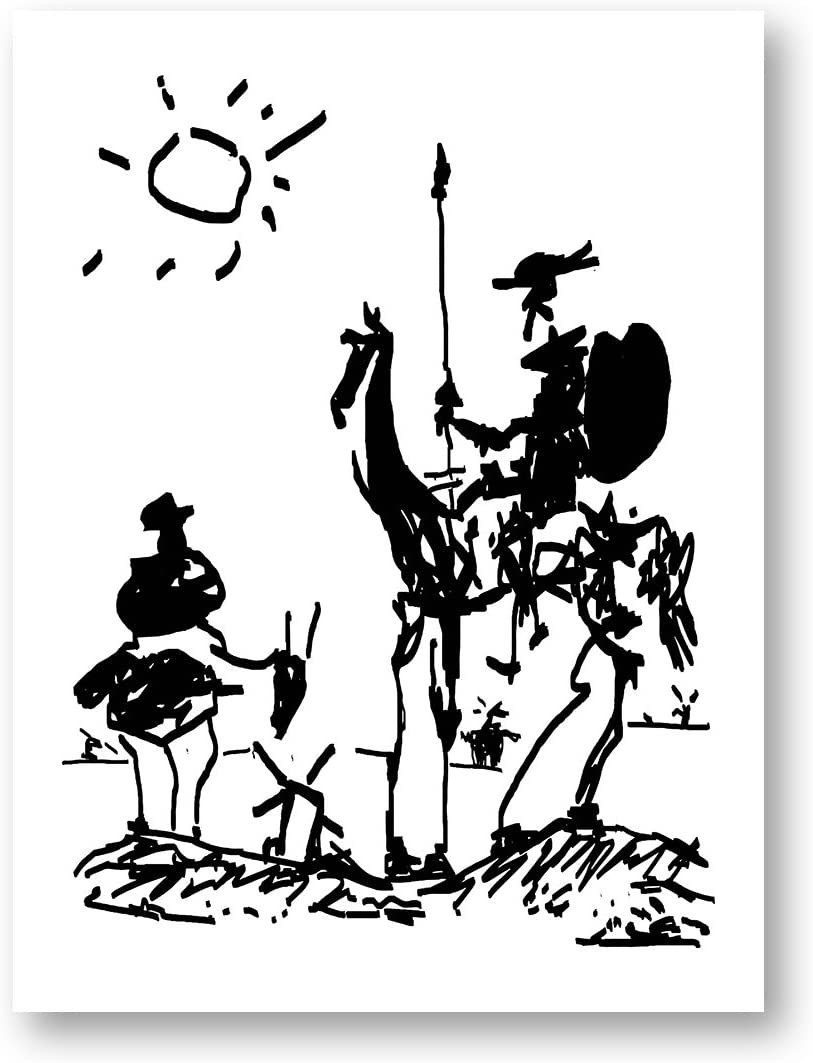
Against Canvas

I love that he uses this print of Pablo Picasso's Don Quixote to visually underline this post in which he must feel as if he's "tilting at windmills".
All humanities courses are second-class citizens in the ed-tech world.
And worse, typically humans are third-class citizens in the ed-tech world.
Why isn’t there anything on our class’s Canvas page? Because Canvas and Blackboard are evil and must be destroyed. So-called “learning management software” is very possibly the worst software ever created by anyone for any purpose, and I will not add to the store of suffering in the world by making use of it. I explain in more detail my objections to Canvas here.
Awesome AND true.
Levenson, T. (2021, June 23). When a Good Scientist Is the Wrong Source. Nautilus. http://nautil.us/issue/102/hidden-truths/when-a-good-scientist-is-the-wrong-source
Health, A. G. D. of. (2021, March 13). COVID-19 vaccines – Is it true? [Text]. Australian Government Department of Health; Australian Government Department of Health. https://www.health.gov.au/initiatives-and-programs/covid-19-vaccines/is-it-true
Derrick, G. (2021). A year after lockdowns began, has research got any kinder? Nature. https://doi.org/10.1038/d41586-021-01579-7
mmv1,2 is also a very nice tool for such a task, applied to the current job, it would be mmv '*.md' 'test - #1.md'
Introduced to briefly by Giampaolo Ferradini at I Annotate 2021. A tool for reading and learning.
CMP or consent management platform is a platform or a tool to take consent from the visitor to use his/her digital identity for marketing efforts.
Siegrist, M., & Bearth, A. (2021). Worldviews, trust, and risk perceptions shape public acceptance of COVID-19 public health measures. Proceedings of the National Academy of Sciences, 118(24), e2100411118. https://doi.org/10.1073/pnas.2100411118
Stay engaged. As mentioned above, you are expected to check your GVSU email twice daily, read new posts on CampusWire twice daily, contribute to the discussion board daily, and make at least two significant contributions to CampusWire per week. Make daily engagement with the course a habit, and don’t take days off (unless it’s a weekend and you have all your work done).
Budget your time. MTH 124 is a 5-credit course with no meetings, so you will need to plan on spending about 15-20 hours per week doing mindful work. That’s 3-4 hours per weekday if you choose not to work on weekends. If you are taking other courses or have job of family responsibilities, you’ll need to think about where to put these hours in your daily and weekly schedules. In my experience, the #1 reason students don’t succeed in online courses is overcommitment and not managing time well.
The garden helps us move away from time-bound streams and into contextual knowledge spaces.
SaaS startups have become a popular business recently. However, very few startups become successful. How can you avoid startup failure? Check our article.
I particularly enjoyed the California water commons, with its quiet nod to Elinor Ostrom’s original post-graduate research on emergent cooperation between county water-boards.
A quiet nod here in it's own right. Now I want to dig into Elinor Ostrom's research and work.
I can refer to a section of page in a book by using #(booknr)p(pagenr)(section), for example #8p113a. There are four sections in my journals: A (upper left), B (down left), C (upper right), D (down right).
An interesting page/section reference method.
We still do not understand how information practices from the worlds of learning, finance, industry, and administration cross-pollinated. From the fourteenth century onward, accountants developed complex instructions for note-taking to describe holdings and transactions, as well for the recording of numbers and calculations. By the seventeenth century, merchants, and indeed ship captains, engineers, and state administrators, were known to travel with trunks of memoranda, massive inventories, scrap books, and various ledgers and log books that mixed descriptive notes and numbers. By the eighteenth century, tables and printed forms cut down on the need for notes and required less description and more systematic numerical notes. Notaries also were master information handlers, creating archives for their legal and financial documents and cross-referencing catalogue systems.
I'm noticing no mention here of double entry book keeping or the accountant's idea of waste books.
There's also no mention of orality or memory methods either.
Humanists had the tools and even the concepts to invent the cross-referenced thematic library catalogue, but they did not do so. We do not know why it took several hundred years and the Italian director of the British Museum, Antonio Panizzi, to create a truly modern reference catalogue through his “Ninety-One Cataloguing Rules” in 1841.
Origin of the modern reference catalogue...
Why did a figure such as Leibniz fail to use his own tools? Perhaps messiness was the source of his creativity. This is a fact of intellectual originality with which Google must still grapple—libraries, after all, allow for the type of manageable disorder which is often the spark of creativity.
Manageable disorder, messiness, and even chaos can be the source of boundless creativity.
There's an idea in complexity theory that the most interesting things happen at the edge of chaos.
In effect, Too Much to Know is a reference book about reference books, containing chapters on early “information management,” note-taking, reference genres and “finding devices,” compiling, and the impact of reference books.
I love all of these various topics.
The humanist remedy for information overload was to produce an unprecedented number of manuals about how to read books. They outlined what Blair calls the four S’s of early modern information management: storage, sorting, selection, summary.
I'd love to have a list of these and some of their similarities. What would oral cultures have done? How would/did they manage their overflow of information, besides overwriting the new/improved and forgetting the old/unuseful?
Sam Bowman. (2021, January 25). If the govt can’t keep a few thousand people fed in hotel quarantine, how exactly was it supposed to provide for fifteen million pensioners self-isolating in Great Barrington-style ‘focused protection’ while the virus was spreading across the rest of the population? [Tweet]. @s8mb. https://twitter.com/s8mb/status/1353666214883684352
Brewer, N. T., DeFrank, J. T., & Gilkey, M. B. (2016). Anticipated Regret and Health Behavior: A Meta-Analysis. Health Psychology : Official Journal of the Division of Health Psychology, American Psychological Association, 35(11), 1264–1275. https://doi.org/10.1037/hea0000294
the three types of power commonly discussed in management theory: power-over, power-with, and power-to. These three types of power were first identified by the Mother of Modern Management, Mary Parker Follett. You may also recognize her as the person who coined the term “win-win.” Here are the three types of power: Power-over is extractive. Power-over is extracted from other people, the natural world, etc. Power-over means getting more of the pie. Power-with is gained when we work together, i.e, collective action. Power-to is generative. Power-to is the power we have to create new things. Power-to means making the pie bigger.
An interesting break down of power.
Conley, D., & Johnson, T. (2021). Opinion: Past is future for the era of COVID-19 research in the social sciences. Proceedings of the National Academy of Sciences, 118(13). https://doi.org/10.1073/pnas.2104155118
This post articulates a lot of what I've been thinking about for the past 18 months or so, but it adds the additional concept of community integration.
Interestingly, this aligns with the early, tentative ideas around what the future of In Beta might look like as a learning community, rather than a repository of content.
mentoring tips
The same is true with my time. So I started blocking all 24 hours of my time (mental breaks, yoga workouts, prepping dinner, sleep, everything) into my digital calendar. There is no time unaccounted for.
This Is the Time-Management Hack That Helped Me Double My Income
ReconfigBehSci on Twitter. (n.d.). Twitter. Retrieved 5 March 2021, from https://twitter.com/SciBeh/status/1325729757447794688
Clinical Data Systems to Support Public Health Practice: A National Survey of Software and Storage Systems Among Local Health Departments
Assessing Open Source Journal Management Software
this is a good start of a mega analysis of all journal management platforms, isn't it?!
Quick summaries of SciBeh Virtual Workshop Day 1. (n.d.). HackMD. Retrieved March 7, 2021, from https://hackmd.io/@scibeh/SkyuLWvtw#Session-1-Open-Science-and-Crisis-Knowledge-Management
Yes, Virginia, PMs Are Responsible for Accessibility
Angela Hooker, Microsoft
Why build in a11y from the start?
Getting support from leadership
Include multiple accessibility reviews in your timeline
Choose the standards and level of compliance you'll achieve
Put accessibility requirements in contracts with outside vendors
Carefully choose the tech you'll use to build your project
Document all your team's work
Get training for your team
How do you coach your team and oversee their work?
Written content comes first
Working with designers
What if you're updating a legacy project?
Sci Beh. (2020, November 19). SciBeh Workshop Day 1 Session 1: Open Science and Crisis Knowledge Management. https://www.youtube.com/watch?v=31KBbnqNJi0
dawnlxh. (2020, October 30). Ideas for discussion: what is the role of open science is crisis knowledge management? [Reddit Post]. R/BehSciAsk. https://www.reddit.com/r/BehSciAsk/comments/jkzooc/ideas_for_discussion_what_is_the_role_of_open/gbtktep/
ReconfigBehSci. (2020, November 9). final speaker in our ‘Open science and crisis knowledge management’ session: Michele Starnini on radically redesigning the peer review system #scibeh2020 https://t.co/Gsr66BRGcJ [Tweet]. @SciBeh. https://twitter.com/SciBeh/status/1325734449783443461
ReconfigBehSci on Twitter: ‘Session 1: “Open Science and Crisis Knowledge Management now underway with Chiara Varazzani from the OECD” How can we adapt tools, policies, and strategies for open science to provide what is needed for policy response to COVID-19? #scibeh2020’ / Twitter. (n.d.). Retrieved 5 March 2021, from https://twitter.com/SciBeh/status/1325720293965443072
If you don't control your schedule, it will control you.
Big fax, no printer!
It is much easier to track what is going on within the activity. Instead of transporting additional state via ctx, you expose the outcome via an additional end event.
Note: It's only super easy to see what's going on if you have the benefit of a diagram.
NOTE: Your strategy should be supported using project management best-practices found within the Management Practices. These practices have been developed by industry, spending billions of dollars each year in projects. Of course, they would want their projects to succeed. Your quality of life is at least this important. Take your efforts seriously and manage your efforts.
Don't Forget These 10 Project Management Best Practices: https://www.wrike.com/blog/project-management-best-practices-infographic/
List of Health Practices https://www.albany.edu/~drewa/health/practices.html
ReconfigBehSci on Twitter: ‘1 week to the SciBeh workshop “Building an online information environment for policy relevant science” Join us, register now! Topics: Crisis open science, interfacing to policy, online discourse, tools for research curation talks, panels, hackathons https://t.co/Gsr66BRGcJ https://t.co/uRrhSb9t05’ / Twitter. (n.d.). Retrieved 2 March 2021, from https://twitter.com/SciBeh/status/1323207455283826690
Lease Management Software
Training and Learning Management System
Real Estate Sales & Marketing Solution
Armeni, Kristijan, Loek Brinkman, Rickard Carlsson, Anita Eerland, Rianne Fijten, Robin Fondberg, Vera Ellen Heininga, et al. ‘Towards Wide-Scale Adoption of Open Science Practices: The Role of Open Science Communities’. MetaArXiv, 6 October 2020. https://doi.org/10.31222/osf.io/7gct9.
Aczel, Balazs, Marton Kovacs, and Rink Hoekstra. ‘The Role of Human Fallibility in Psychological Research: A Survey of Mistakes in Data Management’. PsyArXiv, 5 November 2020. https://doi.org/10.31234/osf.io/xcykz.
Haslam, S. A., Steffens, N. K., Reicher, S., & Bentley, S. (2020). Identity leadership in a crisis: A 5R framework for learning from responses to COVID-19. PsyArXiv. https://doi.org/10.31234/osf.io/bhj49
Establish structured daily check-ins: Many successful remote managers establish a daily call with their remote employees.
make sure there is space during standup for chit-chat.
The great thing about working with reinteractive is you get to work directly with the developers, which is a huge plus. As a technical founder, I find proxying through a project manager adds unnecessary layers of complexity and creates opportunity for human error.
Encapsulation is used to hide the values or state of a structured data object inside a class, preventing direct access to them by clients in a way that could expose hidden implementation details or violate state invariance maintained by the methods.
DSLs can be problematic for the user since the user has to manage state (e.g. am I supposed to call valid? first or update_attributes?). This is exactly why the #validate is the only method to change state in Reform.
The reason Reform does updating attributes and validation in the same step is because I wanna reduce public methods. This is to save users from having to remember state.
I see what he means, but what would you call this (tag)? "have to remember state"? maybe "have to remember" is close enough
Or maybe order is important / do things in the right order is all we need to describe the problem/need.
Safra, L., Chevallier, C., & Sijilmassi, A. (2021). Poverty and Threat Reactivity. PsyArXiv. https://doi.org/10.31234/osf.io/fp35r
One can now picture a future investigator in his laboratory. His hands are free, and he is not anchored. As he moves about and observes, he photographs and comments. Time is automatically recorded to tie the two records together. If he goes into the field, he may be connected by radio to his recorder. As he ponders over his notes in the evening, he again talks his comments into the record. His typed record, as well as his photographs, may both be in miniature, so that he projects them for examination.
This is one of the most important aspects of the essay. Noting that he is continuously talking about the work of a scientist, he stresses the act of recording, of looking at reality. This is radically different from what Ahrens claims in his book "How to take Smart Notes", in which there is not a single hint to the fact that you must look through the window and not just into previous works.
OKRs in Product Management
good overview on OKRs and how to craft them
Using integrations with other tools in the product stack such as Jira and GitHub, progress on specific items can be viewed directly from the digital product roadmap, offering an accurate view of how well things are sticking to the schedule
Why not just use built in tools in Jira and Github? Still struggling to see how roadmapping tool differs from, for example, Github project boards
Translating these concepts into attractive visual product roadmaps that connect with a diverse set of internal stakeholders,
In a small organization like Hypothesis, I'm not sure that a visually pretty roadmap is a pressing need. Willing to keep reading, but color me skeptical.
Management
Management : easy to use
Nowogrodzki. A., (2020). Four tools that help researchers working in collaborations to see the big picture.nature. Retrieved from: https://www.nature.com/articles/d41586-020-01918 utm_source=twt_nnc&utm_medium=social&utm_campaign=naturenews&sf235555174=1
Researchers and Their Stories (2020) WEBINAR: Managing your mental health is an ongoing journey – Let's embrace the process!. Retrieved from https://www.editage.com/insights/managing-your-mental-health-is-an-ongoing-journey-lets-embrace-the-process
PopupState HelperTo make managing the popover state easier, we can use the material-ui-popup-state library to manage the state.
There are lots of trees around us but we don’t know which one plant is harmful for us means a trigger to pollen allergy. Let’s know the pollen allergy symptoms which include sneezing, nasal congestion, wheezing etc. Don’t worry if you are suffering through this allergy, just stick to the allergy medications suggested by your doctor for better allergy management.
Theemergence of the termcontent strategyitselfrepresents widespread recognition that componentcontent management was in great need of aroadmap.
For me this is one of the key sentences of this paper. It is impossible to understand content strategy without taking component content management into consideration. For an academic approach to content strategy component content management is a key.
In its most commondefinition, a genre is a rhetorical action that istypified and socially recognized based on recurrentsituations; members of organizations use genresfor specific communicative and collaborativepurposes [6], [7]
This might be translated following the approach of semiotic practices defined by Fontanille et.al.
Demers. J., Bewick. S., Folashade. A., Caillouet. K. A., Fagan. W. F. Robertson. S. L., (2020) . Managing disease outbreaks: The importance of vector mobility and spatially heterogeneous control. PLOS COMPUTATIONAL BIOLOGY. Retrieved from: https://journals.plos.org/ploscompbiol/article?id=10.1371%2Fjournal.pcbi.1008136&utm_source=feedburner&utm_medium=feed&utm_campaign=Feed%3A+ploscompbiol%2FNewArticles+%28PLOS+Computational+Biology+-+New+Articles%29
"Organizational change management ensures that the new processes resulting from a project are actually adopted by the people who are affected.”
Definition of change management
brag
React will update state throughout the user’s session. localStorage won’t change.When the user ends their session, save whatever the state is at that time to localStorage, making it available for hydrating in the next session.
Is this safe/reliable to defer saving until then? What if browser crashes? I guess that's why onbeforeunload is needed. Hopefully onbeforeunload is reliable and can't be skipped (unless browser crashes?).
So rather than continuously keeping localStorage in-sync with React state, let’s simply save state to localStorage whenever the user ends their session, either by leaving the app (‘unmounting’ the component) or refreshing the page.
set(key, v) { localStorage.setItem(key, JSON.stringify(v)) store.set(key, v) return v },
Our large project is going to need highly structured and predictable state management, and Svelte’s flexibility scales from trivial projects up to our big one. We’re looking at statecharts and XState to wrangle this problem.
Microsoft says it will make changes in its new Productivity Score feature, including removing the ability for companies to see data about individual users, to address concerns from privacy experts that the tech giant had effectively rolled out a new tool for snooping on workers.
It's great that MS has reacted so quickly to the outcry around the privacy of workers.
I thought it would be super-interesting to see how academics might have responded to the idea of institutional administrators keeping tabs on the number of hours that they'd spent in meetings (via Teams), composing and reading emails (via Outlook), writing articles (via Word), and so on.
And yet these would be the same academics who do this kind of monitoring of student work.
Schindler, S., Reinhardt, N., & Reinhard, M.-A. (2020). Defending one’s worldviews under mortality salience – Testing the validity of an established idea. PsyArXiv. https://doi.org/10.31234/osf.io/7bxcs