《作为一个快 70w 粉的 b 站 up 主,我为什么停更?》这篇文章,我只用了两个小时写作,这些话其实我一年前就想说了。
指的是微信公众号上的 作为一个快70w粉的b站up主,我为什么停更?。
《作为一个快 70w 粉的 b 站 up 主,我为什么停更?》这篇文章,我只用了两个小时写作,这些话其实我一年前就想说了。
指的是微信公众号上的 作为一个快70w粉的b站up主,我为什么停更?。
流量没那么值钱了。只要有流量就能赚到钱的时代已经结束。
作为一个自媒体或者 IP,生命周期也就几年而已,如果做了一两年还没有完成商业化,那继续下去也不过是充当 B 站股价的加油器罢了。
签约并不代表会得到特殊扶持。很多资深 UP 主跟我抱怨, 「B 站运营能左右很多,必须要搞好和他们的关系」
B 站对于在站外有流量的 UP 主是有扶持的,就是通过给你更好的推荐位,「帮助你涨粉,管到 20 万」,等这个线一过,福利就没了。
还有一点让很多 UP 主们头疼,就是很多弹幕、评论对广告投放不友好。
还有一个更直接的问题,就是「决定广告预算去向的人不上 B 站」。
因为 B 站用户基数本身比抖音小,所以从广告投放的角度,性价比也会比抖音低一些。
B 站用户普遍比较低龄,也是很难商业化的原因。而且 B 站以中长视频为主,其实更适合深度的理性消费种草,比如做相机、电器等评测类开箱视频,就很适合长视频的形式。但这类产品也要求了用户的消费能力要高。可是 B 站用户又很年轻,可支配收入有限,这就成了一个死结。
一句话来讲,B 站涨粉要比抖音难得多,但 B 站粉丝的商业价值却不一定会更高。不像很多人觉得,因为 B 站涨粉慢,似乎粉丝的价值就更高一些了,并不是这个逻辑。
一位持冷静态度的行业人士认为,疫情三年直至当前,整个广告市场都在萎缩,B 站 UP 主接单难,不应该被特殊看待。
目前,进驻大陆且顺利扩张的外资便利店就是日系三杰:7-ELEVEn、罗森和全家。尽管 7-ELEVEn 和罗森都源自美国,但进入日本市场后,它们早已被改造成日系便利店,最大的特质是标准化管理、熟食品类丰富、服务周到细致。
日系便利店对员工的培训更加规范化,具体体现在话术、行为以及个人界限的把控上,罗森的店员很难像红旗的阿姨一样跟你讨论哪个牌子的酱油更好,不过这更符合都市打工人保持距离的需求。对于年轻人来说,便利店满足即买即走的需求就够了,人情往来反而是负担。
邻几的优势在于,非常清晰地知道自己要卖什么,以及怎么卖。邻几的创始人刘建忠有个执念,门店只要塞得下,那么就得尽量放 12 张桌子。邻几的目标,是成为城市里的第三空间,在办公室和家之外,提供一个温馨的场所。
2018 年,十足便利店迈步出省,在苏州、无锡、常州等城市同时开业,成为浙江首个走向全国的便利店品牌。
公路商店曾形象地比喻:「如果把成都比作一盆毛血旺,全家和罗森的数量就是那为数不多的毛肚,剩下每次都吃不完的豆芽就是红旗连锁。」
当一个四川的家庭中,出现一位在国企、事业单位、学校等地的职员,那么这个家庭的茶米油盐酱醋茶统统将被红旗连锁承包。要是「突袭」一个这样的成都本地家庭,说不定还能找到一沓标志性的、带有红旗连锁钢印的票券。
中国新闻周刊曾这样调侃北京便利店的匮乏:「当上海、广州的朋友热烈讨论罗森新出的甜点蛋糕,7-ELEVEn 关东煮的汤汁最浓,车仔面拌上沙茶酱有多香,全家又出了什么网红零食时,北京的朋友默默退群了。」
柳市人都离不开叶建华,因为他跑遍全镇后整理出一本带样品插图和售价的产品目录,那是购销员外出跑业务必不可少的工具。十多年后,一个叫马云的人和他的阿里巴巴做了同一件事,蝴蝶振翅般改写了中国互联网的历史。
改革开放初期的「淘金卖水」致富故事。
过去三年里,疫情让直营门店成了品牌们最大的风险敞口。就拿卤味来说,做直营的周黑鸭,就比做加盟的绝味要惨烈的多。前者净利润跌去了 94%,后者却能少跌 20%。而在加盟模式里,品牌和加盟商形成的利益共同体中,加盟商会分走一部分利润,往往做不到直营模式那么高的利润率和坪效,但反之,加盟商也分摊了风险,封控营不了业,房租反正也是加盟商在承担。因此,很多品牌扛不住自己做直营的成本压力,也开始拥抱加盟。喜茶在很长一段时间内都坚称「绝不开放加盟」,现在也不得不放下身段,在下沉市场寻找起加盟伙伴;张拉拉、老乡鸡等超过 12 个餐饮品牌都在 2022 年选择开放加盟。
和加盟商做生意,蜜雪冰城是优秀案例。比如蜜雪冰城在四川建了柠檬种植基地,再以低于市场价的价格卖给加盟商;还把一毛、八分采购来的杯子、吸管,加价卖给加盟商,平均毛利率能达到 30%。2021 年,蜜雪冰城营收 103.5 亿元,其中售卖给加盟商的食材和包材两项合计贡献超过 85%[7]。
啤酒本身是一个正在衰落的市场。在 2013 年到达顶峰后一路下滑,而百威、青岛、华润等五大巨头牢牢把控着 80%的市场,像海伦司这样的新品牌难有立足之地。
不论是酒馆还是新式茶饮,都是开一家店、赚一份钱的餐饮生意。但随着门店扩张,还会出现门店难管、食客挑剔、成本飙升、增收不增利等诸多问题。投资人李岳就说过:「随着规模增长,你只是变得更大,并没有变得更强。[6]」
不同于想从消费者身上多赚钱的同行,海伦司的策略是,先从自己身上缩成本。通过在人工、房租、原材料上的极致抠门,海伦司的门店经营成本还不到 50%,优秀同行则为 70%,海伦司的成本控制堪称业界教科书。
海伦司是一类餐饮品牌的代表,他们讲着「中国星巴克」「中国麦当劳」的故事跑步进入资本市场,在新消费的余热里拿融资、开新店,几年之内就要拼一个「千店连锁」「万店连锁」的奇迹。
消费投资热时,每年一轮资金向这批新消费创业公司注入燃料——是燃料也是悬在创业者头顶的剑。一家餐饮公司不到 10 家店时,融资估值就接近 20 亿元。并不是投资方相信一家 50 平米的小店价值两亿元,只是提前按照几百几千店连锁这样的理想 “终局” 开出价码。风险是双方共同铺就的。不给这样的估值,投资者往往抢不到最热门的项目。而拿到这样的估值,创业者也必须按照 「终局」 提前搭建当前规模不需要的基础设施,把传统品牌 5-10 年的准备压缩在一两年走完。开店成倍加速、风险也成倍聚集,容不下任何意外。
创业者是一群天生乐观的人,这种乐观让他们倾向于冒险,很多时候,人们受益于他们的冒险精神。把资本作为提速的杠杆本身没有错,但当环境开始变化,创业者没能及时识别危险信号,产生的风险有可能致命。
早期直营模式,一开始就铺好多个城市,很容易拉断现金流。
大家都会做的事情一定不是胜负手,一些打破的东西才是。
在餐饮行业十几年,胡亭先后开过奶茶店、小笼包店。她一直想做一个更大规模的生意。2014 年,她从外送蛋糕品牌 21Cake 离职,搬去苏州加入西式烘焙连锁店礼颂至品。那年中秋,她注意到泸溪河桃酥在南京开了第一家品牌门店,由此关注起中式糕点。她发现,西式烘焙日常要用 1700 多种原料,中式烘焙只有 300 多个。
自有品牌上耕耘,成为了不少新零售的发力点,Costco 和山姆自有品牌的占比分别为 25%和 30%,而盒马自有品牌销售占比超过 35%。
「盒区房」所代表的便利优势,也左右了人们的居住选择和房地产市场的动向。2019 年时,贝壳找房曾发布报告称,在全国北上广深等 10 个城市中,盒区房的平均租房关注量高于周边非盒区房 21.45%,买卖层面,报告发现盒区房的平均交易周期比周边非盒区房快 7 天,流通性相对较强。
这份调查结果是否是倒因为果?是盒马生鲜的门店提升了所覆盖区域房产的价值,还是盒马主动选择区位条件对自己有利的点位新开门店?
后端供应链的标准化和预制化提升,进一步简化了门店的运营难度。
员工疲劳是影响标准化运营中的障碍,但责任不在员工。萨莉亚创始人认为,门店运营出现失误,不是员工不努力,而是因为总部考虑不周全。为此总部会不断测试新的解决方案
餐饮是劳动密集型产业,人工成本对业绩会有明显的影响。在人工成本提高的环境下,「小时人效」这把刀将会变得越来越锋利,背后需要的是企业对门店运营的反复迭代。萨莉亚的日本门店可以达到小时人效人民币 400~500 元。一家 300 平米的门店,平均每日销售为 1.5 万元,运营需要 30 小时~35 小时的工时,是大约 4 名员工的工作量。但其中仅有 1 名店长是全职员工,店铺会在午餐和晚餐时间段灵活用工,尽量提高人员效率,减少多余劳动力。
萨莉亚综合了连锁化餐饮的高性价比和丰富菜品,以及对意大利菜的文化追求。而它实现性价比的基础则是门店高效运营和供应链端的壁垒。
餐品的丰富度是价值感最直接的体现。萨莉亚的日本菜单上共有 65 个 SKU,主食约占 30%。为了提供更多丰富选择,创始人正垣泰彦认为餐品需要坚持 6:3:1 的比例。「6」是放着就能卖出去的单品、「3」是店铺想卖出去的单品、「1」是需要有的单品。例如,墨鱼意面和餐后甜酒销量较低,但有着提升萨莉亚意大利餐厅形象的功能。
日本零售专家渥美俊一曾提到:「连锁餐饮渠道最佳的价格范围,是让消费者可以闭着眼睛点的价格」。为了做到这点,萨莉亚菜品的最高定价尽量不超过最低定价的 2 倍,让消费者每顿午餐平均花费 30 元。低价会让消费者对渠道获得安全感,有意愿全餐段都光顾萨莉亚,获得类似社区食堂的心智定位。一般消费者在早餐、午餐、晚餐的预算比例为 1:2:4。晚餐时间段,消费者会在萨莉亚点更多单品:一份焗饭、一份汉堡肉和一份沙拉,刚好拼到 50 元左右的客单价。
拉面出西北最早始于 1980 年代末,那时的化隆人将目光转移到了外出开拉面馆上。故事始于他们发现去「大城市」打工的回族人很难吃到清真食品,便觉得这是一个不错的商机。随着第一批人开始挣钱,他们回乡后的阔绰被同乡人看在眼里,激发了大家致富的雄心。大批的人开始离开化隆,纷纷支起「兰州拉面」的招牌。
西北版「淘金卖水」的致富故事。
Wigent, William David, Burton David William Housel, and Edward Harry Gilman. Modern Filing and How to File: A Textbook on Office System. Rochester, N.Y.: Yawman & Erbe Mfg. Co., 1916. http://archive.org/details/modernfilingate02compgoog.
Original .pdf converted with docdrop.org for OCR annotation on 2023-03-24.
annotation target: urn:x-pdf:3c1f14d64c91cf4b513efa16df4ed90d
Annotations: https://hypothes.is/users/chrisaldrich?q=url%3Aurn%3Ax-pdf%3A3c1f14d64c91cf4b513efa16df4ed90d
Wigent, William David, Burton David William Housel, and Edward Harry Gilman. Modern Filing and How to File: A Textbook on Office System. Rochester, N.Y.: Yawman & Erbe Mfg. Co., 1916. http://archive.org/details/modernfilingate02compgoog.
Watts, Charles J. The Cost of Production. Muskegon, MI: The Shaw-Walker Company, 1902. http://archive.org/details/costproduction01wattgoog.
Short book on managing manufacturing costs. Not too much of an advertisement for Shaw-Walker manufactured goods (files, file management, filing cabinets, etc.). Only 64 pages are the primary content and the balance (about half) are advertisements.
Given the publication date of 1902, this would have preceded the publication of System Magazine which began in 1903. This may have then been a prototype version of an early business magazine, but with a single author, no real editorial, and only one article.
Presumably it may also have served the marketing interests of Shaw-Walker as a marketing piece as well.
Tangentially, I'm a bit intrigued by the "Mr. Morse" mentioned on page 109 who is being touted as an in-house consultant for Shaw-Walker.... Is this the same Frank Morse who broke off to form the Browne-Morse Co.? (very likely)
see: see also: https://hypothes.is/a/Sp8s4sprEe24jitvkjkxzA for a snippet on Frank Morse.
Shaw-Walker. Flexowriter File-Desks. Accessed March 24, 2023. http://archive.org/details/TNM_Flexowriter_File-Desks_-_Shaw-Walker_20171021_0001.
An interesting in-desk filing system for punched cards. Interesting I've not seen anything like this prior for a mini card index maintained in an office desk drawer.
Perhaps such a system wouldn't have been as easily accessible for use on a daily basis versus potentially more portable small systems that could have been transferred from desk to desk (person to person).
9/8b2 "Multiple storage" als Notwendigkeit derSpeicherung von komplexen (komplex auszu-wertenden) Informationen.
Seems like from a historical perspective hierarchical databases were more prevalent in the 1960s and relational databases didn't exist until the 1970s. (check references for this historically)
Of course one must consider that within a card index or zettelkasten the ideas of both could have co-existed in essence even if they weren't named as such. Some of the business use cases as early as 1903 (earlier?) would have shown the idea of multiple storage and relational database usage. Beatrice Webb's usage of her notes in a database-like way may have indicated this as well.
‘‘I think it lets us be more thoughtful and more deliberate about safety issues,’’ Altman says. ‘‘Part of our strategy is: Gradual change in the world is better than sudden change.’’
What are the long term effects of fast breaking changes and gradual changes for evolved entities?
OpenAI had a novel structure, which the organization called a ‘‘capped profit’’ model.
https://www.ebay.com/itm/115727768658
The Shaw=Walker Card Systems catalogue from circa 1899.
Seen in a Hoskins business equipment advertisement in Business magazine (1903) for card index:
YOUR BUSINESS AT YOUR FINGER ENDS
Close to the phrase "at your finger tips". Would it have appeared before or after this?
Business: The Magazine for Office, Store and Factory. Vol. 16. Business Man’s Publishing Company, 1903. https://www.google.com/books/edition/Business/QKaxezfHjL0C?hl=en&gbpv=0.
mindex.THIS is the name Howard L. Wilson, of Rochester, N.Y.,hasgivenhisvestpocket cardsystem.Itisa
Geyers Stationer. “Memindex Advertisement.” Geyer’s Stationer: Devoted to the Interests of the Stationery, Fancy Goods and Notion Trades, September 15, 1904. https://www.google.com/books/edition/Geyer_s_Stationer/L507AQAAMAAJ?hl=en&gbpv=0
Howard L. Wilson of Rochester, NY named his vest pocket card index system the Memindex.
Standard business cards are 3.5″x 2″
STANDARD INDEX CARD CO.
Fascinating to see the 8 various types of hole punches different card index systems may have used on their index card filing cabinets.
Advertisement from System, December 1906:
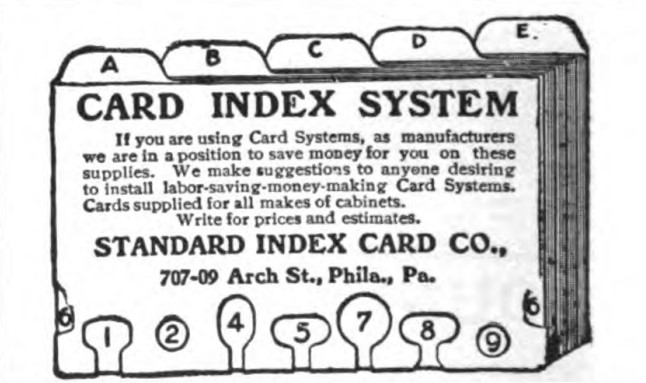
CARD INDEX SYSTEM <br /> If you are using Card Systems, as manufacturers we are in a position to save money for you on these supplies. We make suggestions to anyone desiring to install labor-saving-money- making Card Systems.<br /> Cards supplied for all makes of cabinets.<br /> Write for prices and estimates.<br /> STANDARD INDEX CARD CO.,<br /> 707-09 Arch St., Phila., Pa.
TheCalculagraph
Beyond having people make direct copies of cards by hand or using carbon paper, The Calculagraph Company manufactured a copying machine for duplicating data.
There is an accompanying picture (which I haven't copied here). Advertisement from 1906 System Magazine:
The Calculagraph<br /> Makes individual records of actual<br /> working time on separate cards<br /> which may be used interchangeably<br /> for Cost Accounting, for Pay-rolls and<br /> for a number of other purposes with-<br /> out copying or transcribing a single<br /> figure, by simply assorting the cards<br /> and adding the records directly from<br /> their faces.<br /> A card containing all the work<br /> records of one man for a week may<br /> be useful for pay-roll purposes, but it<br /> is utterly worthless for learning the<br /> cost of products, until all the items<br /> have been copied or transcribed for<br /> classification.<br /> The Calculagraph requires a large<br /> number of cards in a factory employ-<br /> ing several hundred persons, but it<br /> Saves Clerical Labor. (In one<br /> factory it saves $150.00 per week).<br /> Cards Are Cheaper Than Labor<br /> The Calculagraph Makes No<br /> Clerical Errors.<br /> Let us send you our printed matter.<br /> CALCULAGRAPH COMPANY<br /> 1414 JEWELERS BUILDING, NEW YORK CITY
TheSateliteCombinationCard IndexCabinetandTelephoneStand

A fascinating combination of office furniture types in 1906!
The Adjustable Table Company of Grand Rapids, Michigan manufactured a combination table for both telephones and index cards. It was designed as an accessory to be stood next to one's desk to accommodate a telephone at the beginning of the telephone era and also served as storage for one's card index.
Given the broad business-based use of the card index at the time and the newness of the telephone, this piece of furniture likely was not designed as an early proto-rolodex, though it certainly could have been (and very well may have likely been) used as such in practice.
I totally want one of these as a side table for my couch/reading chair for both storing index cards and as a temporary writing surface while reading!
This could also be an early precursor to Twitter!
Folks have certainly mentioned other incarnations: - annotations in books (person to self), - postcards (person to person), - the telegraph (person to person and possibly to others by personal communication or newspaper distribution)
but this is the first version of short note user interface for both creation, storage, and distribution by means of electrical transmission (via telephone) with a bigger network (still person to person, but with potential for easy/cheap distribution to more than a single person)
Shaw, A. W. System: The Magazine of Business. Vol. 10. A. W. Shaw Company, 1906. https://www.google.com/books/edition/System/3qvNAAAAMAAJ?hl=en&gbpv=0.
via image at https://www.ebay.com/itm/125806081747
W.K.Kellogg,President ofthe ToastedCornFlakeCompanyandalliedBattleCreekinterestsusing 640 drawers,says:"Ourbusiness involvesthehandling ofavastamountofdetail.Thedaily mailsometimescontainsthousandsofletters.IdonotknowhowallthesedetailscouldpossiblyhavebeenhandledwithoutShaw-WalkerSystems.
In the December 1906 issue of System, a magazine which would eventually become Bloomberg Business Week), W. K. Kellogg, the President of the Toasted Corn Flake Company is quoted touting the invaluable nature of the Shaw-Walker filing system at a time when his company was using 640 drawers of their system.
Antique Calculagraph Machine Time Clock Card Recorder Old Factory Punch Vintage
https://www.ebay.com/itm/293124175605
For advertisement from 1906, see: https://hypothes.is/a/OGREvL98Ee2mYVO2Fqim6Q
Arch Wilkinson Shaw<br /> https://en.wikipedia.org/wiki/Arch_Wilkinson_Shaw

https://catalog.hathitrust.org/Record/100006275<br /> System: The Magazine of Business Published: Shaw-Walker Co., [1900]-1927. Muskegon, Mich.
Later Business Week and then Bloomberg Business Week
Você pode criar somente duas contas no Gerenciador de Negócios
Verificar se é possível ter mais de DUAS CONTAS no Gerenciador de Negócios
Criar um Gerenciador de Negócios
Central de Ajuda da Meta para Empresas
Vintage 1900 Macey Card Business System Fred Macey Company Original Ad 1021 A2<br />

https://www.ebay.com/itm/275147213477
Copy in notes folder as backup

Copy in Notes folder.
Amazon removing titles from Kindle Unlimited due to ebook piracy issues<br /> by Sovan Mandal
Read at Tue 2023-02-28 6:50 AM
"Prosperity is something created by businessmen for politicians to take credit for."
—Ronald Reagan
I agree, of course, with the criticism of the price point. As I often say, $9.99/month (or even $4.99/month) is more expensive than premium email—and no matter how cool you think your thing is, it's way less important than email. You should always return something for ~$20, especially if you already have a free tier. (When I say "for $20" here, I'm talking about a one time payment, or on a subscription basis that maxes out at $20/yr.)
The following musings are highly specific to the market for what's being sold here.
Paying $20 should get you something that you aren't bothered about again for the next year. Maybe to make it even easier, enable anyone to request a refund of their $20 for any reason within the first 7 days. This gives a similar feel to a free trial, but it curbs abuse and helps target serious buyers in the first place. In the event that 7 days is not enough time even for people to convince themselves that they need it, maybe keep open the ability to use a severely limited version of the service for the remainder of the year. E.g. you can continue to log in and simulate what you'd get with the full version, but it's only accessible to you because you can't publish them and/or share links with anyone who doesn't have access to your account.
Apple can afford to make user privacy a priority AND be very strict about cookies because its revenue does not strongly depend on advertising.
Stettler, Lucia. “Geheime Gästekartei überlebt Hotelbrand – und birgt Zündstoff.” Schweizer Radio und Fernsehen (SRF), April 8, 2021, sec. Kultur. https://www.srf.ch/kultur/gesellschaft-religion/brisanter-fund-geheime-gaestekartei-ueberlebt-hotelbrand-und-birgt-zuendstoff.
<small><cite class='h-cite via'>ᔥ <span class='p-author h-card'>ManuelRodriguez331</span> in Advantages of Analog note taking : Zettelkasten (<time class='dt-published'>02/07/2023 08:33:25</time>)</cite></small>
Wie durch ein Wunder blieben vier Holzkisten mit hochbrisantem Inhalt verschont. Sie waren zum Zeitpunkt des Infernos in einem anderen Gebäude eingelagert. Sie enthielten 20'000 Gästekarten, die Concierges und Rezeptionisten zwischen 1920 und 1960 heimlich geführt hatten.
Google translate:
four wooden boxes with highly explosive contents were spared. They were stored in a different building at the time of the inferno. They contained 20,000 guest cards that concierges and receptionists had kept secretly between 1920 and 1960.
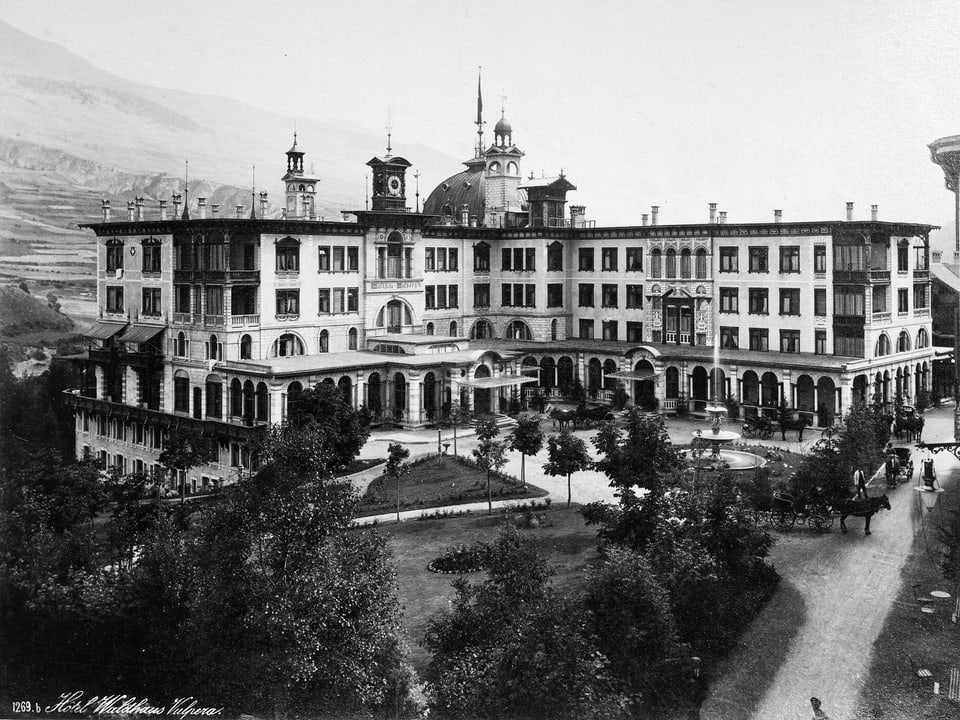
The Grandhotel Waldhaus burned down in 1989, but saved from the inferno were 20,000 guest cards with annotations about them that were compiled between 1920 and 1960.
At the Grandhotel Waldhaus in Vulpera, Switzerland concierges and receptionists maintained a business-focused zettelkasten of cards. In addition to the typical business function these cards served denoting names, addresses, and rooms, the staff also made annotations commenting on the guests and their proclivities.
1: 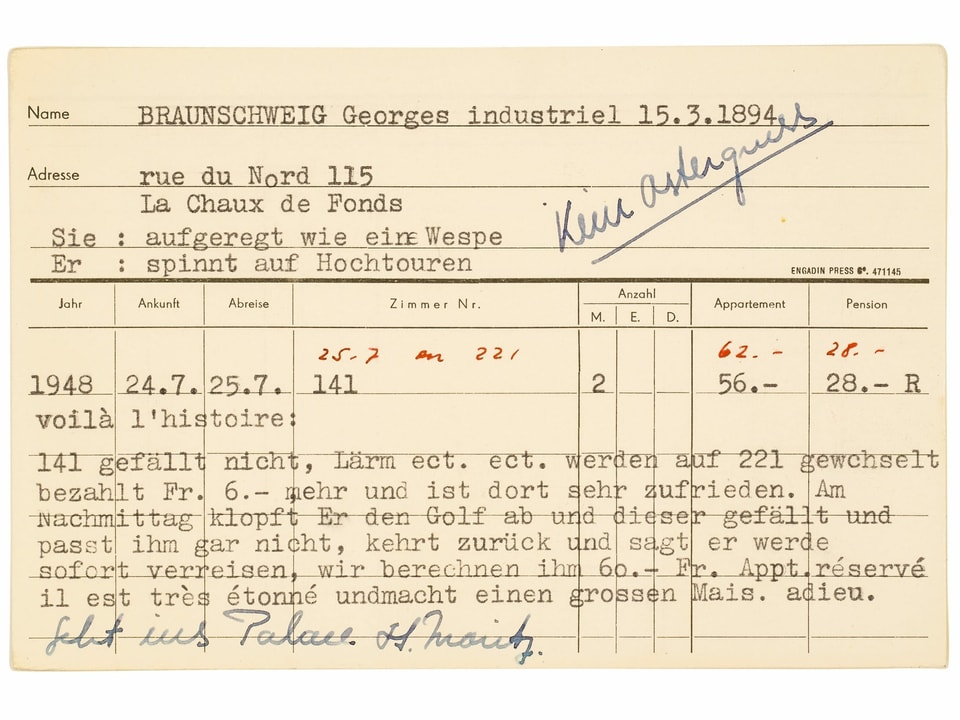
2: 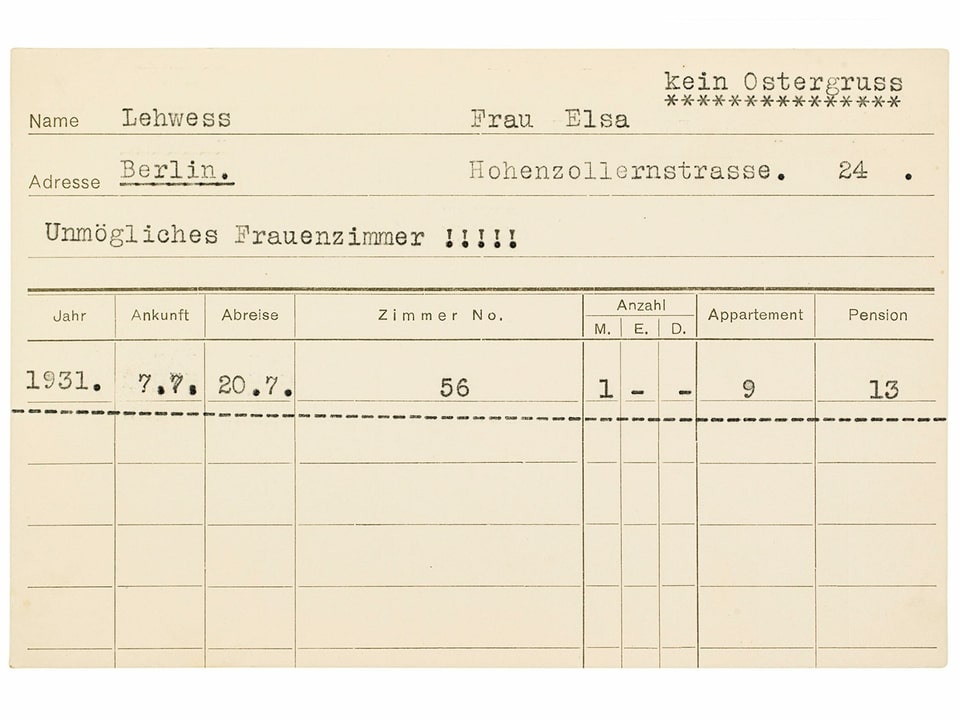
3: 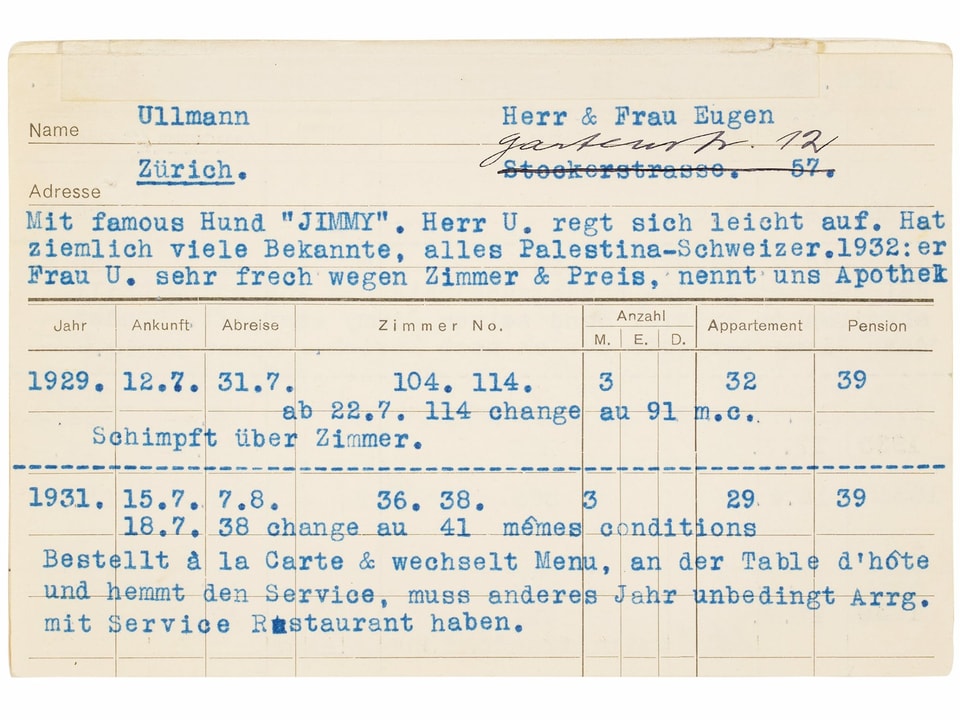
4: 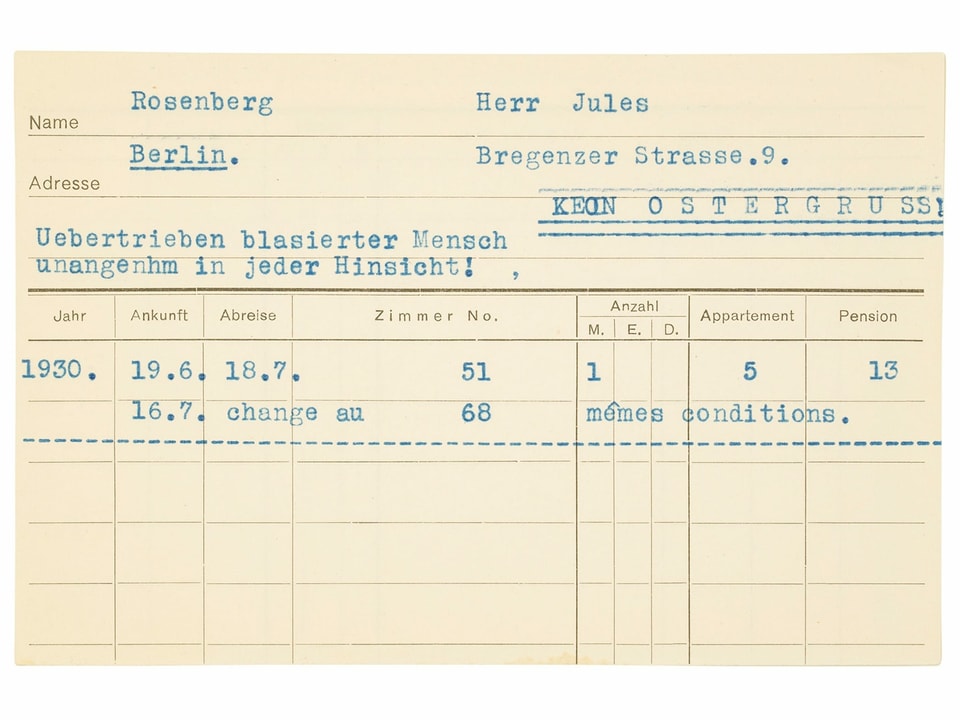
5:
6: 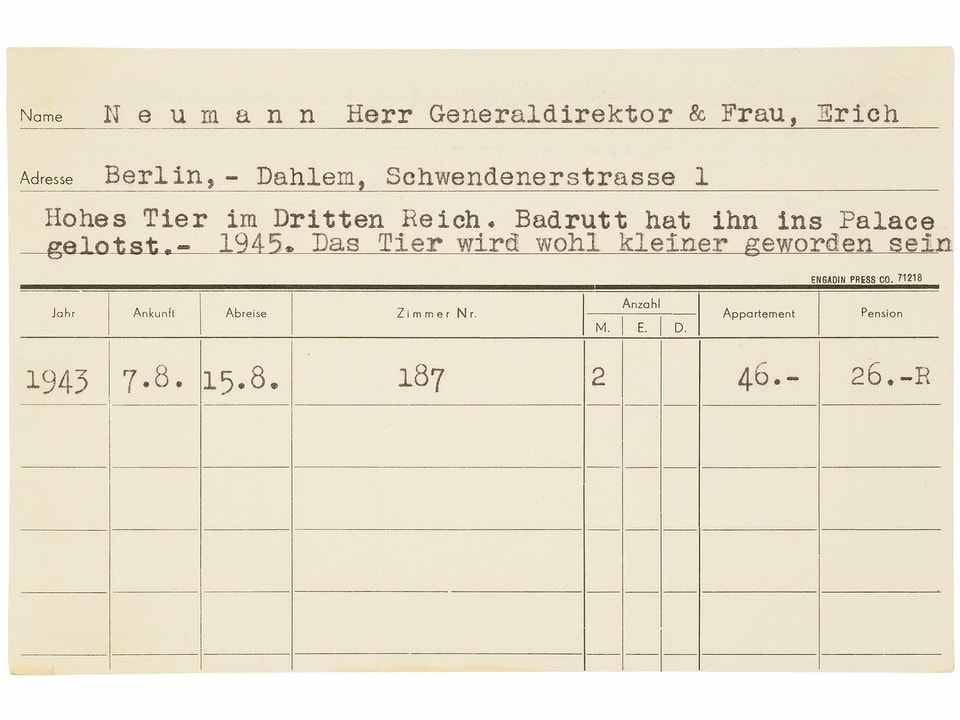
Lois Hechenblaikner, Andrea Kühbacher, Rolf Zollinger (Hrsg.): «Keine Ostergrüsse mehr! Die geheime Gästekartei des Grandhotel Waldhaus in Vulpera». Edition Patrick Frey, 2021.Der reich bebilderte Band bietet eine spannende Reise in ein Stück Schweizer Tourismusgeschichte: Die Herausgeber haben die 20'000 Karteikarten aus den Jahren 1920-1960 sehr sorgfältig kuratiert, nach Themen gegliedert und in einen grösseren, gesellschaftlichen Zusammenhang gestellt.Die Leserinnen und Leser erfahren viel über die Klientel im Hotel Waldhaus, zum Teil sogar in kleinen biografischen Porträts; und sie können an konkreten Beispielen verfolgen, wie sich der Sprachgebrauch der Concierges im Laufe der Zeit verändert – gerade zum Beispiel im Zusammenhang mit jüdischen Gästen.
Google Translate:
Lois Hechenblaikner, Andrea Kühbacher, Rolf Zollinger (editors): «No more Easter greetings! The secret guest file of the Grandhotel Waldhaus in Vulpera". Edition Patrick Frey, 2021.
The richly illustrated volume offers an exciting journey into a piece of Swiss tourism history: the editors have very carefully curated the 20,000 index cards from the years 1920-1960, structured them by topic and placed them in a larger, social context.
The readers learn a lot about the clientele in the Hotel Waldhaus, sometimes even in small biographical portraits; and they can use concrete examples to follow how the concierge's use of language has changed over time - especially in connection with Jewish guests, for example.
Die Klientel bewegte sich unter ihresgleichen und hatte keine Ahnung, dass der höfliche Concierge an der Rezeption heimlich seinem Ärger Luft machte – mittels giftiger Kommentare: «Ganz grober Kerl; treibt es arg mit den Weibern», «Grosser Protz à la Neureich», «Rappenspalter», «blöde Ziege» oder «Beisszange».
Google translate:
The clientele moved among their own kind and had no idea the polite concierge at the front desk was secretly venting his anger with venomous comments: 'Very rude fellow; does it badly with the women", "Big Protz à la Neureich", "Rappensplitter", "Stupid Goat" or "Tongs".
Anybody using this approach to manage contacts? How?
reply to IvanFerrero at https://forum.zettelkasten.de/discussion/1740/anybody-using-this-approach-to-manage-contacts-how#latest
Many of the digital note taking tools that run off of text allow you to add metadata to your basic text files (as YAML headers, inline with a key:: value pair, or via #tags). Many of them have search functionality or use other programmatic means like query blocks, DataView, DataViewJS, etc. for doing queries on your files to get back lists, tables, charts, etc. of the data you're looking for.
The DataView repository has some good examples of how this works with something like Obsidian. Fortunately if you're using simple text files you can usually put them into one or more platforms to get the data and affordances you want out of them individually.
As an example, I have a script block in my daily note in Obsidian for birthdays in my notes that fall on today's date:
```dataview
LIST birthday
FROM "Lists/People"
WHERE birthday.day = date(2023-01-18).day
```
If I put the text birthday:: 1927-12-08 into a note about Niklas Luhmann, his name and birthday would appear in my daily note on his birthday. One can use similar functionality to create tables of books they read with titles, authors, ratings, dates read, etc. or a variety of other data input which parses through your plaintext files. Services like Obsidian, Logseq, et al. are getting better about allowing these types of programmatic searches for users without backgrounds in programming and various communities usually provide help for pre-made little snippets like the one above that one can cut and paste into their notes to get the outputs that they need. Another Obsidian based example that uses text files for tracking academic journal articles can be found at https://nataliekraneiss.com/your-academic-reading-list-in-obsidian/; I'm sure there are similar versions for other text-based platforms.
In pre-digital times, for a manual version of a rolodex like this in paper, one could use different color cards as pseudo-tags (doctors are on yellow cards, family members on blue cards, friends on green cards, etc.) or adding edge notches or even tabs to represent different types of metadata. See for example the edge colored cards in Hawkexpress' Pile of Index Cards: https://www.flickr.com/photos/hawkexpress/albums/72157594200490122
<small><cite class='h-cite via'>ᔥ <span class='p-author h-card'>Peter Smith</span> in Zettelkasten (<time class='dt-published'>01/17/2023 16:52:31</time>)</cite></small>
I have a bit of a soft spot for Niklas Luhmann ever since David Seidl introduced me to his ideas. I think it was at an EGOS conference in the early 2000s.
https://petersmith.org/blog/2022/12/10/zettelkasten/
Peter Smith was introduced to Niklas Luhmann at an European Group for Organizational Studies (EGOS) Conference in the early 2000s, ostensibly a business related group.
I came across this via an IndieWeb reference and webmention.
https://archive.org/details/practicalbookkee00ellirich/page/6/mode/2up
<small><cite class='h-cite via'>ᔥ <span class='p-author h-card'>u/stockwestfale</span> in Requesting antinet hivemind assistance: ANALOG ACCOUNTING/BUDGETING/BOOKKEEPING : antinet (<time class='dt-published'>01/08/2023 12:04:20</time>)</cite></small>
https://tedgioia.substack.com/p/what-can-we-learn-from-barnes-and
creative fields like music and writing live and die based on creativity, not financial statements and branding deals.
The band began rehearsing in Eno’s house, with Eno acting as “sound manipulator,” a cross between a live-sound engineer and a band member.
Sound manipulator, what a great title for a business card.
Reply to:
Who is Zettelkasten note-taking system for? <br /> u/Beens__<br /> https://www.reddit.com/r/Zettelkasten/comments/zhyu5i/who_is_zettelkasten_notetaking_system_for/
Perhaps your use case may benefit from knowing the longer term outcomes of such processes, particularly as they relate to idea generation and innovation within your areas of interest? Keeping notes which you review over periodically and between which you create potential links will help to foster more productive long term combinatorial creativity, which will help you create new and potentially useful ideas much more quickly than blank page-based brainstorming.
Her method was much more ad hoc than the more highly refined methods of Luhmann which allowed him to write, but perhaps there's something you might appreciate from the example of the character Tess McGill in the movie Working Girl. Even more base in practice is that of Eminem, which shows far less structure, but could still have interesting long term creativity effects, though again, it bears repeating that one should occasionally revisit their notes (even if they're only in "headline form") in attempts to refresh their memory and link old ideas to new to generate completely new ideas.
One of the clear signs that the bottleneck to low-income adults working moreresults from their lack of opportunities is provided by looking at their hours of workover the business cycle. When the economy is strong and jobs are plentiful, low-incomeworkers are more likely to find work, find work with higher pay, and be able to securemore hours of work than when the economy is weak. In 2000, when the economy wasclose to genuine full employment, the unemployment rate averaged 4.0 percent and thepoverty rate was 11.3 percent; but in 2010, in the aftermath of the Great Recession, theunemployment rate averaged 9.6 percent and the poverty rate was almost 15.1 percent.What changed in those years was not poor families’ attitudes toward work but simplythe availability of jobs. Among the bottom one-fifth of nonelderly households, hoursworked per household were about 40 percent higher in the tight labor market of 2000than in recession- plagued 2010.Given the opportunity for work or additional work hours, low-income Americanswork more. A full-employment agenda that increases opportunities in the labor market,alongside stronger labor standards such as a higher minimum wage, reduces poverty.
How can we frame the science of poverty with respect to the model of statistical mechanics?
Unemployment numbers have very little to do with levels of poverty. They definitely don't seem to be correlated with poverty levels, in fact perhaps inversely so. Many would say that people are lazy and don't want to work when the general reality is that they do want to work (for a variety of reasons including identity and self-esteem), but the amount of work they can find and the pay they receive for it are the bigger problems.
Buddy Single Drawer Index Card File Holds 1600 Cards #1335 Catalog 16" New
Wow, a new file drawer still in the box!

Donations
To add some other intermediary services:
To add a service for groups:
To add a service that enables fans to support the creators directly and anonymously via microdonations or small donations by pre-charging their Coil account to spend on content streaming or tipping the creators' wallets via a layer containing JS script following the Interledger Protocol proposed to W3C:
If you want to know more, head to Web Monetization or Community or Explainer
Disclaimer: I am a recipient of a grant from the Interledger Foundation, so there would be a Conflict of Interest if I edited directly. Plus, sharing on Hypothesis allows other users to chime in.
A typical ridiculous, unquestioned business adage is "If you can't measure it, you can't manage it." That's BS on the face of it, because the vast majority of important things we manage at work aren't measurable, from the quality of our new hires to the confidence we instill in a fledgling manager.
Something @chrisaldrich mentioned on Reddit as examples of someone selling niche Zettelkasten decks. Seem more like protocol-kasten decks to aid problem-solving in specific contexts.
https://threadreaderapp.com/thread/1590111416014409728.html
I'm slowly getting the feeling that Musk is a system one thinker who relies on others to do his system two thinking.
take a step back and ask a basic question: “What kind of business value are we trying to provide?"
Recommended approach over saying "it depends" to your stakeholders
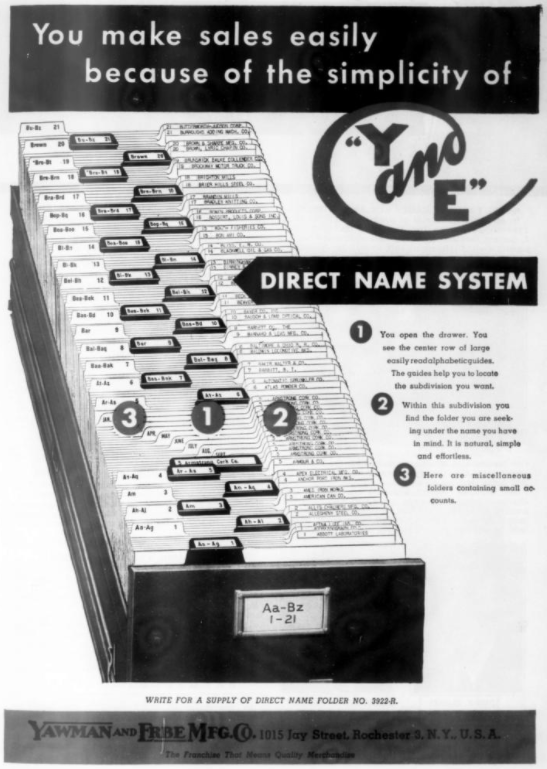
Yawman & Erbe Manufacturing Company
https://mycompanies.fandom.com/wiki/Yawman_%26_Erbe_Manufacturing_Company
Some fascinating advertisements for Yawman and Erbe
Because it's easy money. You just set up OpenVPN on a few servers, and essentially start reselling bandwidth with a markup.
How to start a VPN business
Business ModelWill I get charged at some point? How do you make money to run this product?TBD
"TBD 🚀🚀🚀" is such a bad indication for the future of a product
spamming open-source as a growth strategy is a super bad idea
Decision-making in uncertainty | BPS. (n.d.). Retrieved November 22, 2021, from https://www.bps.org.uk/events/decision-making-uncertainty
In the end, universities live off of being exclusive.
Annotate Books has added a 1.8-inch ruled margin on every page. The ample space lets you to write your thoughts, expanding your understanding of the text. This edition brings an end to does convoluted, parallel notes, made on minute spaces. Never again fail to understand your brilliant ideas, when you go back and review the text.
This is what we want to see!! The publishing company Annotate Books is republishing classic texts with a roomier 1.8" ruled margin on every page to make it easier to annotate texts.
It reminds me about the idea of having print-on-demand interleaved books. Why not have print-on-demand books which have wider than usual margins either with or without lines/grids/dots for easier note taking and marginalia?
many of their parents are still paying back their student loans.
Harris said this model is often better for the textbook authors OpenStax works with, whom Harris called "the long tail" behind the minority of financially successful academic authors -- those who wouldn't necessarily sell enough units to make a lot in royalties, but who are committed to their work nonetheless.
"We are fully committed to providing affordable, high-quality learning solutions for students," Joyner said. "We are excited to think openly and collaboratively with key partners like OpenStax to ensure that we, and our authors, are able to reach as many students as possible in new and highly accessible ways."
5 ERP system examples (who benefits from ERP?)
The term EnterpriseResourcePlanning (ERP) system refers to a large number of integrated softwaresuites used by companies to manage day-to-day operations and business workflows, including datamanagement, inventory control, accounting, CRM, and projectmanagement. Thus, in order to remain an effective contender in an era of digital commerce, ERP_systems are an important part of the business information technology infrastructure.

The guru of community-led products is Greg Isenberg. I follow his content religiously. Why? The future of business won’t be customer-led. Nope. It’ll be community-led. Customers are transactional. They care about price. They shop around for the best deal.
Is the future of business something that is someting you've seen or read elsewhere (except out of the mouth of the undoubtedly rhetorically gifted Greg. But i have not actually looked for othe best deal for something in a community - or does that also mean checking reddit /r/tabletbrand to see what is wrong with it? what is the involvement for it to be a community...
The WhatsApp UI sucks, but they took the hit on UI to focus on reliable sending and fast growth. Those are arguably the features that win over users, not UI.
At the end, the top priority is solving problems for users.
The way I think about things, consider FB a giant fly-wheel.... You want the external edge to move very quickly and iteratively -- and small dings when you get things wrong don't cost much, but the deeper you go in the stack / towards the infrastructure core (and really the human capital core even below that), you want things to move more slowly and predictably.
This is an interesting analogy
“The idea makes sense, but perhaps the timing was bad,” says the art market economist and author Magnus Resch, who in June published the book How To Create And Sell NFTs. “Prohibitively high prices and a complicated entry into collecting are the biggest problems with NFTs. But by holding events and educating people you’re building trust.”
A lot of the crypto/web3 ideas focus on "exiting" the physical world status quo. However, being more inclusive seems to be a better way to help better adoption of web3.
Opening up physical galleries feels very expensive, though.
https://www.youtube.com/watch?v=7s4xx_muNcs
Don't recommend unless you have 100 hours to follow up on everything here that goes beyond the surface.
Be aware that this is a gateway for what I'm sure is a relatively sophisticated sales funnel.
Motivational and a great start, but I wonder how many followed up on these techniques and methods, internalized them and used them every day? I've not read his book, but I suspect it's got the usual mnemonic methods that go back millennia. And yet, these things are still not commonplace. People just don't seem to want to put in the work.
As a result, they become a sales tool with a get rich quick (get smart quick) hook/scheme. Great for Kwik's pocketbook, but what about actual outcomes for the hundreds who attended or the 34.6k people who've watched this video so far?
These methods need to be instilled in youth as it's rare for adults to bother.
Acronyms for remembering things are alright, but not incredibly effective as most people will have issues remembering the acronym itself much less what the letters stand for.
There seems to be an over-fondness for acronyms for people selling systems like this. (See also Tiago Forte as another example.)
It was as if Silicon Valley had made a secret pact to subsidize the lifestyles of urban Millennials. As I pointed out three years ago, if you woke up on a Casper mattress, worked out with a Peloton, Ubered to a WeWork, ordered on DoorDash for lunch, took a Lyft home, and ordered dinner through Postmates only to realize your partner had already started on a Blue Apron meal, your household had, in one day, interacted with eight unprofitable companies that collectively lost about $15 billion in one year.
...but we'll make up for it in volume.
why is the moment you ask someone is a woman as electable as a man how come the moment you ask that everything changes yeah this is this was one of those really remarkable we didn't do this 00:21:01 research so i can brag about it right right it's regina bateson this is really fantastic research looking at gender bias in politics right because it's unbelievable 00:21:14 like women are so underrepresented in intellectual politics it's just you can't it's but like here's the thing like it's important to understand what's driving that and and for sure let's just be clear just straight up sexism 00:21:27 certainly is involved sometimes like that that's certainly the case but what what uh dr bateson found what i think was really fascinating is that given our winner-take-all um like sort of two-party system 00:21:41 so much is dependent on what the gatekeepers think who who because now like if we were doing something like ranked choice voting it doesn't really matter i don't have to care what i think anybody else thinks right but in a winner-take-all system i 00:21:54 have to do a little bit of guessing about who do i think most people are going to vote for right because otherwise my vote is quote unquote wasted right if i take a flyer on that so what was interesting is if you look at how women perform when they are 00:22:08 nominated in general elections women win at the same rate as white men it's just so i suggest obviously it's not a general election problem and what what she found was that it was like 00:22:20 party leaders especially donors right they're like well wait a minute i'm not sexist but i think most people in the party are so i don't think you're going to be able to win and so they don't get the support they don't get the the 00:22:32 resources and it becomes self-fulfilling it's so clear when you put it that way how that becomes a self-fulfilling prophecy but there there is so much pressure within certain groups to say this the the dominant ideology and just 00:22:44 like don't like if you can't it's like a cult right because like the second you question maybe you're like what does the evidence actually show they're like you're out you're not being loyal um wow 00:22:57 yeah so that's it's actually um in the book i i was looking at what i call these conformity traps like these these three kinds of situations where you are likely to slip into blind conformity and you are quite likely to do that 00:23:10 under an illusion to begin with and you know this this sort of identity trap where you've got these groups that matter so much to who you are right and and especially when it's just one group that group has cult-like power 00:23:23 over you
In summary, women don't do well in politics (and probably business) due to a collective illusion effect of the gatekeepers who believe everyone else thinks that they are rocking the boat.
Groups can influence a cult like power on individual group members.
Free public projects private projects starting at $9/month per project
For many tools and apps payment for privacy is becoming the norm.
Examples: - Kumu.io - Github for private repos - ...
pros: - helps to encourage putting things into the commons
cons: - Normalizes the idea of payment for privacy which can be a toxic tool.
discuss...
The 6 Business Objectives of SaaS
The main business objectives of a company are to address the problems and needs of their customers with products or services that are a solution for them. The importance of technology in our daily lives means that we simply cannot ignore SaaS when it comes to running our business.

Templates for recurring projects.
Food for thought.
How do companies that produce goods (light notebooks and graph paper) turn a profit? (For either of the two aforementioned examples, anyone can make their own from possibly cheaper primitives. Making graph paper, for example, is just putting lines on paper.)
Those goods being disposable and tangibly/temporally "rivalrous" in the physical world is one part of it, but it's not everything. People pay for convenience. (Look to e.g. paid Netflix subscriptions versus just pirating the stuff.) "Buy this ready-to-consume ebook" is one example of potentially profitable convenience that has made at least some inroads with the general public. Why shouldn't "buy this ready-to-use template" belong to the same set? Yeah, you could make your own, but this is graph paper.
design reviews exist to persuade stakeholders that you’re offering the best solution at the intersection of customer and business needs.
Shenkar wouldlike to see students in business schools and other graduate programs taking
courses on effective imitation.
If imitation is so effective, what would teaching imitation to students look like in a variety of settings including, academia, business, and other areas?
Is teaching by way of imitation the best method for the majority of students? Are there ways to test this versus other methods for broad effectiveness?
How can we better leverage imitation in teaching for application to the real world?
An alternative kind of note-taking was encouraged in the late Middle Agesamong members of new lay spiritual movements, such as the Brethren of theCommon Life (fl. 1380s–1500s). Their rapiaria combined personal notes andspiritual reflections with readings copied from devotional texts.
I seem to recall a book or two like this that were on the best seller list in the 1990s and early 2000s based on a best selling Christian self help book, but with an edition that had a journal like reflection space. Other than the old word rapiaria, is there a word for this broad genre besides self-help journal?
An example might be Rhonda Byrne's book The Secret (Atria Books, 2006) which had a gratitude journal version (Atria Books, 2007, 978-1582702087).
Another example includes Rick Warren's The Purpose Driven Life (Zondervan, 2002) with a journal version (Zondervan, 2002, 978-0310807186).
There's also a sub-genre of diaries and journals that have these sort of preprinted quotes/reflections for each day in addition to space for one to write their own reflections.
Has anyone created a daily blogging/reflection platform that includes these sorts of things? One might repurpose the Hello Dolly WordPress plugin to create journal prompts for everyday writing and reflection.
Referencebooks also typically offered a larger collection of excerpts than most individualscould amass in a lifetime.
This makes me wonder if it would be a useful product to have a highly linked note collection to sell to others in a modern context? It could be done entirely in text files for compatibility with Roam Research, Obsidian, Logseq, et al. Ideally it would be done in a more commonplace way with quotes and interlinked and could be expanded upon by the purchaser.
Mackenzie County won’t contract businesses with ‘coercive’ COVID-19 vaccine mandates, reeve says. (n.d.). Edmontonjournal. Retrieved 28 February 2022, from https://edmontonjournal.com/news/local-news/mackenzie-county-wont-contract-businesses-with-coercive-covid-19-vaccine-mandates-reeve-says
Hur, K. (2022, February 16). Restaurateur says he spends around $750,000 on security to deal with unruly diners. CNBC. https://www.cnbc.com/2022/02/16/restauranteur-says-he-spends-around-750000-on-security-to-deal-with-unruly-diners.html
Gap analysis in 4 steps
Instead of groping around in the dark, a gap analysis of the gap leads us through a detailed investigation of where our organization is currently and where we want to be. This allows us to act on the basis of facts, not on the basis of assumptions.

integrierten IT-basierten Management- und Entscheidungsunterstützung (Business Intelligence)
Business Intelligence
Major COVID course correction immediately required. (n.d.). Retrieved February 7, 2022, from https://ozsage.org/media_releases/major-covid-course-correction-immediately-required/
Therefore, they were frequently used as lottery tickets, marriage and death announcements, notepads, or busi-ness cards.
With blank backs, French playing cards in the late 1700s were often used as lottery tickets, marriage and death announcements, notepads, and business cards.
Smith, J., & Duncan, P. (2022, February 3). Firms handed £1.3bn in Covid contracts claimed £1m in furlough grants. The Guardian. https://www.theguardian.com/uk-news/2022/feb/03/dozen-uk-companies-given-vip-covid-ppe-contracts-also-claimed-furlough-grants
Most writing is chasing clout, rather than insight
As the result of online business models and SEO, most writing becomes about chasing clout and audience eyeballs rather than providing thought provoking insight and razor sharp analysis. The audience reaction has weakened with the anger reaction machines like Twitter.
We need better business models that aren't built on hype.
Founded in partnership with a team of entrepreneurial journalists who believe in a better model to create excellent content while narrowing the synapse between elite creators and their audiences.
http://puck.news/who-is-puck/
Another platform play of journalists banding together to find a niche space of readers.
Aligning editorial mission and business model is critical.
One of the most complex questions in journalism in the past decade or more is how can one best align editorial mission with the business model? This is particularly difficult because the traditional business model(s) have been shifting in the move to online.
Axios Pro is bundling newsletters together in a high-priced subscription product ($2,500 for the bundle; $599 each) aimed squarely at deep-pocketed investors.
Old business advice: find the rich and charge them a pretty penny for something they either think they need or fear they can't live without.
The finding is supported by a related spike in face-lifts when elective surgeries opened last summer.
Booming time to start a plastic surgeon affiliate marketing business targeted at frequent Zoom callers!
Even major corporations such as Qantas Airlines, Red Bull, and the Los Angeles Clippers have started putting a Linktree in their Instagram and TikTok bios, Anthony Zaccaria, Linktree’s co-founder and chief commercial officer, told me. These companies all have expensive websites, but he said that link-in-bios have come to represent a space in between social media and websites: a regularly updated page where artists can plug their new music, airlines can promote their new flight routes, and even non-influencers can list out the TV shows they’re currently watching. While a traditional website might remain relatively static over time—an airline like Qantas, for instance, is always going to want its flight-booking tool to be front and center—a link-in-bio is a sort of ever-shifting homepage, the ideal spot for brands and influencers to house updates or tout new products.
Who says the link in bio needs to go to a company's homepage? Why couldn't it be a custom landing page geared toward the social media site the link is placed on?
The reasoning here is completely false.
Elliott, L., & editor, L. E. E. (2022, January 24). Omicron pushes UK business growth to 11-month low. The Guardian. https://www.theguardian.com/business/2022/jan/24/uk-business-growth-omicron-covid-variant-january
Is ITIL Losing Importance Due To SaaS?
ITIL is a set of procedures and practices of IT service management when we mistakenly believe that we don't have to worry about that in SaaS. However, ITIL has many aspects and facets that encompasses running IT in an organization. Moreover, it is not a checklist for the implementation of specific services in specific environments. For SaaS, we can just use a different toolset to follow the general ITIL guidelines.
Prof. Gavin Yamey MD MPH. (2022, January 10). Yes, Neoliberal John Snow wins the Internet today 👏 H/T @gregggonsalves Reminds me of this…. Https://t.co/zt9tINBxal [Tweet]. @GYamey. https://twitter.com/GYamey/status/1480527550531186696
An interesting coming book grouping various application issues (business, crime, military and terrorism).
Prof. Christina Pagel. (2022, January 19). This makes it so clear that the release of all measures right now (esp masks, esp schools) is only to protect himself & his job. Boris has zero interest in protecting others from getting sick, needing hospital or dying. Or protecting businesses, schools, NHS from disruption. [Tweet]. @chrischirp. https://twitter.com/chrischirp/status/1483884632651313152
How to Write a Sales Letter
Follow the the methods of 'HOPPP'
Mailspring isn't VC funded and doesn't need to make millions to succeed. Just a thousand paid subscriptions will make Mailspring a stable business and we have big ideas for the future of email.
When a product manager trusts that the engineers on the team have the interest of the product at heart, they also trust the engineer’s judgment when adding technical tasks to the backlog and prioritizing them. This enables the balanced mix of feature and technical work that we’re aiming for.
Why is it so common for engineering teams to be mistrusted by other parts of the business?
Part of that is definitely on engineers: chasing the new shiny, over-engineering, etc.
That seems unlikely to account for all of it, though.
The Business Strategy stems from a detailed strategic planning process. However, the question we want to answer in this article is whether we can execute multiple strategies side by side while they do not interfere with each other. We compare multiple strategies for business, information provision and IT and focus on Strategic planning.
Business strategy alignment and the secrets of strategic planning https://en.itpedia.nl/2022/01/02/business-strategie-alignment-en-de-geheimen-van-strategische-planning/ The Business Strategy stems from a detailed strategic planning process. However, the question we want to answer in this article is whether we can execute multiple strategies side by side while they do not interfere with each other. We compare multiple strategies for business, information provision and IT and focus on Strategic planning.
Warning: End-of-year exhaustion coming. We can receive some advice to assist us in expanding our company while preserving your creative spark. 
Kim Willsher. (2021, December 16). Let’s try again...new “drastic” regulations for anyone planning to come to France from UK. There must be a “compelling” reason. This does not include tourism or business French nationals/residents can return but must have a negative Covid test within 24hrs before departure. 1/2 [Tweet]. @kimwillsher1. https://twitter.com/kimwillsher1/status/1471401803828764682
Green computing, or green information technology, is the practice of environmentally sustainable computing. In this article we take a closer look at: * Greening the workplace. * A green workplace business case. * Opportunities to make Data Centers greener by: - Other IT equipment. - The cooling of IT spaces. - The data center buildings.
Green computing : Workplace and data center, a real business case
https://en.itpedia.nl/2021/12/11/green-computing-werkplek-datacenter-business-case/
Green computing, or green information technology, is the practice of environmentally sustainable computing. In this article we take a closer look at: Greening the workplace. A green workplace business case. * Opportunities to make Data Centers greener by: - Other IT equipment. - The cooling of IT spaces. - The data center buildings.

That being said, often rental properties don’t generate significant amounts of net income after deducting mortgage interest and other expenses including property tax, insurance and repairs.
Does that mean you don't pay much taxes at least while you're paying mortgage on the property? Maybe but remember that you can only claim the mortgage interest not the mortgage principal.
Much of the taxes paid are refundable and can be recovered if you pay yourself a dividend, which must then be declared on your personal taxes.
Look into how this works
A corporation whose principal purpose is to derive income from property is usually considered a specified investment business, and is not eligible for the small business deduction.
What happens in my case? Would the principal purpose be categorized as mentorship or investment.
Corporations generally pay tax at about 50% on net rental income, and at about 25% on a rental property capital gain (rates differ by province). This is similar to what a top-rate taxpayer might pay if they owned the same property personally. Therefore, many people would pay less tax to own a rental property personally instead of corporately, and could also avoid the cost and complexity of the corporate structure.
If that's true then it makes no sense to run a rental business through your corporation.
Critics of petition against COVID-19 measures say it is grounded in hyperbole and misinformation. (n.d.). Retrieved December 9, 2021, from https://www.canadianlawyermag.com/news/general/critics-of-petition-against-covid-19-measures-say-it-is-grounded-in-hyperbole-and-misinformation/362441
Standard algorithms as a reliable engine in SaaS https://en.itpedia.nl/2021/12/06/standaard-algoritmen-als-betrouwbaar-motorblok-in-saas/ The term "Algorithm" has gotten a bad rap in recent years. This is because large tech companies such as Facebook and Google are often accused of threatening our privacy. However, algorithms are an integral part of every application. As is known, SaaS is standard software, which makes use of algorithms just like other software.

Should Financial Executives lead the IT department? A bit of IT-financials thinking... https://en.itpedia.nl/2021/11/23/moeten-financial-executives-leiding-geven-aan-de-it-afdeling/
Rattner, N. (2021, October 28). Some 5% of unvaccinated adults quit their jobs over Covid vaccine mandates, survey shows. CNBC. https://www.cnbc.com/2021/10/28/covid-vaccine-some-5percent-of-unvaccinated-adults-have-quit-their-jobs-over-a-mandate-survey-shows.html
Dogadać się z firmami z podobnej branży i umieszczać u siebie zdjęcia ich produktów, bez żadnego kodu. Napisać czasem (odpowiednio oznaczony) artykuł sponsorowany. Dodać link do bezpośrednich wpłat na swoje konto. Pomysłów jest multum. Niestety wielu wybrało najłatwiejszą opcję i podpięcie się pod globalne sieci reklamowe. Niekoniecznie zyskują na tym „partnerstwie”. Elementy reklamowe zbierają informacje o użytkownikach nawet jeśli ich nie klikniemy (a zatem i tak nie przyniesiemy zarobków właścicielom stron).
Why it's worth to use ad blockers & how site owners could replace this business model
10 Ideas to Start a SaaS Business in 2021
Software as a service, or SaaS, is one of the most promising business models in 2021. It’s popular among entrepreneurs, investors, and customers alike. Learn about the most promising ideas you can tap into to build your own SaaS startup and make it successful.
also into business models that can better serve the interests of both students and educators.
We are at a point in time where we need to reflect on our business practices. The question should be who are we serving and how do we show we are serving them.
A common good (CG) process begins with an initiator proposing the production of a common good. Then, during the predefined lifetime of the process, funders who care about this common good may pledge funds for its production, being reassured that their money will only be used retroactively, had the common good been eventually produced — no risk taken. Executors who wish to produce the common good may do so, being reassured that they will be compensated by the pledged funds had they been successful. And profit-seeking investors may buy a portion of the potential reward from executors (in the form of per-executor tokens that are made redeemable against the future reward had they been successful), and by that provide them with liquid funding for operation. Finally, if and when executors achieve the desired outcome, as decreed by a predefined judge, the pledged funds are released as a reward to the successful executors and the investors who bought their tokens. If no success has been reached after some predefined limit of time, the funds go back to the funders who provided them. Executors and investors only see profit, and funders only spend it, if and only when the common good is produced.
A trustless conditional reward model for production of common goods.
In the future envisioned here, decentralized networks play the role of governments, municipalities and intentional commons, fostering common goods. It is possible to produce common goods when a big-enough community cooperates to bear the cost of production and its implementation; but this, correspondingly, requires large-scale coordination, and large-scale coordination is generally a very hard problem. In this article we introduce Common Good, a blockchain-based application that solves this problem by enabling the coordination and motivation of different relevant actors for achieving a desired common good, by providing it with a “business model” just as in the profit-seeking sector. Our solution takes inspiration from the Social Impact Bonds (SIB) model.
A proposal to use decentralized blockchain to make large scale coordination possible.
The best part is you can start your transportation business with one single van and later expand as you grow. We’ll talk more on this later in the blog.
Visualize and communicate a simple story of your business model.
Lean Canvas is a 1-page business plan template created by Ash Maurya that helps you deconstruct your idea into its key assumptions. It is adapted from Alex Osterwalder's Business Model Canvas and optimized for Lean Startups. It replaces elaborate business plans with a single page business model.
The lean canvas is an adaption of Alex Osterwalder’s “Business Model Canvas” which he describes in his book: “Business Model Generation”
Lean Canvas has been adapted by Ash Maurya from the very popular Business Model Canvas by Alexander Osterwalder
US to lift Covid travel ban for vaccinated passengers from UK and most of EU | US immigration | The Guardian. (n.d.). Retrieved September 21, 2021, from https://www.theguardian.com/us-news/2021/sep/20/us-travel-ban-lifted-uk-eu-flights-allowed-vaccinated-latest-covid-restrictions
Let me in you on a big secret. You can start a car rental business with a large fleet of vehicles, a single car, or even without owning any cars.
Morris, S. (2021, August 26). ‘It’s really hit us now’: Newquay becomes England’s Covid capital. The Guardian. http://www.theguardian.com/uk-news/2021/aug/26/newquay-cornwall-becomes-england-covid-capital
“The real economics of college have shifted so much during the last 70 years, and we have not made adjustments to all those changes. Students are in an equation that has not adapted to the circumstances.”
Peters, Adele, Adele Peters, and Adele Peters. “Turning Empty Office Buildings into Housing Could Instantly Transform Post-COVID Cities.” Fast Company, July 30, 2021. https://www.fastcompany.com/90659901/turning-empty-office-buildings-into-housing-could-instantly-transform-post-covid-cities.
a technology that uses waste wood products to produce ethyl levulinate, which it says is a carbon-neutral substitute for home heating oil.
Open source is not a good business model.If you want to make money do literally anything else: try to sell software, do consulting, build a SAAS and charge monthly for it, rob a bank.
Open-source software is not money friendly
https://blog.jonudell.net/2021/07/21/a-virtuous-cycle-for-analytics/
Some basic data patterns and questions occur in almost any business setting and having a toolset to handle them efficiently for both the end users and the programmers is an incredibly important function.
Too often I see businesses that don't own their own data or their contracting out the programming portion (or both).
Ben: The business started blossoming when we were in Texas. I had told my wife to give me…Within five years we'll have a house and we'll both have good vehicles, dependable vehicles, but it's going to take a while. Well within a year and a half from when I started, we bought out first house and we both had good, dependable vehicles. However, it was still tight when I took a project on in Akron, Ohio. And when I took that project on, I did not want to go up there for many reasons. One, because I had this immigration issue on me and I'm going near the Canadian border. Another, I didn't really want to be away from my family.Ben: But when these customers get persistent, "What's it going to take? What's it going to take?" And I said, "It's just out of the question. I can't go up there, I got all these jobs going on. Plus, I got bad equipment, my equipment’s old and if my equipment breaks down up there, I'm not going to be able to meet the schedules and we're all going to be in trouble.” "Is that it? Really?" The last price he had upped the price of what the contract was to pay, and the pay was fine. I had other reasons why I didn't want to go. Well when he says, "I'll throw in a brand-new texture machine on top of it, but I'll sign off on the paperwork after you complete the project.” And I go, "You'll do that?" "I'll do that and when have you known me to not keep my word?" And I go, "Done deal.”Ben: One of those texture machines, the price tag at that time was about $30,000. Right now, it's probably closer to $40,000 because we're talking about 1996. And he followed through, I came up to Akron, when I got up to Akron though, they had projects, there were projects everywhere, Kentucky, Michigan. And the pay, the pay was awesome. And that is where it really, within I think about the second month that I was up north, it just completely changed.Ben: But I hadn't seen my wife and children since I had taken off up there. So, I told her to come up there and visit and I started discuss with her. I go, "Look these other jobs,” and I had already said I was going to take them, but I didn't tell her that. I told her, she says, "What if you go to be traveling?" I go, "It's worth it to be traveling back and forth, but I'm not going to be traveling back and forth. We're going to just take the kids; we're going to move up here and we're going to be together".Ben: And so that's when I moved them to Indianapolis. We stationed in Indianapolis although I did travel quite a bit. I was on the road quite a bit because I had later ended up with jobs as far down as Orlando, Florida. And I ended up in New Orleans after Hurricane Katrina to repair a bunch of apartments which we had worked on before. But it was a pretty wild ride, but we really were doing really well, and it was really amazing.
Time in the US, Jobs/employment/work, Small business owner, Earnings, Careers, Construction; Time in the US, States, Texas, Indiana, Louisiana, Florida, Ohio
Anne: So, you were in Texas initially, is that where you got married?Ben: Yes, in Texas.Anne: Your wife. When did the business start blossoming to help you move out of Texas?
Time in the US, States, Texas
Policy Opportunities for the Remote Economy | Upwork. (n.d.). Retrieved July 2, 2021, from https://www.upwork.com/press/releases/policy-opportunities-for-the-remote-economy
Covid-19 jabs for staff “should be our call” say 58% of UK managers | Business | The Guardian. (n.d.). Retrieved June 28, 2021, from https://www.theguardian.com/business/2021/mar/17/covid-19-jabs-for-staff-should-be-our-call-say-58-of-uk-managers?CMP=Share_iOSApp_Other
Do add business logic to helpers or utilities, so you can test them separately from your component.
Essley Whyte, L. (2021, June 8). Spreading Vaccine Fears, And Cashing In. HuffPost UK. https://www.huffpost.com/entry/anti-vaccine-influencers_n_60be36b9e4b0ea8a1920d73f
Enter the AudioPiLe: The Hardware
Is this the Sonos-killer box?
In a way, the essential premise of the collab-house business model is not far from that of pornographic entertainment. (Where else do talent and crew and cadres of management congregate in furnished mansions to produce intimate content?) Interestingly, but maybe not surprisingly, many TikTok influencers, including some here at the Clubhouse, have made the crossover from social media to pornography, using apps such as OnlyFans to post nude pics for their legions of subscribers.
Later in my visit, Chase Zwernemann, the twenty-one-year-old VP of talent management, will tell me that “we really see ourselves like influencing professors.” And if this weren’t enough, under the Clubhouse aegis is a trio of TikTok houses, each of which corresponds, apparently, to a different level of academe. There’s Clubhouse BH—the grad school—which is meant for “our more seasoned influencers.” (If this phrase conjures for you images of geriatrics taking selfies in suggestive postures, please know that by “seasoned influencers” they simply mean people who have been in the business a while and have thus reached the ripe old age of twenty-two or twenty-three.) Beneath that is Clubhouse FTB, which apparently serves as the undergraduate program. And finally, there’s Not a Content House, the high school of the Clubhouse venture, one meant to appeal to an even younger demographic.
He uses academe, but I might liken it to a studio system of sorts.
Microsoft 365 Business Standard and Microsoft 365 Business Premium plans will include all the features above for up to 300 attendees
In viewing academia as a business, you should always give customers what they want, and this applies on two levels. First, always consider the demand for the research product. This is much easier said than done. Anyone can acknowledge that the customers are always right, but truly listening to them and extracting what they need is difficult, especially if you have your own personal desires with respect to the product (in this case, the research). Talk to the funding customer constantly. Second, most students are, in effect, employees, and the adviser is a boss who doubles as a customer. In some respects, your adviser will provide your pay cheque, or at least govern it. Thus, do what the customer requires. In addition, always consider your audience when writing and presenting. In the case of a thesis, the audience is your adviser and committee. Again, talk to the customers constantly.
Anyone who treats research as a business tends not to be well received in academia, but they likely have the funding necessary to drive advances, and they may eventually be wealthy.
There can be clear benefits to treating academia like a business.
Derek Thompson. (2021, May 17). Weeks ago, Gov. Abbott made Texas the first state to abolish its mask mandate and lift capacity constraints for all businesses. So, what changed? Nothing. There was ~no effect on COVID cases, employment, mobility, or retail foot traffic, in either liberal or conservative areas. Https://t.co/M8aeKOKJuP [Tweet]. @DKThomp. https://twitter.com/DKThomp/status/1394294260787261447
Substack insists that advances are determined by “business decisions, not editorial ones”. Yet it offers writers mentoring and legal advice, and will soon provide editing services.
Some evidence of Substack acting along the lines of agent, production company, and studio. Then taking a slice of the overall pie.
By having the breadth of the space they're able to see who to invest in over time, much the same way that Amazon can put smaller companies out of business by knocking off big sales items.
Record labels are another endangered middleman. They have historically taken care of turning a song into a hit, in return for an ongoing share of revenues. But more and more artists are going it alone. More than 60,000 new songs are uploaded to Spotify every day, most by bedroom-based rockstars who can use new online services to handle the logistics themselves. UnitedMasters, a music-distribution platform which bills itself as “a record label in your pocket”, recently raised $50m in a venture-capital round led by Apple. Tools like Splice make recording easier. Companies like Fanjoy take care of merchandise.And financing is getting simpler. One startup, HIFI, helps artists manage their royalties, paying them regularly and fronting them small sums to make up shortfalls. Another, Karat, extends credit to creators based on their follower count. Helped by such services independent artists took home 5.1% of global recorded music revenues last year, up from 1.7% in 2015, calculates MIDiA Research, a consultancy. In the same period the share of the three largest record labels fell from 71.1% to 65.5%.
The same sort of dis-aggregation and disintermediation that has hit the publishing business is also taking place to newspapers, magazines, and music.
The question is how to best put the pieces of the pie together in the best way possible. There's probably room for talented producers to put these together to better leverage the artists' work.
Alon, T., Doepke, M., Olmstead-Rumsey, J., & Tertilt, M. (2020). This Time It’s Different: The Role of Women’s Employment in a Pandemic Recession. IZA Discussion Paper, 13562.
The Economic Impacts of COVID-19: Evidence from a New Public Database Built Using Private Sector Data. (2020, May 7). Opportunity Insights. https://opportunityinsights.org/paper/tracker/
We know the audience for such games is limited. In order for us to produce games up to our standards, we rely on a direct sales model. Our games are not designed for traditional distribution or retail channels. The vast majority of all copies produced will be sent to Kickstarter backers or to people who purchase games through our store. This means we can spend many more resources on the game's physical production without having to worry about retail viability.
Only the Starter Kit is available in this reboot. The Starter Kit is FREE, in order to distribute it as widely as possible. This goal of this Kickstarter campaign is to introduce Clash of Deck to the whole word and to bring a community together around the game. If the Kickstarter campaign succeeds, we will then have the necessary dynamic to publish additional paid content on a regular basis, to enrich the game with: stand-alone expansions, additional modules, alternative game modes..
Paywall success stories are a mix of specialized news, often catering to the ultrawealthy (WSJ), superstar news orgs focused on specific national and international news (NYT) or news with billionaire backstops (WP). The civic function of news is not met by any of these models. But reader-supported, open access news, like Canadaland and The Halifax Examiner are filling in the gaps. The co-op model is a most welcome adjunct to these success stories.
List of business models for news.
BBC Worklife. (2020, October 23). Coronavirus: How the world of work may change forever. https://www.bbc.com/worklife/article/20201023-coronavirus-how-will-the-pandemic-change-the-way-we-work
‘Chinatown Businesses Face a Particularly Brutal Winter’. Bloomberg.Com, 7 December 2020. https://www.bloomberg.com/news/articles/2020-12-07/covid-19-has-been-a-disaster-for-u-s-chinatowns.
U.S. Census Bureau. (2021, February 4). Small Business Pulse Survey Shows Shift in Expectations from Spring to Winter. The United States Census Bureau. https://www.census.gov/library/stories/2021/01/small-business-pulse-survey-shows-shift-in-expectations-from-spring-to-winter.html?utm_campaign=20210126msacos1ccstors&utm_medium=email&utm_source=govdelivery
Boutin, P. (2020, July 29). The Great Reset is here, like it or not. Dropbox Blog. https://blog.dropbox.com/topics/work-culture/the-great-reset-is-here
Goolsbee, Austan, and Chad Syverson. ‘Fear, Lockdown, and Diversion: Comparing Drivers of Pandemic Economic Decline 2020’. Journal of Public Economics 193 (1 January 2021): 104311. https://doi.org/10.1016/j.jpubeco.2020.104311.
Wolf, Martin. ‘Ten Ways Coronavirus Crisis Will Shape World in Long Term’, 3 November 2020. https://www.ft.com/content/9b0318d3-8e5b-4293-ad50-c5250e894b07.
2021 Edelman Trust Barometer. (n.d.). Edelman. Retrieved February 17, 2021, from https://www.edelman.com/trust/2021-trust-barometer
Loolu sa afeer la.
C'est ton affaire.
loolu -- that.
sa -- your.
afeer bi -- (French: "affair") case.
la -- the (?).