After backlash on social media, Meta abolished the internal leaderboard last week.
Meta在社交媒体上的负面反应导致其取消内部排行榜,这一事件表明社交媒体对企业管理决策的影响力。
After backlash on social media, Meta abolished the internal leaderboard last week.
Meta在社交媒体上的负面反应导致其取消内部排行榜,这一事件表明社交媒体对企业管理决策的影响力。
Hotez, P. J. (2021). America’s deadly flirtation with antiscience and the medical freedom movement. The Journal of Clinical Investigation, 131(7). https://doi.org/10.1172/JCI149072
Drury, P. J. (2021, December 31). the crowd: Three forms of Covid leadership. The Crowd. https://drury-sussex-the-crowd.blogspot.com/2021/12/three-forms-of-covid-leadership.html
Jones, C. M., Diethei, D., Schöning, J., Shrestha, R., Jahnel, T., & Schüz, B. (2021). Social reference cues can reduce misinformation sharing behaviour on social media. PsyArXiv. https://doi.org/10.31234/osf.io/v6fc9
Tang, J.-L., & Abbasi, K. (2021). What can the world learn from China’s response to covid-19? BMJ, 375, n2806. https://doi.org/10.1136/bmj.n2806
Al-Hasan, A., Khuntia, J., & Yim, D. (2021). Does Seeing What Others Do Through Social Media Influence Vaccine Uptake and Help in the Herd Immunity Through Vaccination? A Cross-Sectional Analysis. Frontiers in Public Health, 9, 1668. https://doi.org/10.3389/fpubh.2021.715931
Merchant, R. M., & Lurie, N. (2020). Social Media and Emergency Preparedness in Response to Novel Coronavirus. JAMA, 323(20), 2011–2012. https://doi.org/10.1001/jama.2020.4469
Clift, A. K., von Ende, A., Tan, P. S., Sallis, H. M., Lindson, N., Coupland, C. A. C., Munafò, M. R., Aveyard, P., Hippisley-Cox, J., & Hopewell, J. C. (2021). Smoking and COVID-19 outcomes: An observational and Mendelian randomisation study using the UK Biobank cohort. Thorax, thoraxjnl-2021-217080. https://doi.org/10.1136/thoraxjnl-2021-217080
(7) BUSPH COVID Corps—YouTube. (n.d.). Retrieved 4 August 2021, from https://www.youtube.com/channel/UC_VJ9KJ-9aLzZs4CeUahZ8g
Park, Jiwon, Seungmin Lee, Sunhae Sul, and Dongil Chung. “Depression Symptoms Mediate Mismatch Between Perceived Severity of the COVID-19 Pandemic and Preventive Motives.” Frontiers in Psychology 0 (2021). https://doi.org/10.3389/fpsyg.2021.650042.
The CDC Should Be More Like Wikipedia—The Atlantic. (n.d.). Retrieved July 23, 2021, from https://www.theatlantic.com/ideas/archive/2021/07/cdc-should-be-more-like-wikipedia/619469/
Ortiz, E., & Serrano, M. Á. (2021). Multiscale opinion dynamics on real networks. ArXiv:2107.06656 [Physics]. http://arxiv.org/abs/2107.06656
Living normally, with Covid-19: Task force ministers on how S’pore is drawing road map for new normal, Opinion News & Top Stories—The Straits Times. (n.d.). Retrieved June 29, 2021, from https://www.straitstimes.com/opinion/living-normally-with-covid-19
The Anti-Vaxx Playbook | Center for Countering Digital Hate. (n.d.). Retrieved June 26, 2021, from https://www.counterhate.com/playbook
Teague, S., Shatte, A. B. R., Fuller-Tyszkiewicz, M., & Hutchinson, D. M. (2021). Social media monitoring of mental health during disasters: A scoping review of methods and applications. PsyArXiv. https://doi.org/10.31234/osf.io/ykz2n
Doctors for XR on Twitter: “https://t.co/OwN3VQsGqw @richardhorton1 speaking to @DrTedros today on video link at #WHA74 about the similarities of #COVID19 and #climatecrisis and the cost of inaction. This before Tedros addressed Doctors + Nurses protesting at the WHO. #WHO #RedAlertWHO https://t.co/yComw7YNR3” / Twitter. (n.d.). Retrieved June 6, 2021, from https://twitter.com/DoctorsXr/status/1398656730570145796
Wellenius, G. A., Vispute, S., Espinosa, V., Fabrikant, A., Tsai, T. C., Hennessy, J., Dai, A., Williams, B., Gadepalli, K., Boulanger, A., Pearce, A., Kamath, C., Schlosberg, A., Bendebury, C., Mandayam, C., Stanton, C., Bavadekar, S., Pluntke, C., Desfontaines, D., … Gabrilovich, E. (2021). Impacts of social distancing policies on mobility and COVID-19 case growth in the US. Nature Communications, 12(1), 3118. https://doi.org/10.1038/s41467-021-23404-5
Beaumont, P. (2021, April 22). Covid-19: India’s response to second wave is warning to other countries. The Guardian. https://www.theguardian.com/world/2021/apr/22/covid-19-india-response-to-second-wave-is-warning-to-other-countries
BMJ GH Blogs. ‘An Effective National Response to COVID-19: What Not to Learn from Sweden’. BMJ Global Health blog, 1 November 2020. https://blogs.bmj.com/bmjgh/2020/11/01/covid-19-what-not-to-learn-from-sweden/.
Karlsson, L. C., Soveri, A., Lewandowsky, S., Karlsson, L., Karlsson, H., Nolvi, S., … Antfolk, J. (2021, March 4). The Behavioral Immune System and Vaccination Intentions During the Coronavirus Pandemic. https://doi.org/10.31234/osf.io/r8uaz
Haslam, S. A., Steffens, N. K., Reicher, S., & Bentley, S. (2020). Identity leadership in a crisis: A 5R framework for learning from responses to COVID-19. PsyArXiv. https://doi.org/10.31234/osf.io/bhj49
Baum, F., Freeman, T., Musolino, C., Abramovitz, M., Ceukelaire, W. D., Flavel, J., Friel, S., Giugliani, C., Howden-Chapman, P., Huong, N. T., London, L., McKee, M., Popay, J., Serag, H., & Villar, E. (2021). Explaining covid-19 performance: What factors might predict national responses? BMJ, 372, n91. https://doi.org/10.1136/bmj.n91
Fischer, K., Chaudhuri, A., & Atkinson, Q. (2020, October 5). Responses to the COVID-19 pandemic reflect the dual evolutionary foundations of political ideology. https://doi.org/10.31234/osf.io/qeap8
ow the Coronavirus Recovery Is Changing Cities
Plosz. J., (2020/06/22)., How the Coronavirus Recovery Is Changing Cities. Retrieved from https://www.bloomberg.com/features/2020-city-in-recovery/?utm_medium=social&utm_campaign=socialflow-organic&utm_source=twitter&utm_content=citylab
Lau, P. Y. F. (2020). Fighting COVID-19: Social capital and community mobilisation in Hong Kong. International Journal of Sociology and Social Policy, ahead-of-print(ahead-of-print). https://doi.org/10.1108/IJSSP-08-2020-0377
Yang Chan, E. Y., Shahzada, T. S., Sham, T. S. T., Dubois, C., Huang, Z., Liu, S., Ho, J. Y., Hung, K. K. C., Kwok, K. O., & Shaw, R. (n.d.). Narrative review of non-pharmaceutical behavioural measures for the prevention of COVID-19 (SARS-CoV-2) based on the Health-EDRM framework. British Medical Bulletin. https://doi.org/10.1093/bmb/ldaa030
The HOPE-project (http://hope-project.dk ) tracks public opinion during #covid19, sharing findings with the public & authorities. This graph is the most concerning yet: The # willing to use an approved COVID-vaccine recommended for them
Burel, Gregoire; Farrell, Tracie; Mensio, Martino; Khare, Prashant and Alani, Harith (2020). Co-Spread of Misinformation and Fact-Checking Content during the Covid-19 Pandemic. In: Proceedings of the 12th International Social Informatics Conference (SocInfo), LNCS.
Coronavirus cases are rising again in the UK. Here’s what should happen next | Devi Sridhar. (2020, September 8). The Guardian. http://www.theguardian.com/commentisfree/2020/sep/08/coronavirus-cases-rising-uk-second-wave
Casoria, F., Galeotti, F., & Villeval, M. C. (2020). Perceived Social Norm and Behavior Quickly Adjusted to Legal Changes During the COVID-19 Pandemic (SSRN Scholarly Paper ID 3681204). Social Science Research Network. https://doi.org/10.2139/ssrn.3681204
Zheng, Q., Jones, F. K., Leavitt, S. V., Ung, L., Labrique, A. B., Peters, D. H., Lee, E. C., & Azman, A. S. (2020). HIT-COVID, a global database tracking public health interventions to COVID-19. Scientific Data, 7(1), 286. https://doi.org/10.1038/s41597-020-00610-2
Senior, J. (2020, July 21). Opinion | I Spoke With Anthony Fauci. He Says His Inbox Isn’t Pretty. The New York Times. https://www.nytimes.com/2020/07/21/opinion/anthony-fauci-coronavirus.html
Yu, X. (n.d.). Opinion | I’m from Wuhan. I got covid-19—After traveling to Florida. Washington Post. Retrieved 17 July 2020, from https://www.washingtonpost.com/opinions/2020/07/15/im-wuhan-i-got-covid-19-after-traveling-florida/
Using Social and Behavioral Science to Support COVID 19 Pandemic Response with Dr. Jay Van Bavel. (2020, May 7). https://www.youtube.com/watch?v=nuTPmaFsNrA
Beytía, P., & Infante, C. C. (2020). Digital Pathways, Pandemic Trajectories. Using Google Trends to Track Social Responses to COVID-19 [Preprint]. SocArXiv. https://doi.org/10.31235/osf.io/yndb7
Holtz, D., Zhao, M., Benzell, S. G., Cao, C. Y., Rahimian, M. A., Yang, J., Allen, J., Collis, A., Moehring, A., Sowrirajan, T., Ghosh, D., Zhang, Y., Dhillon, P. S., Nicolaides, C., Eckles, D., & Aral, S. (2020). Interdependence and the cost of uncoordinated responses to COVID-19. Proceedings of the National Academy of Sciences, 117(33), 19837–19843. https://doi.org/10.1073/pnas.2009522117
Stay-At-Home Orders, Social Distancing and Trust. COVID-19 and the Labor Market. (n.d.). IZA – Institute of Labor Economics. Retrieved August 5, 2020, from https://covid-19.iza.org/publications/dp13234/
Chang, D. C., & Stapleton, S. M. (2020). Response: The Proliferation and Misinterpretation of “As Safe As” Statements in Surgical Science: A Call for Professional Discourse to Search for a Solution. Journal of Surgical Research, 0(0). https://doi.org/10.1016/j.jss.2020.03.074
Hong, Jihoon, Ikjae Jung, Mingeol Park, Kyumin Kim, Sungook Yeo, Joohee Lee, Yujin Hong, Jangho Park, and Seockhoon Chung. ‘The Attitudes of Medical Students for Their Roles and Social Accountability in the COVID-19 Pandemic Era’. Preprint. PsyArXiv, 19 August 2020. https://doi.org/10.31234/osf.io/478ef.
Lewis, D. (2020). ‘We felt we had beaten it’: New Zealand’s race to eliminate the coronavirus again. Nature. https://doi.org/10.1038/d41586-020-02402-5
Brown, C. S., & Ravallion, M. (2020). Inequality and the Coronavirus: Socioeconomic Covariates of Behavioral Responses and Viral Outcomes Across US Counties (Working Paper No. 27549; Working Paper Series). National Bureau of Economic Research. https://doi.org/10.3386/w27549
Allcott, H., Boxell, L., Conway, J. C., Gentzkow, M., Thaler, M., & Yang, D. Y. (2020). Polarization and Public Health: Partisan Differences in Social Distancing during the Coronavirus Pandemic (Working Paper No. 26946; Working Paper Series). National Bureau of Economic Research. https://doi.org/10.3386/w26946
Ding, W., Levine, R., Lin, C., & Xie, W. (2020). Social Distancing and Social Capital: Why U.S. Counties Respond Differently to COVID-19 (Working Paper No. 27393; Working Paper Series). National Bureau of Economic Research. https://doi.org/10.3386/w27393
Bellafante, G. (2020, August 7). Lifestyles of the Rich and Reckless: Posh Pandemic Parties. The New York Times. https://www.nytimes.com/2020/08/07/nyregion/coronavirus-rich-parties.html
Simonov, A., Sacher, S. K., Dubé, J.-P. H., & Biswas, S. (2020). The Persuasive Effect of Fox News: Non-Compliance with Social Distancing During the Covid-19 Pandemic (Working Paper No. 27237; Working Paper Series). National Bureau of Economic Research. https://doi.org/10.3386/w27237
Stock, James H. ‘Data Gaps and the Policy Response to the Novel Coronavirus’. Working Paper. Working Paper Series. National Bureau of Economic Research, March 2020. https://doi.org/10.3386/w26902.
Barrios, J. M., Benmelech, E., Hochberg, Y. V., Sapienza, P., & Zingales, L. (2020). Civic Capital and Social Distancing during the Covid-19 Pandemic (Working Paper No. 27320; Working Paper Series). National Bureau of Economic Research. https://doi.org/10.3386/w27320
Fetzer, T. R., Witte, M., Hensel, L., Jachimowicz, J., Haushofer, J., Ivchenko, A., Caria, S., Reutskaja, E., Roth, C. P., Fiorin, S., Gómez, M., Kraft-Todd, G., Götz, F. M., & Yoeli, E. (2020). Global Behaviors and Perceptions at the Onset of the COVID-19 Pandemic (Working Paper No. 27082; Working Paper Series). National Bureau of Economic Research. https://doi.org/10.3386/w27082
Jinjarak, Y., Ahmed, R., Nair-Desai, S., Xin, W., & Aizenman, J. (2020). Accounting for Global COVID-19 Diffusion Patterns, January-April 2020 (Working Paper No. 27185; Working Paper Series). National Bureau of Economic Research. https://doi.org/10.3386/w27185
Social Stability Challenged: Pandemics, Inequality and Policy Responses. COVID-19 and the Labor Market. (n.d.). IZA – Institute of Labor Economics. Retrieved August 5, 2020, from https://covid-19.iza.org/publications/dp13249/
Were Urban Cowboys Enough to Control COVID-19? Local Shelter-In-Place Orders and Coronavirus Case Growth. COVID-19 and the Labor Market. (n.d.). IZA – Institute of Labor Economics. Retrieved August 4, 2020, from https://covid-19.iza.org/publications/dp13262/
EU Jobs at Highest Risk of COVID-19 Social Distancing: Will the Pandemic Exacerbate Labour Market Divide?. COVID-19 and the Labor Market. (n.d.). IZA – Institute of Labor Economics. Retrieved July 29, 2020, from https://covid-19.iza.org/publications/dp13281/
Akbarpour, M., Cook, C., Marzuoli, A., Mongey, S., Nagaraj, A., Saccarola, M., Tebaldi, P., Vasserman, S., & Yang, H. (2020). Socioeconomic Network Heterogeneity and Pandemic Policy Response (Working Paper No. 27374; Working Paper Series). National Bureau of Economic Research. https://doi.org/10.3386/w27374
La, V.-P., Pham, T.-H., Ho, T. M., Hoàng, N. M., Linh, N. P. K., Vuong, T.-T., Nguyen, H.-K. T., Tran, T., Van Quy, K., Ho, T. M., & Vuong, Q.-H. (2020). Policy response, social media and science journalism for the sustainability of the public health system amid the COVID-19 outbreak: The Vietnam lessons [Preprint]. SocArXiv. https://doi.org/10.31235/osf.io/cfw8x
Krumpal, I. (2020). Soziologie in Zeiten der Pandemie [Preprint]. SocArXiv. https://doi.org/10.31235/osf.io/yqdsu
Salvador, C., Kraus, B., Ackerman, J., Gelfand, M., & Kitayama, S. (2020, April 10). Interdependent Self-Construal Predicts Complacency Under Pathogen Threat: An Electrocortical Investigation. https://doi.org/10.31234/osf.io/t5pg6
The Lancet. (2020). The gendered dimensions of COVID-19. The Lancet, 395(10231), 1168. https://doi.org/10.1016/S0140-6736(20)30823-0
Atlani-Duault, L., Chauvin, F., Yazdanpanah, Y., Lina, B., Benamouzig, D., Bouadma, L., Druais, P. L., Hoang, A., Grard, M.-A., Malvy, D., & Delfraissy, J.-F. (2020). France’s COVID-19 response: Balancing conflicting public health traditions. The Lancet, 0(0). https://doi.org/10.1016/S0140-6736(20)31599-3
Bosancianu, C. M., Dionne, K. Y., Hilbig, H., Humphreys, M., Kc, S., Lieber, N., & Scacco, A. (2020). Political and Social Correlates of Covid-19 Mortality [Preprint]. SocArXiv. https://doi.org/10.31235/osf.io/ub3zd
Starominski-Uehara, M. (2020). Powering Social Media Footage: Simple Guide for the Most Vulnerable to Make Emergency Visible [Preprint]. SocArXiv. https://doi.org/10.31235/osf.io/ek6tz
Méndez, P. F. (2020). Blue uncertainty: Warding off systemic risks in the Anthropocene – Lessons from COVID-19 [Preprint]. SocArXiv. https://doi.org/10.31235/osf.io/z2br5
Davies. S., (2020/06/12). Architects are redesigning cities to help with social distancing. Retrieved from https://www.weforum.org/agenda/2020/06/architects-covid19-urban-infrastructure-cities-social-distancing
Breznau, N. (2020). The Welfare State and Risk Perceptions: The Novel Coronavirus Pandemic and Public Concern in 70 Countries. https://doi.org/10.31235/osf.io/96fd2
Kaufman, S. B. (n.d.). Forced Social Isolation Causes Neural Craving Similar to Hunger. Scientific American Blog Network. Retrieved 26 June 2020, from https://blogs.scientificamerican.com/beautiful-minds/forced-social-isolation-causes-neural-craving-similar-to-hunger/
Adam-Troian, J., & Bagci, S. (2020). The pathogen paradox: Evidence that perceived COVID-19 threat is associated with both pro- and anti-immigrant attitudes. https://doi.org/10.31234/osf.io/948ch
Levita, L., Gibson Miller, J., Hartman, T. K., Murphy, J., Shevlin, M., McBride, O., McKay, R., Mason, L., Martinez, A. P., Stocks, T. V. A., bennett, kate m, & Bentall, R. (2020). Report1: Impact of Covid-19 on young people aged 13-24 in the UK- preliminary findings [Preprint]. PsyArXiv. https://doi.org/10.31234/osf.io/uq4rn
US, A. B., The Conversation. (n.d.). Coronavirus Responses Highlight How Humans Have Evolved to Dismiss Facts That Don’t Fit Their Worldview. Scientific American. Retrieved June 30, 2020, from https://www.scientificamerican.com/article/coronavirus-responses-highlight-how-humans-have-evolved-to-dismiss-facts-that-dont-fit-their-worldview/
Bulbulia, J., Barlow, F., Davis, D. E., Greaves, L., Highland, B., Houkamau, C., Milfont, T. L., Osborne, D., Piven, S., Shaver, J., Troughton, G., Wilson, M., Yogeeswaran, K., & Sibley, C. G. (2020). National Longitudinal Investigation of COVID-19 Lockdown Distress Clarifies Mechanisms of Mental Health Burden and Relief [Preprint]. PsyArXiv. https://doi.org/10.31234/osf.io/cswde
Sacchetti, M. (2020, June 19). Vermont borders states with major covid-19 outbreaks, but you won’t find that here. Washington Post. https://www.washingtonpost.com/national/vermont-borders-states-with-major-covid-19-outbreaks-but-you-wont-find-that-here/2020/06/18/221b0988-a888-11ea-b619-3f9133bbb482_story.html
Youth and COVID 19: Response, Recovery and Resilience—OECD. (n.d.). Retrieved June 17, 2020, from https://read.oecd-ilibrary.org/view/?ref=134_134356-ud5kox3g26&title=Youth-and-COVID-19-Response-Recovery-and-Resilience
Farr, C. (2020, May 23). Why scientists are changing their minds and disagreeing during the coronavirus pandemic. CNBC. https://www.cnbc.com/2020/05/23/why-scientists-change-their-mind-and-disagree.html
McBride, O., Murphy, J., Shevlin, M., Gibson Miller, J., Hartman, T. K., Hyland, P., Levita, L., Mason, L., Martinez, A. P., McKay, R., Stocks, T. V. A., bennett, kate m, Vallières, F., Karatzias, T., Valiente, C., Vazquez, C., & Bentall, R. (2020). An overview of the context, design and conduct of the first two waves of the COVID-19 Psychological Research Consortium (C19PRC) Study [Preprint]. PsyArXiv. https://doi.org/10.31234/osf.io/z3q5p
Gozzi, N., Tizzani, M., Starnini, M., Ciulla, F., Paolotti, D., Panisson, A., & Perra, N. (2020). Collective response to the media coverage of COVID-19 Pandemic on Reddit and Wikipedia. ArXiv:2006.06446 [Physics]. http://arxiv.org/abs/2006.06446
Herzog, S. (2020, March 26). "How can you encourage individuals to keep the recommended minimal distance to others?" Reddit. https://www.reddit.com/r/BehSciAsk/comments/fpju78/how_can_you_encourage_individuals_to_keep_the/
Branswell, H. (2020, April 4). Q&A: CDC director on the coronavirus, masks, and an agency gone quiet. STAT. https://www.statnews.com/2020/04/04/an-interview-with-the-cdc-director-on-coronavirus-masks-and-an-agency-gone-quiet/
Crystal, J. (2020, April 23). The Behavioral science response to COVID-19 Working Group: Recommendations to increase social distancing. Psychonomic Society Featured Content. https://featuredcontent.psychonomic.org/the-behavioral-science-response-to-covid-19-working-group-recommendations-to-increase-social-distancing/
WHO “Immunity passports” in the context of COVID-19. (2020 April 27). https://www.who.int/news-room/commentaries/detail/immunity-passports-in-the-context-of-covid-19
Social Scientists Scramble to Study Pandemic, In Real Time. (n.d.). Association for Psychological Science - APS. Retrieved April 20, 2020, from https://www.psychologicalscience.org/news/social-scientists-scramble-to-study-pandemic-in-real-time.html
Alshaabi, T., et al. (2020 March 27). How the world's collective attention is being paid to a pandemic: COVID-19 related 1-gram time series for 24 languages on Twitter. Cornell University. arXiv:2003.12614
Kim, H. (2020, March 20). South Korea learned its successful Covid-19 strategy from a previous coronavirus outbreak: MERS. Bulletin of the Atomic Scientists. https://thebulletin.org/2020/03/south-korea-learned-its-successful-covid-19-strategy-from-a-previous-coronavirus-outbreak-mers/
Hargreaves, J., Davey, C., Hargreaves, J., Davey, C., Auerbach, J., Blanchard, J., Bond, V., Bonell, C., Burgess, R., Busza, J., Colbourn, T., Cowan, F., Doyle, A., Hakim, J., Hensen, B., Hosseinipour, M., Lin, L., Johnson, S., Masuka, N., … Yekeye, R. (2020). Three lessons for the COVID-19 response from pandemic HIV. The Lancet HIV, S2352301820301107. https://doi.org/10.1016/S2352-3018(20)30110-7
Rahmani P, Peruani F, Romanczuk P (2020) Flocking in complex environments—Attention trade-offs in collective information processing. PLoS Comput Biol 16(4): e1007697. https://doi.org/10.1371/journal.pcbi.1007697
de Montjoye, Y. et al. (2020 April 02). Evaluating COVID-19 contact tracing apps? Here are 8 privacy questions we think you should ask. Computational Privacy Group. https://cpg.doc.ic.ac.uk/blog/evaluating-contact-tracing-apps-here-are-8-privacy-questions-we-think-you-should-ask/
Brangwynne, C. (2020 April 29). How a Landmark Physics Paper from the 1970s Uncannily Describes the COVID-19 Pandemic. Scientific American Blog Network. https://blogs.scientificamerican.com/observations/how-a-landmark-physics-paper-from-the-1970s-uncannily-describes-the-covid-19-pandemic/
Brzezinski, A., Kecht, V., Van Dijcke, D., Wright, A. (2020) Belief in Science Influences Physical Distancing in Response to COVID-19 Lockdown Policies. BFI. https://bfi.uchicago.edu/working-paper/belief-in-science-influences-physical-distancing-in-response-to-covid-19-lockdown-policies/
A flood of coronavirus apps are tracking us. Now it’s time to keep track of them. (n.d.). MIT Technology Review. Retrieved May 12, 2020, from https://www.technologyreview.com/2020/05/07/1000961/launching-mittr-covid-tracing-tracker/
Steinbrook, R. (2020). Contact Tracing, Testing, and Control of COVID-19—Learning From Taiwan. JAMA Internal Medicine. https://doi.org/10.1001/jamainternmed.2020.2072
West, R., Michie, S., Rubin, G. J., & Amlôt, R. (2020). Applying principles of behaviour change to reduce SARS-CoV-2 transmission. Nature Human Behaviour, 1–9. https://doi.org/10.1038/s41562-020-0887-9
Walensky, R. P., & Rio, C. del. (2020). From Mitigation to Containment of the COVID-19 Pandemic: Putting the SARS-CoV-2 Genie Back in the Bottle. JAMA. https://doi.org/10.1001/jama.2020.6572
Clay, J. M., & Parker, M. O. (2020). Alcohol use and misuse during the COVID-19 pandemic: A potential public health crisis? The Lancet Public Health, S2468266720300888. https://doi.org/10.1016/S2468-2667(20)30088-8
Seth Flaxman, Swapnil Mishra, Axel Gandy et al. Estimating the number of infections and the impact of non-pharmaceutical interventions on COVID-19 in 11 European countries. Imperial College London (2020), doi:https://doi.org/10.25561/77731
Serrano, J. C. M., Papakyriakopoulos, O., & Hegelich, S. (2020). Dancing to the Partisan Beat: A First Analysis of Political Communication on TikTok. ArXiv:2004.05478 [Cs]. http://arxiv.org/abs/2004.05478
Psychonomic Society (2020 April 29). Keep Your Social Distance Up (Tips from behavioral scientists to help slow the spread of COVID-19). https://www.youtube.com/watch?v=ZVL66099O0s
Lelonkiewicz, J. R., Gambi, C., Weller, L., & Pfister, R. (2020, April 15). Lelonkiewicz_et_al_2020_Adaptation_and_Anticipation. https://doi.org/10.1037/xhp0000717
Bischetti, L., Canal, P., & Bambini, V. (2020). Funny but aversive: A large-scale survey on the emotional response to Covid-19 humor in the Italian population during the lockdown [Preprint]. PsyArXiv. https://doi.org/10.31234/osf.io/efk93
Ahmad, A., Chung, R., Eckenwiler, L., Ganguli, A. M., Hunt, M., Richards, R., Saghai, Y., Schwartz, L., Scully, J. L., & Wild, V. (2020). What does it mean to be made vulnerable in the era of COVID-19? The Lancet, 0(0). https://doi.org/10.1016/S0140-6736(20)30979-X
Mental health COVID-19: Research priorities. (2020, April 27). National Elf Service. https://www.nationalelfservice.net/mental-health/mental-health-covid-19/
Vijayaraghavan, P., & SINGHAL, D. (2020, April 13). A Descriptive Study of Indian General Public’s Psychological responses during COVID-19 Pandemic Lockdown Period in India. https://doi.org/10.31234/osf.io/jeksn
Lades, L., Laffan, K., Daly, M., & Delaney, L. (2020, April 22). Daily emotional well-being during the COVID-19 pandemic. https://doi.org/10.31234/osf.io/pg6bw
Keeling, M. J., Hollingsworth, T. D., & Read, J. M. (2020). The Efficacy of Contact Tracing for the Containment of the 2019 Novel Coronavirus (COVID-19). [Preprint]. Public and Global Health. https://doi.org/10.1101/2020.02.14.20023036
Wolf, M. G. (2020, April 26). Survey Uses May Influence Survey Responses. https://doi.org/10.31234/osf.io/c4hd6
CDC. (2020, February 11). Coronavirus Disease 2019 (COVID-19). Centers for Disease Control and Prevention. https://www.cdc.gov/coronavirus/2019-ncov/covid-data/forecasting-us.html
Okruszek, Ł., Aniszewska-Stańczuk, A., Piejka, A., Wiśniewska, M., & Żurek, K. (2020, April 10). Safe but lonely? Loneliness, mental health symptoms and COVID-19. https://doi.org/10.31234/osf.io/9njps
Abu-Akel, A., Spitz, A., & West, R. (2020, April 9). Who is listening? Spokesperson Effect on Communicating Social and Physical Distancing Measures During the COVID-19 Pandemic. https://doi.org/10.31234/osf.io/bmzve
Rafiei, F., & Rahnev, D. (2020, April 9). Does the diffusion model account for the effects of speed-accuracy tradeoff on response times?. https://doi.org/10.31234/osf.io/bhj85
Kirkegaard, E., Taji, W., & Gerritsen, A. (2020, April 5). Predicting a Pandemic: testing crowd wisdom and expert forecasting amidst the novel COVID-19 outbreak. https://doi.org/10.31234/osf.io/2d75g
Gardam, T. (2020 March 12). How should the Nuffield Foundation research community respond to the social implications of the coronavirus (COVID-19) pandemic?. NuffieldFoundation.org. https://www.nuffieldfoundation.org/news/opinion/how-should-the-nuffield-foundation-research-community-respond-to-the-social-implications-of-the-coronavirus-covid-19-pandemic
Xu, S., & Li, Y. (2020). Beware of the second wave of COVID-19. The Lancet, S014067362030845X. https://doi.org/10.1016/S0140-6736(20)30845-X
Koren, M., & Petö, R. (2020, March 20). Business disruptions from social distancing. Cornel University. arXiv:2003.13983.
Kamel Boulos, M.N., Geraghty, E.M. Geographical tracking and mapping of coronavirus disease COVID-19/severe acute respiratory syndrome coronavirus 2 (SARS-CoV-2) epidemic and associated events around the world: how 21st century GIS technologies are supporting the global fight against outbreaks and epidemics. Int J Health Geogr 19, 8 (2020). https://doi.org/10.1186/s12942-020-00202-8
Hall, K. S., Samari, G., Garbers, S., Casey, S. E., Diallo, D. D., Orcutt, M., Moresky, R. T., Martinez, M. E., & McGovern, T. (2020). Centring sexual and reproductive health and justice in the global COVID-19 response. The Lancet, 395(10231), 1175–1177. https://doi.org/10.1016/S0140-6736(20)30801-1
IGM Forum. Policy for the COVID-19 crisis. Chicago Booth. http://www.igmchicago.org/surveys/policy-for-the-covid-19-crisis/
Kutscher, C. (2020 April 8). The Coronavirus and Climate Change: How we're making the same mistakes. Medium. https://medium.com/@chuck.kutscher/the-coronavirus-and-climate-change-how-were-making-the-same-mistakes-2cd01cce2295
Gao, S., Rao, J., Kang, Y., Liang, Y., & Kruse, J. (2020). Mapping county-level mobility pattern changes in the United States in response to COVID-19. ArXiv:2004.04544 [Physics, q-Bio]. http://arxiv.org/abs/2004.04544
British Psychological Society. Responding to Coronavirus: Resources and support. https://www.bps.org.uk/responding-coronavirus
Liao, H., Zhang, L., Marley, G., Tang, W. (2020). Differentiating COVID-19 response strategies. University of North Carolina Project-China. DOI: 10.1016/j.xinn.2020.04.003
Atchison, C. J., Bowman, L., Vrinten, C., Redd, R., Pristera, P., Eaton, J. W., & Ward, H. (2020). Perceptions and behavioural responses of the general public during the COVID-19 pandemic: A cross-sectional survey of UK Adults [Preprint]. Public and Global Health. https://doi.org/10.1101/2020.04.01.20050039
Rotman, D. (2020 April 8). Stop covid or save the economy? We can do both. MIT Technology Review. https://www.technologyreview.com/2020/04/08/998785/stop-covid-or-save-the-economy-we-can-do-both/
Tomova, L., Wang, K., Thompson, T., Matthews, G., Takahashi, A., Tye, K., & Saxe, R. (2020). The need to connect: Acute social isolation causes neural craving responses similar to hunger. BioRxiv, 2020.03.25.006643. https://doi.org/10.1101/2020.03.25.006643
Alam, F., Sajjad, H., Imran, M., & Ofli, F. (2020). Standardizing and Benchmarking Crisis-related Social Media Datasets for Humanitarian Information Processing. ArXiv:2004.06774 [Cs]. http://arxiv.org/abs/2004.06774
Our extensions also have implications for theories ontrust.
Bookmarked section for later consideration of proposal studies on how time interacts with trust in time- and safety-critical social coordination.
Therefore, training should focus on learning how toquickly recognize volunteers’ volition in participating inan emergent group, the tasks they might engage in, andthe support they might need to carry out those tasks.Such training could also help people to recognize thebenefits and dangers of generalized trust. It could alsohelp people to quickly evolve a coordination mecha-nism that does not rely on what people know, but oncompiling and communicating a narrative of the actionsthat volunteers take, so that others are able to assess forthemselves what actions they could take to help.
Majchrzak et al continue to suggest that emergent response training could reconceptualize a new role for emergency management professionals, aside from the default coordination/management. Further, they suggest that citizens could be trained to participate.
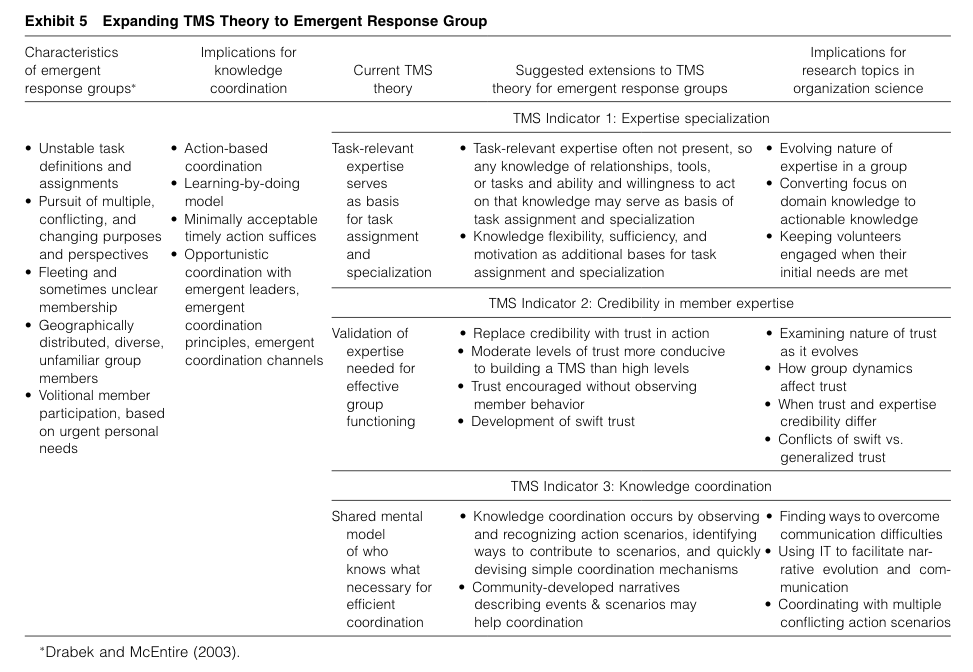
ur examination suggests that by expandingthe context in which TMS theory is applied to includeemergent response groups, insights can be gained intotheir internal dynamics. The three indicators of the levelof development of a TMS provide a useful frameworkfor organizing these insights in the exhibit.
The urgency of time may make it too onerous forthe extra effort of articulating actions as they are beingperformed, yet most emergency response requires somecommunication.
Interaction of time (tempo/pace) and breakdowns in articulation work.
Explicitly articulated narratives mayalso make clearer that multiple sequences of actions maybe occurring simultaneously, thus resolving role conflictsby allowing multiple ways to accomplish a task
Evokes Schmidt and Bannon's articulation work in CSCW.
Emergent response groups may also use a mechanismof creating a community narrative (Boland and Tenkasi1995), which is a running narrative of the actions takenand not taken, the decisions made, and the theories inuse. Narratives do not represent a single shared under-standing of a domain; rather they represent the mul-tiplicity of events and actions a community is taking,as members are taking them. Narratives may be articu-lated explicitly or understood implicitly.
SBTF after-action report, as an example. But who is the audience for this narrative?
Whenemergent response groups first come together, membersare likely not to ask one another about who knows what;instead, they are likely to ask about what is knownabout the situation and about the actions taken thus far(Dyer and Shafer 2003, Hale et al. 2005). The cogni-tive structure that they develop for the group centersnot around people, but on action-based scenarios thateither have been or might be carried out. These scenariosinclude decisions, actions, knowledge, events, and feed-back (Vera and Crossan 2005).
Suggested extensions for TMS theory:
"1. Tailor the Role of Expertise"
"2. "Replacing Credibility in Expertise with Trust Through Action"
"3. "Coordinating Knowledge Processes Without a Shared Metastructure"
On the surface, the lack of sta-ble membership suggests that a shared mental modelmay not be viable or even desired in emergent responsegroups. Time may be too precious to seek consensus onevents and actions, and agreements may make the groupless flexible to accommodate to changing inputs.
Evokes pluritemporal concerns about tempo, pace and synchronization.
hus, we believe challenges occur in all three indica-tors of the level of development of a TMS—expertisespecialization, credibility, and expertise coordination—requiring a need to consider extending theorizing abouteach indicator for emergent response groups.
Ways to extend TMS to emergent groups:
"1. Reconceptualize the Role of Expertise Specialization as a Basis for Task Assignment"
"2. Assessing Credibility in Emergent Response Groups"
"3. Expertise Coordination in Emergent Response Groups"
These extensions evoke boundary objects and invisibility
Moreland and Argote(2003) suggest that the dynamic conditions under whichthese groups form and work together are likely to havenegative effects on the development of transactive mem-ory.
Are there workflow or technology breakdowns that could help ameliorate the negative effects?
Research on TMS has identified three indicators of thelevel of development of a TMS (Lewis 2003, Morelandand Argote 2003):1.Memory (or expertise) specialization:the tendencyfor groups to delegate responsibility and to specialize indifferent aspects of the task;2.Credibility:beliefs about the reliability of mem-bers’ expertise; and3.Task (or expertise) coordination:the ability of teammembers to coordinate their work efficiently based ontheir knowledge of who knows what in the group.The greater the presence of each indicator, the more de-veloped the TMS and the more valuable the TMS is forefficiently coordinating the actions of group members.
Three indicators of the level of sophistication of the system:
• Memory specialization (think trauma/hospital care CSCW studies)
• Credibility
• Task coordination
A TMS can be thoughtof as a network of interconnected individual memorysystems and the transfer of knowledge among them(Wegner 1995). Individuals who are part of a TMSassume responsibility for different knowledge domains,and rely on one another to access each other’s expertiseacross domains. Expertise is defined in the TMS litera-ture to broadly include the know-what, know-how, andknow-why of a knowledge domain (Quinn et al. 1996),what Blackler (1995) refers to as embodied competen-cies. Expertise specialization, then, reduces the cognitiveload of each individual and the amount of redundantknowledge in the group, while collectively providingthe dyad or group access to a larger pool of knowl-edge. What makes transactive memory transactive arethe communications (called transactions) among individ-uals that make possible the codifying, storing, retrieving,and updating of information from individual memorysystems. For transactive memory to function effectively,individuals must have a shared conceptualization of whoknows what in the group.
Majchrzak et al describe how TMS is oeprationalized as a network.
TMS theory, a theoryof group-level cognition, explains how people in collec-tives learn, store, use, and coordinate their knowledge toaccomplish individual, group, and organizational goals.It is a theory about how people in relationships, groups,and organizations learn who knows what, and use thatknowledge to decide who will do what, resulting in moreefficient and effective individual and collective perfor-mance.
Definition of transactive memory systems theory -- used in org studies to understand how knowledge is coordinated among groups.
The urgency of the situation meansthat the objective of coordination is to achieve minimallyacceptable and timely action, even when more effec-tive responses may be feasible—but would take longerand use more resources.
temporal issues related to emergent response: pace and timeliness
hese characteristics require thatemergent response groups adopt specific approaches forknowledge coordination. One such approach commonlydocumented in studies of such groups is their use ofa learn-by-doing (versus decision making) action-basedmodel of coordinated problem solving, in which sensemaking and improvisation are the norm rather than theexception
Evokes LPP, sensemaking, and improvised coordination.
isaster researchers havedefinedemergent response groupsas collectives of indi-viduals who use nonroutine resources and activities toapply to nonroutine domains and tasks, using nonroutineorganizational arrangements (Bigley and Roberts 2001,Drabek et al. 1981, Drabek 1986, Drabek and McEntire2003, Kreps 1984, Tierney et al. 2001).
Definition of emergent response groups
Disasters have wideimplications for expertise coordination because the pre-conditions known to facilitate expertise coordination arelimited or nonexistent in disaster response. Such precon-ditions include but are not limited to, a shared goal; aclear reward structure; known group membership, exper-tise, and skills to accomplish the task; and time to sharewho knows what.
Implications for org studies research.
At least as of 2007 (publication date), the internal dynamics of emergent orgs were still relatively unknown.
The dynamics of professional-emergent disaster response is under-studied.
Although the con-ventional indicators of efficient coordination—expertisespecialization, credibility in expertise, and coordinationof expertise—are relevant in disaster response, disasterspresent a unique operational environment. Disasters are“events, observable in time and space, in which societiesor their subunits (e.g., communities, regions) incur phys-ical damages and losses and/or disruption of their routine
"Disasters represent a unique operational environment."