MiMo-V2.6 模型即将推出
【局限】文章提到模型即将推出,但未提供具体时间表和预期性能指标。这种模糊表述可能是为了避免承诺无法兑现的情况,但也反映了媒体在报道AI进展时常见的过度乐观倾向,缺乏对技术局限性的坦诚讨论。
MiMo-V2.6 模型即将推出
【局限】文章提到模型即将推出,但未提供具体时间表和预期性能指标。这种模糊表述可能是为了避免承诺无法兑现的情况,但也反映了媒体在报道AI进展时常见的过度乐观倾向,缺乏对技术局限性的坦诚讨论。
If our response to uncertainty is to ask what we should do, and then look for somebody to supply the answer, what are we teaching students about thought? The consultant has become a familiar presence in education partly because uncertainty can be turned into a service. The problem is diagnosed, a framework supplied, and the way forward explained, usually at a price.
This is a really interesting information literacy/critical thinking lens on consultancy. Also perhaps a "wicked problems" or Cynefin approach to analyzing issues in the first place.
the error bars look almost comically wide in the graph above — across the different estimates, they range from around 1.1× to 300× per year!
Progress estimates wildly uncertain
Most treat software progress estimates as precise, but author reveals uncertainty spans orders of magnitude, making predictions unreliable.
Confidently wrong answers are penalized. So are unnecessarily uncertain correct ones.
RLCR方法通过惩罚过度自信的错误答案和不必要的确定性正确的答案,来鼓励模型表达不确定性。
Each platform surfaces different vulnerabilities, making it difficult to establish a single, reliable source of truth for what is actually secure.
令人惊讶的是:AI安全工具之间存在不一致性,导致难以确定真正的安全状况。这种混乱局面使得企业面临更大的决策困境,即使有先进的安全工具,也无法保证全面保护,这反映了AI安全领域尚未成熟的现实。
For the remaining cases, the full SELFDOUBT score significantly outperforms sampling-based semantic entropy at 10x lower inference cost.
令人惊讶的是:SELFDOUBT方法在处理剩余情况时,不仅显著优于基于采样的语义熵方法,而且计算成本降低了10倍。这一发现表明,通过分析模型推理过程中的自我怀疑和验证行为,可以在极低成本下实现比传统方法更准确的不确定性估计,为实际应用提供了高效解决方案。
METR's confidence interval for Claude Opus 4.6 ranges from 5 hours to 66 hours.
置信区间从 5 小时到 66 小时——这个跨度本身就令人震惊。5 小时和 66 小时是 13 倍的差距,却是对「同一个模型」的同一项测量。当一个数字被广泛引用为「Claude Opus 4.6 的时间地平线是 12 小时」时,真相是这个数字的不确定性区间宽达一个数量级。这是整个 AI 能力评测领域目前面临的核心危机:我们在用极度不精确的测量数字来驱动极其重要的决策。
Sometimes you feel like you need to find something that is sure to succeed. But nothing worth doing has that profile – nothing in life.
for - youtube - UAB presentation - Remaining Carbon Budget - Kevin Anderson, 2024 - to - paper - Assessing the size and uncertainty of Remaining Carbon Budget (RCB) - Lamboll et al, 2023
to - paper - Assessing the size and uncertainty of Remaining Carbon Budget (RCB) - Lamboll et al, 2023 - https://hyp.is/0OGiIq-6Ee-xlr9v_TU2ZQ/www.nature.com/articles/s41558-023-01848-5
for - paper - Assessing the size and uncertainty of Remaining Carbon Budget (RCB) - Lamboll et al, 2023 - from - youtube - Climate scientist Kevin Anderson warns: Only 4 years left to stay below 1.5°C without urgent action
from - youtube - Climate scientist Kevin Anderson warns: Only 4 years left to stay below 1.5°C without urgent action - https://hyp.is/u-rKxK-6Ee-TT7OpdMUOTw/www.youtube.com/watch?v=kFDRp-JMf9Q
TensionThe ability to see like a data structure afforded us the technology we have today. But it was built for and within a set of societal systems—and stories—that can’t cope with nebulosity. Worse still is the transitional era we’ve entered, in which overwhelming complexity leads more and more people to believe in nothing. That way lies madness. Seeing is a choice, and we need to reclaim that choice. However, we need to see things and do things differently, and build sociotechnical systems that embody this difference.This is best seen through a small example. In our jobs, many of us deal with interpersonal dynamics that sometimes overwhelm the rules. The rules are still there—those that the company operates by and laws that it follows—meaning there are limits to how those interpersonal dynamics can play out. But those rules are rigid and bureaucratic, and most of the time they are irrelevant to what you’re dealing with. People learn to work with and around the rules rather than follow them to the letter. Some of these might be deliberate hacks, ones that are known, and passed down, by an organization’s workers. A work-to-rule strike, or quiet quitting for that matter, is effective at slowing a company to a halt because work is never as routine as schedules, processes, leadership principles, or any other codified rules might allow management to believe.The tension we face is that on an everyday basis, we want things to be simple and certain. But that means ignoring the messiness of reality. And when we delegate that simplicity and certainty to systems—either to institutions or increasingly to software—they feel impersonal and oppressive. People used to say that they felt like large institutions were treating them like a number. For decades, we have literally been numbers in government and corporate data structures. BreakdownAs historian Jill Lepore wrote, we used to be in a world of mystery. Then we began to understand those mysteries and use science to turn them into facts. And then we quantified and operationalized those facts through numbers. We’re currently in a world of data—overwhelming, human-incomprehensible amounts of data—that we use to make predictions even though that data isn’t enough to fully grapple with the complexity of reality.How do we move past this era of breakdown? It’s not by eschewing technology. We need our complex socio-technical systems. We need mental models to make sense of the complexities of our world. But we also need to understand and accept their inherent imperfections. We need to make sure we’re avoiding static and biased patterns—of the sort that a state functionary or a rigid algorithm might produce—while leaving room for the messiness inherent in human interactions. Chapman calls this balance “fluidity,” where society (and really, the tech we use every day) gives us the disparate things we need to be happy while also enabling the complex global society we have today.
But that’s not the case for a computer, or a robot, or even a corporate food service, which can’t navigate the intricacies and uncertainties of the real world with the flexibility we expect of a person. And at an even larger scale, our societal systems, whether we’re talking about laws and governments or just the ways our employers expect us to get our jobs done, don’t have that flexibility built into them. We’ve seen repeatedly how breaking corporate or government operations into thousands of disparate, rigid contracts ends in failure.
Advocating for the great booksidea, then, could mean fighting against anti-intellectualism, antira-tionalism (i.e., the reliance on ideology), and “agnotology.”
definition of agnotology:
Within the sociology of knowledge, agnotology (formerly agnatology) is the study of deliberate, culturally induced ignorance or doubt, typically to sell a product, influence opinion, or win favour, particularly through the publication of inaccurate or misleading scientific data (disinformation). More generally, the term includes the condition where more knowledge of a subject creates greater uncertainty. https://en.wikipedia.org/wiki/Agnotology
Einer neuen Studie zufolge liegt das CO2 Budget, mit dem sich das 1,5 Grad Ziel mit wenigstens 50% Wahrscheinlichkeit noch erreichen ließe, bei 250 Milliarden Tonnen. Es ist damit nur halb so hoch, wie bisher angenommen. Bei der von den UN vorangetriebenen Halbierung der Emissionen bis 2030 liege die Chance bei maximal 40%. https://www.theguardian.com/environment/2023/oct/30/climate-crisis-carbon-emissions-budget
Die Schere zwischen den nötigen Maßnahmen zur Anpassung an die globale Erhitzung und den dafür zur Verfügung gestellten Mitteln geht weiter auf. Der neue Adaptation Gap Report der Vereinten Nationen stellt fest, dass die Kosten für die Anpassung dramatisch steigen. https://www.derstandard.at/story/3000000193529/anpassung-an-klimakrise-hat-sich-verlangsamt-statt-an-fahrt-aufzunehmen
Report: https://www.unep.org/resources/adaptation-gap-report-2023
Reflecting on this, I'm reminded of a pattern that has been evident since my days co-running Third Wave with Johannes: the adoption of Uncertainty Coping Strategies. Broadly speaking, these are various behaviors, products, and practices people employ to manage the strains of everyday reality. Our work has consistently identified a spectrum ranging from technological interventions like neuroimplants to the rise in mindfulness services.The staggering contrasts in how different socioeconomic groups address these pressures are well illustrated by the recent New York Times article.
'uncertainty coping strategies' equal living your life I suppose, in the face of the 'strains of everyday reality' since the groups in caves. What is different here wrt Igor and Johannes' work experience and patterns. Just Urbanism (then how is this diff from 18th century?) The complexity of those strains? The inability to withdraw from strains created by others through industrial work practices / social media algo inducement? The sense of looming doom wrt ecocollapse, financial crash etc, systemic threats iw and no agency to individually address some of that? Or is it merely the high end market catering to it, exploiting the stress rather than solving the stressors? What is Igo saying here?
This is one of the challenges of being reactive to the public mood, rather than shaping it. Donald Trump, too, launched his first presidential campaign by elevating arguments and rhetoric from right-wing media, but he also shaped what the media was talking about. DeSantis has largely followed the trends, and the trends shift.
While Donald J. Trump seemed to hold say over what was trending and the media was discussing, Philip Bump notices that Ron DeSantis seems to be trailing or perhaps riding the trends rather than leading them.
Is this because he's only tubthumping one or two at a time while Trump floats trial balloons regularly and is pushing half a dozen or more at time?
when we step into uncertainty, our bodies respond physiologically and mentally.
“Biaya paling mahal hidup di Indonesia adalah biaya ketidakpastian (uncertainties),”
The Hawthorne effect is a type of human behavior reactivity
explore relationships here with body doubling, observer effect (physics), and Heisenberg's uncertainty principle...
Note 9/8j says - "There is a note in the Zettelkasten that contains the argument that refutes the claims on every other note. But this note disappears as soon as one opens the Zettelkasten. I.e. it appropriates a different number, changes position (or: disguises itself) and is then not to be found. A joker." Is he talking about some hypothetical note? What did he mean by disappearing? Can someone please shed some light on what he really meant?
9/8j Im Zettelkasten ist ein Zettel, der das Argument enthält, das die Behauptungen auf allen anderen Zetteln widerlegt.
Aber dieser Zettel verschwindet, sobald man den Zettelkasten aufzieht.
D.h. er nimmt eine andere Nummer an, verstellt sich und ist dann nicht zu finden.
Ein Joker.
—Niklas Luhmann, ZK II: Zettel 9/8j
Translation:
9/8j In the slip box is a slip containing the argument that refutes the claims on all the other slips. But this slip disappears as soon as you open the slip box. That is, he assumes a different number, disguises himself and then cannot be found. A joker.
Many have asked about the meaning of this jokerzettel over the past several years. Here's my slightly extended interpretation, based on my own practice with thousands of cards, about what Luhmann meant:
Imagine you've spent your life making and collecting notes and ideas and placing them lovingly on index cards. You've made tens of thousands and they're a major part of your daily workflow and support your life's work. They define you and how you think. You agree with Friedrich Nietzsche's concession to Heinrich Köselitz that “You are right — our writing tools take part in the forming of our thoughts.” Your time is alive with McLuhan's idea that "The medium is the message." or in which his friend John Culkin said, "We shape our tools and thereafter they shape us."
Eventually you're going to worry about accidentally throwing your cards away, people stealing or copying them, fires (oh! the fires), floods, or other natural disasters. You don't have the ability to do digital back ups yet. You ask yourself, can I truly trust my spouse not to destroy them?,What about accidents like dropping them all over the floor and needing to reorganize them or worse, the ghost in the machine should rear its head?
You'll fear the worst, but the worst only grows logarithmically in proportion to your collection.
Eventually you pass on opportunities elsewhere because you're worried about moving your ever-growing collection. What if the war should obliterate your work? Maybe you should take them into the war with you, because you can't bear to be apart?
If you grow up at a time when Schrodinger's cat is in the zeitgeist, you're definitely going to have nightmares that what's written on your cards could horrifyingly change every time you look at them. Worse, knowing about the Heisenberg Uncertainly Principle, you're deathly afraid that there might be cards, like electrons, which are always changing position in ways you'll never be able to know or predict.
As a systems theorist, you view your own note taking system as a input/output machine. Then you see Claude Shannon's "useless machine" (based on an idea of Marvin Minsky) whose only function is to switch itself off. You become horrified with the idea that the knowledge machine you've painstakingly built and have documented the ways it acts as an independent thought partner may somehow become self-aware and shut itself off!?!
https://www.youtube.com/watch?v=gNa9v8Z7Rac
And worst of all, on top of all this, all your hard work, effort, and untold hours of sweat creating thousands of cards will be wiped away by a potential unknowable single bit of information on a lone, malicious card and your only recourse is suicide, the unfortunate victim of dataism.
Of course, if you somehow manage to overcome the hurdle of suicidal thoughts, and your collection keeps growing without bound, then you're sure to die in a torrential whirlwind avalanche of information and cards, literally done in by information overload.
But, not wishing to admit any of this, much less all of this, you imagine a simple trickster, a joker, something silly. You write it down on yet another card and you file it away into the box, linked only to the card in front of it, the end of a short line of cards with nothing following it, because what could follow it? Put it out of your mind and hope your fears disappear away with it, lost in your box like the jokerzettel you imagined. You do this with a self-assured confidence that this way of making sense of the world works well for you, and you settle back into the methodical work of reading and writing, intent on making your next thousands of cards.
We analyzed URLs cited in Twitter messages before and after the temporary interruption of the vaccine development on September 9, 2020 to investigate the presence of low credibility and malicious information. We show that the halt of the AstraZeneca clinical trials prompted tweets that cast doubt, fear and vaccine opposition. We discovered a strong presence of URLs from low credibility or malicious websites, as classified by independent fact-checking organizations or identified by web hosting infrastructure features. Moreover, we identified what appears to be coordinated operations to artificially promote some of these URLs hosted on malicious websites.
We found that users who followed elites who made more false or inaccurate statements themselves shared news from lower-quality news outlets (as judged by both fact-checkers and politically-balanced crowds of laypeople), used more toxic language, and expressed more moral outrage.
Elite mis and disinformation sharers have a negative effect on followers.
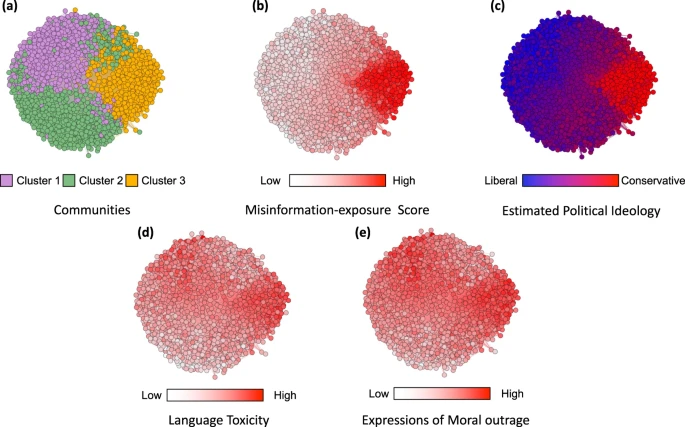
Nodes represent website domains shared by at least 20 users in our dataset and edges are weighted based on common users who shared them. a Separate colors represent different clusters of websites determined using community-detection algorithms29. b The intensity of the color of each node shows the average misinformation-exposure score of users who shared the website domain (darker = higher PolitiFact score). c Nodes’ color represents the average estimated ideology of the users who shared the website domain (red: conservative, blue: liberal). d The intensity of the color of each node shows the average use of language toxicity by users who shared the website domain (darker = higher use of toxic language). e The intensity of the color of each node shows the average expression of moral outrage by users who shared the website domain (darker = higher expression of moral outrage). Nodes are positioned using directed-force layout on the weighted network.
We found that misinformation-exposure scores are significantly positively related to language toxicity (Fig. 3a; b = 0.129, 95% CI = [0.098, 0.159], SE = 0.015, t (4121) = 8.323, p < 0.001; b = 0.319, 95% CI = [0.274, 0.365], SE = 0.023, t (4106) = 13.747, p < 0.001 when controlling for estimated ideology) and expressions of moral outrage (Fig. 3b; b = 0.107, 95% CI = [0.076, 0.137], SE = 0.015, t (4143) = 14.243, p < 0.001; b = 0.329, 95% CI = [0.283,0.374], SE = 0.023, t (4128) = 14.243, p < 0.001 when controlling for estimated ideology). See Supplementary Tables 1, 2 for full regression tables and Supplementary Tables 3–6 for the robustness of our results.
The style is one that is now widely recognized as a tool of sowing doubt: the author just asked ‘reasonable’ questions, without making any evidence-based conclusions.Who is the audience of this story and who could potentially be targeted by such content? As Bratich argued, 9/11 represents a prototypical case of ‘national dissensus’ among American individuals, and an apparently legitimate case for raising concerns about the transparency of the US authorities13. It is indicative that whoever designed the launch of RT US knew how polarizing it would be to ask questions about the most painful part of the recent past.
In the Irish sample, the combined vaccine hesitant and resistant group differed most pronouncedly from the vaccine acceptance group on the following psychological variables: lower levels of trust in scientists (d = 0.51), health care professionals (d = 0.45), and the state (d = 0.31); more negative attitudes toward migrants (d’s ranged from 0.27 to 0.29); lower cognitive reflection (d = 0.25); lower levels of altruism (d’s ranged from 0.17 to 0.24); higher levels of social dominance (d = 0.22) and authoritarianism (d = 0.14); higher levels of conspiratorial (d = 0.21) and religious (d = 0.20) beliefs; lower levels of the personality trait agreeableness (d = 0.15); and higher levels of internal locus of control (d = 0.14).
The only negative to this method is that it may not ALWAYS work. If the data is faulty, or the link is inaccurately provided by the sender, Gmail won’t be able to recognise and include the unsubscribe button in Gmail.
You may find this link isn’t available straight away, after a few emails one should appear, this is a common technique with mailing list providers.
I often think back to MySpace’s downfall. In 2007, I penned a controversial blog post noting a division that was forming as teenagers self-segregated based on race and class in the US, splitting themselves between Facebook and MySpace. A few years later, I noted the role of the news media in this division, highlighting how media coverage about MySpace as scary, dangerous, and full of pedophiles (regardless of empirical evidence) helped make this division possible. The news media played a role in delegitimizing MySpace (aided and abetted by a team at Facebook, which was directly benefiting from this delegitimization work).
danah boyd argued in two separate pieces that teenagers self-segregated between MySpace and Facebook based on race and class and that the news media coverage of social media created fear, uncertainty, and doubt which fueled the split.
Trope, trope, trope, strung into a Gish Gallop.
One of the issues we see in the Sunday morning news analysis shows (Meet the Press, Face the Nation, et al.) is that there is usually a large amount of context collapse mixed with lack of general knowledge about the topics at hand compounded with large doses of Gish Gallop and F.U.D. (fear, uncertainty, and doubt).
Amos Tversky's famous "The Hot Hand in Basketball: On the Misperception of Random Sequences".
Today, the people in politics who most often invoke the name of Jesus for their political causes tend to be the most merciless and judgmental, the most consumed by rage and fear and vengeance. They hate their enemies, and they seem to want to make more of them. They claim allegiance to the truth and yet they have embraced, even unwittingly, lies. They have inverted biblical ethics in the name of biblical ethics.
Your Alternator Is Not A ChargerYes, you read that right. An alternator is designed to MAINTAIN your car battery, not recharge it from a deeply discharged state. Its designed to run at only 35-50% of its fully rated output. When you use your cars alternator to recharge a dead battery, you force it to run at nearly 100% of its rated capacity and that overheats the alternator and dramatically shortens its life.
This was the opinion also of https://hyp.is/YNQwwlF0Ee206UcS3HYLnA/www.reddit.com/r/Cartalk/comments/aoks7b/how_much_idling_needed_after_jump_start_to/
but are they misinformed?
But this sounds like spreading fear and doubt when the Ruby parser has no such concepts :) {} always binds tightly to the call right next to it. This block {} will never go to using, unless it's rewritten as do ... end.
We observed an overall increase in the amount of negative information as it passed along the chain—known as the social amplification of risk.
Could this be linked to my FUD thesis about decisions based on possibilities rather than realities?
The request might or might not eventually be acted upon, as it might be disallowed when processing actually takes place.
Sridhar, D. (2021, September 23). ‘I Know Who Caused Covid-19’ review – the global blame game. The Guardian. https://www.theguardian.com/books/2021/sep/23/i-know-who-caused-covid-19-review-the-global-blame-game
The pandemic’s true death toll. (2021, November 1). The Economist. https://www.economist.com/graphic-detail/coronavirus-excess-deaths-estimates
McKee, M., Altmann, D., Costello, A., Friston, K., Haque, Z., Khunti, K., Michie, S., Oni, T., Pagel, C., Pillay, D., Reicher, S., Salisbury, H., Scally, G., Yates, K., Bauld, L., Bear, L., Drury, J., Parker, M., Phoenix, A., … West, R. (2022). Open science communication: The first year of the UK’s Independent Scientific Advisory Group for Emergencies. Health Policy. https://doi.org/10.1016/j.healthpol.2022.01.006
Decision-making in uncertainty | BPS. (n.d.). Retrieved November 22, 2021, from https://www.bps.org.uk/events/decision-making-uncertainty
Nerd, G. M.-K. H. (2022, February 25). The Jury is Still Out on Ivermectin. Medium. https://gidmk.medium.com/the-jury-is-still-out-on-ivermectin-7d0a1895549
that's something that insect with a six-legged version is now it's the whole super organism oh well the ant colony is society that whole frame is actually the shadow of 01:18:52 what the evolutionary reality is which is that the ant colony is an organism not a super organism and the ants are tissues and so which level we prioritize or do we say no there's no a priori level ant is just i'm not even 01:19:05 gonna say there's anything out there called ants it's it's you how you're thinking about it or do we get lost or are we going to find a ladder in that multi-scale yeah well the latter is you know the 01:19:17 latter is active inference because it doesn't say active inference doesn't say make a make an internal model of the world that is accurate that actually accurately captures all the all the 01:19:30 details of the world of the universe that's not the point that's not what the mind does that's not the point the point is to act under uncertainty 01:19:41 given some useful model of the world act under uncertainty so that your fitness score improves and by fitness score here we essentially mean you know and anticipated uncertainty so i i would 01:19:55 very much like to be have some certainty that i'm going to be alive tomorrow and if it's freezing outside and i don't have a coat on uh you know that that becomes iffy so uh i'm going to be happy 01:20:06 if i'm going to be i'm going to go find a coat because it is going to reduce my uncertainty about survival over the next 24 hours but you can expand that you know outward right we we need to act the all organisms are acting under 01:20:19 uncertainty and and we can think about that as we can think about that um we can think from that perspective as a society of what are we doing and how do we measure 01:20:31 success well we're measuring success by acting under uncertainty and then re and then paying attention to what happens and then acting the same or differently or you know some other way or somehow some were 01:20:45 then choosing to act again in this cycle of act uh you know act uh process act process act process you know model act model act model that reminds me of course of the ooda 01:20:57 observe orient side act model and other sort of cyclic models of action and perception and then i would say that active inference provides a few nice little benefits over other phrasings of action and perception 01:21:10 qualitative and philosophical ones like inactivism as well as quantitative ones like cybernetics and other kinds of control theories so i totally agree this
An organism acts under uncertainty to reduce it to meet its objective.
This fundamental tension—between quality and quantity—is atension we share as knowledge workers. We also must producework to an extremely high standard, and we must do it fast,continuously, all year long. We are like sprinters who are also tryingto run a marathon.
Do we? Really? This definitely needs reframing and books like this that play on these sorts of fears are both partially responsible, but are also preying on an atmosphere which they're propagating.
This is the sort of sad thing that a productivity guru would say...
It’s as if we need the gravitational pull of both worlds to keep us on track, locked on a good and righteous path. Without both worlds pulling on us, we would crash into one, or simply lose our way, hurtling through the universe on our own, intersecting nothing, helping no one.
As neuroscietist Beau Lotto points out, the Anthropocene is creating greater and greater uncertainty and unpredictability, but the one human trait evolution has created to help us deal with this is the sense of awe. See my annotation on Beau Lotto's beautiful TED Talk: How we experience awe and why it matters https://hyp.is/go?url=http%3A%2F%2Fdocdrop.org%2Fvideo%2F17D5SrgBE6g%2F&group=world
In short, the sacred is the antidote to the increase in uncertainty and unpredictability as we enter into the space of the Anthropocene. Awe can be the leverage point to the ultimate leverage point for system change that Donella Meadows pointed out many years ago- it can lead to rapid shift in paradigms, worldviews and value systems needed to shift the system.
Dr. Deepti Gurdasani [@dgurdasani1]. (2021, December 14). So those critiquing others for being too certain (I get subtweeted a lot for this)- Am I certain about the exact impact of omicron in the UK? Not at all Am I certain it’ll be high impact? Quite Am I certain we should act now? Absolutely [Tweet]. Twitter. https://twitter.com/dgurdasani1/status/1470828234480701443
Julia Raifman. (2021, July 25). Policymakers are pointing fingers at “the unvaccinated” What if they gave them a hand instead? - Bring vax & food to workplaces, schools, homes -Fund local doctors, including pediatricians, to call patients & deliver vax—Learn from success of Indian Health Service approach [Tweet]. @JuliaRaifman. https://twitter.com/JuliaRaifman/status/1419288641885593604
A cause of America’s labor shortage: Millions with long COVID. (n.d.). Retrieved February 2, 2022, from https://www.cbsnews.com/news/long-covid-labor-market-missing-workers/
Goodhart's law is an adage often stated as "When a measure becomes a target, it ceases to be a good measure".[1] It is named after British economist Charles Goodhart, who advanced the idea in a 1975 article on monetary policy in the United Kingdom:[2][3] .mw-parser-output .templatequote{overflow:hidden;margin:1em 0;padding:0 40px}.mw-parser-output .templatequote .templatequotecite{line-height:1.5em;text-align:left;padding-left:1.6em;margin-top:0}Any observed statistical regularity will tend to collapse once pressure is placed upon it for control purposes.
We measure what we find important.
Measures can and often become self-fulfilling targets. (read: Rankings and Reactivity by W. Espeland and M. Sauder https://www.stmarys-ca.edu/sites/default/files/attachments/files/rankings-and-reactivity-2007.pdf)
When a measure becomes a target it ceases to be a good measure.
So why measure?
Is observation and measurement part of a larger complex process which isn't finished until the process itself is finished?
This seems related to the measurement problem in quantum mechanics, Schrödinger's cat, the Heisenberg uncertainty principle, and the observer effect).
Musicals, plays and pantos cancel shows after Covid-19 outbreaks. (2021, December 14). BBC News. https://www.bbc.com/news/entertainment-arts-59638954
Kristian G. Andersen on Twitter. (n.d.). Twitter. Retrieved 3 December 2021, from https://twitter.com/K_G_Andersen/status/1465822536629821442
Wiseman, E. (2021, October 17). The dark side of wellness: The overlap between spiritual thinking and far-right conspiracies. The Observer. https://www.theguardian.com/lifeandstyle/2021/oct/17/eva-wiseman-conspirituality-the-dark-side-of-wellness-how-it-all-got-so-toxic
Desforges, M., Gurdasani, D., Hamdy, A., & Leonardi, A. J. (2021). Uncertainty around the Long-Term Implications of COVID-19. Pathogens, 10(10), 1267. https://doi.org/10.3390/pathogens10101267
Lagnado, D. A. (2022). Explaining the evidence: How the mind investigates the world. Cambridge University Press.
Seth Trueger. (2021, September 14). Https://t.co/LFZ3xWkYYY [Tweet]. @MDaware. https://twitter.com/MDaware/status/1437780952890191878
Covid-19: ‘Vaccine misinformation a dilemma for young people’. (2021, September 19). BBC News. https://www.bbc.com/news/uk-northern-ireland-58616080
Telenti, A., Arvin, A., Corey, L., Corti, D., Diamond, M. S., García-Sastre, A., Garry, R. F., Holmes, E. C., Pang, P., & Virgin, H. W. (2021). After the pandemic: perspectives on the future trajectory of COVID-19. Nature, 1–14. https://doi.org/10.1038/s41586-021-03792-w
Shu, J., Ochsner, K. N., & Phelps, E. A. (2021). The Impact of Intolerance of Uncertainty on Reappraisal and Suppression. PsyArXiv. https://doi.org/10.31234/osf.io/fsnvy
Josh Michaud. “Over the next 2 Months COVAX Expects to Have Access to Almost Twice as Many Covid-19 Vaccine Doses as It Did over the First 8 Months of This Year. Https://Gavi.Org/Sites/Default/Files/Covid/Covax/COVAX-Supply-Forecast.Pdf Https://T.Co/JBtGYXFTwc.” Tweet. @joshmich (blog), September 2, 2021. https://twitter.com/joshmich/status/1433462474544660484.
we find that fixing fossil ages to the midpoint or a random point drawn from within the stratigraphic age range leads to biases in divergence time estimates, while sampling fossil ages leads to estimates that are similar to inferences that employ the correct ages of fossils. Second, we show a comparison using an empirical dataset of extant and fossil cetaceans, which confirms that different methods of handling fossil age uncertainty lead to large differences in estimated node ages
dealing with uncertainties carefully actually matters
Zarzeczna, N., Hanel, P. H. P., Rutjens, B., Bono, S. A., Chen, Y.-H., & Haddock, G. (2021). Scientists, speak up! Source impacts trust in and intentions to comply with health advice cross-culturally. PsyArXiv. https://doi.org/10.31234/osf.io/279yg
Stop trying to connect all the dots ahead of time. Embrace uncertainty and start doing. “You can’t connect the dots looking forward; you can only connect them looking backwards. So you have to trust that the dots will somehow connect in your future. You have to trust in something — your gut, destiny, life, karma, whatever. This approach has never let me down, and it has made all the difference in my life." - Steve Jobs
decent write up, solid concluding quote.
Before you go like “Wow!!!”, understand that the packages highlighted above take a lot into consideration when detecting timezones. This makes them slightly more accurate than Intl API alone.
What exactly does moment do for us, then, that
TimeFormat().resolvedOptions().timeZone;
doesn't do? Name one example where it is more accurate.
Covid-19: New poll shows why some vaccine-hesitant Americans decided to get the shot—CNNPolitics. (n.d.). Retrieved August 2, 2021, from https://edition.cnn.com/2021/07/13/politics/poll-covid-19-vaccine-decision/index.html
Smith, M. J., Ahmad, A., Arawi, T., Dawson, A., Emanuel, E. J., Garani-Papadatos, T., Ghimire, P., Iliyasu, Z., Lei, R., Mastroleo, I., Mathur, R., Okeibunor, J., Parker, M., Saenz, C., Thomé, B., Upshur, R. E. G., & Voo, T. C. (2021). Top five ethical lessons of COVID-19 that the world must learn. Wellcome Open Research, 6, 17. https://doi.org/10.12688/wellcomeopenres.16568.1
Padilla, L., Hosseinpour, H., Fygenson, R., Howell, J., Chunara, R., & Bertini, E. (2021). Effects of COVID-19 Uncertainty Visualizations on Novice Risk Estimates. PsyArXiv. https://doi.org/10.31234/osf.io/6axc7
The Anti-Vaxx Playbook | Center for Countering Digital Hate. (n.d.). Retrieved June 26, 2021, from https://www.counterhate.com/playbook
Career decision making involves so much uncertainty that it’s easy to feel paralysed. Instead, make some hypotheses about which option is best, then identify key uncertainties: what information would most change your best guess?
We tend to think that uncertainties can't be weighted in our decision-making, but we bet on uncertainties all the time. Rather than throw your hands up and say, "I don't have enough information to make a call", how can we think deliberately about what information would reduce the uncertainty?
think of your career as a series of experiments designed to help you learn about yourself and test out potentially great longer-term paths
I wonder if there's a connection here to Duke, A. (2019). Thinking in Bets: Making Smarter Decisions When You Don’t Have All the Facts. Portfolio.
I haven't read the book but it's on my list.
the Guardian. “How Good Are We at Predicting the Pandemic? | David Spiegelhalter & Anthony Masters,” May 9, 2021. http://www.theguardian.com/theobserver/commentisfree/2021/may/09/how-good-are-we-at-predicting-pandemic.
Broniatowski, D. A., Kerchner, D., Farooq, F., Huang, X., Jamison, A. M., Dredze, M., & Quinn, S. C. (2020). The COVID-19 Social Media Infodemic Reflects Uncertainty and State-Sponsored Propaganda. ArXiv:2007.09682 [Physics]. http://arxiv.org/abs/2007.09682
The BMJ on Twitter. (n.d.). Twitter. Retrieved 5 March 2021, from https://twitter.com/bmj_latest/status/1324962326127251457
McKenna, S. (n.d.). COVID Models Show How to Avoid Future Lockdowns. Scientific American. Retrieved 26 February 2021, from https://www.scientificamerican.com/article/covid-models-show-how-to-avoid-future-lockdowns/
ReconfigBehSci on Twitter: ‘RT @DrBrookeRogers: Universities and colleges face Covid funding shortfalls https://t.co/v2s0dVETBa’ / Twitter. (n.d.). Retrieved 24 February 2021, from https://twitter.com/SciBeh/status/1323575049425768448
Universities and colleges face Covid funding shortfalls. (2020, November 3). BBC News. https://www.bbc.com/news/education-54780790
In object-oriented programming, information hiding (by way of nesting of types) reduces software development risk by shifting the code's dependency on an uncertain implementation (design decision) onto a well-defined interface. Clients of the interface perform operations purely through it so if the implementation changes, the clients do not have to change.
Ledford, H. (2020). Oxford COVID-vaccine paper highlights lingering unknowns about results. Nature. https://doi.org/10.1038/d41586-020-03504-w
If you have a better/simpler/"more official" solution, I'd still love to see it!
The "official" solution is to use submitErrors (see Erik's answer).
The Y-intercept of the SML is equal to the risk-free interest rate. The slope of the SML is equal to the market risk premium and reflects the risk return tradeoff at a given time: S M L : E ( R i ) = R f + β i [ E ( R M ) − R f ] {\displaystyle \mathrm {SML} :E(R_{i})=R_{f}+\beta _{i}[E(R_{M})-R_{f}]\,} where: E(Ri) is an expected return on security E(RM) is an expected return on market portfolio M β is a nondiversifiable or systematic risk RM is a market rate of return Rf is a risk-free rate
This is one statement of the key relationship.
The point is that the market will have a single tradeoff between unavoidable (nondiversifiable) risk and return.
Asset's returns must reflect this, according to the theory. Their prices will be bid up (or down), until this is the case ... the 'arbitrage' process.
Why? Because (assuming borrowing/lending at a risk free rate) *any investor can achieve a particular return for a given risk level simply by buying the 'diversified market basket' and leveraging this (for more risk) or investing the remainder in the risk free-asseet (for less risk). (And she can do no better than this.)
This abnormal extra return above the market's return at a given level of risk is what is called the alpha.
this is why you here the stock-touts bragging about their 'alpha'
Capital asset pricing model
please read this article
quantity beta (β)
You hear about this 'beta' all the time as the measure of 'the correlation of the risk of an asset with the representative market basket'...
but confusingly, \(\beta\) is used to represent the slope of the expected return of an asset as this risk increases.
If the fraction q {\displaystyle q} of a one-unit (e.g. one-million-dollar) portfolio is placed in asset X and the fraction 1 − q {\displaystyle 1-q} is placed in Y, the stochastic portfolio return is q x + ( 1 − q ) y {\displaystyle qx+(1-q)y} . If x {\displaystyle x} and y {\displaystyle y} are uncorrelated, the variance of portfolio return is var ( q x + ( 1 − q ) y ) = q 2 σ x 2 + ( 1 − q ) 2 σ y 2 {\displaystyle {\text{var}}(qx+(1-q)y)=q^{2}\sigma _{x}^{2}+(1-q)^{2}\sigma _{y}^{2}} . The variance-minimizing value of q {\displaystyle q} is q = σ y 2 / [ σ x 2 + σ y 2 ] {\displaystyle q=\sigma _{y}^{2}/[\sigma _{x}^{2}+\sigma _{y}^{2}]} , which is strictly between 0 {\displaystyle 0} and 1 {\displaystyle 1} . Using this value of q {\displaystyle q} in the expression for the variance of portfolio return gives the latter as σ x 2 σ y 2 / [ σ x 2 + σ y 2 ] {\displaystyle \sigma _{x}^{2}\sigma _{y}^{2}/[\sigma _{x}^{2}+\sigma _{y}^{2}]} , which is less than what it would be at either of the undiversified values q = 1 {\displaystyle q=1} and q = 0 {\displaystyle q=0} (which respectively give portfolio return variance of σ x 2 {\displaystyle \sigma _{x}^{2}} and σ y 2 {\displaystyle \sigma _{y}^{2}} ). Note that the favorable effect of diversification on portfolio variance would be enhanced if x {\displaystyle x} and y {\displaystyle y} were negatively correlated but diminished (though not eliminated) if they were positively correlated.
Key building block formulae.
Start with 'what happens to the variance when we combine two assets (uncorrelated with same expected return)'
What are the variance minimizing shares and what is the resulting variance of the portfolio.
Similarly, a 1985 book reported that most value from diversification comes from the first 15 or 20 different stocks in a portfolio.[6]
the conventional wisdom is that there are sharply diminishing returns to this diversification
Smith, G. D., Blastland, M., & Munafò, M. (2020). Covid-19’s known unknowns. BMJ, 371. https://doi.org/10.1136/bmj.m3979
Brown, R. C. H., Kelly, D., Wilkinson, D., & Savulescu, J. (2020). The scientific and ethical feasibility of immunity passports. The Lancet Infectious Diseases, 0(0). https://doi.org/10.1016/S1473-3099(20)30766-0
This balancing act needs to take into account project complexity (size, distribution, etc.), uncertainty (risk, innovation need, etc.), and the cost of change at the project level and for each major component.
Disclaimer: I’m new to Svelte so this isn’t so much a recommendation as it is a “I guess this is a way to do it 🤷♂️”
COVID-19 and the Labor Market. (n.d.). IZA – Institute of Labor Economics. Retrieved October 11, 2020, from https://covid-19.iza.org/publications/dp13632/
COVID-19 and the Labor Market. (n.d.). IZA – Institute of Labor Economics. Retrieved October 10, 2020, from https://covid-19.iza.org/publications/dp13569/
NW, 1615 L. St, Suite 800Washington, & Inquiries, D. 20036USA202-419-4300 | M.-857-8562 | F.-419-4372 | M. (2020, September 17). U.S. Public Now Divided Over Whether To Get COVID-19 Vaccine. Pew Research Center Science & Society. https://www.pewresearch.org/science/2020/09/17/u-s-public-now-divided-over-whether-to-get-covid-19-vaccine/
The challenge is to find a way to live with uncertainty,
Finding a way to be okay with uncertainty in life is a challenge for many people. I struggle with this as well. But over the last few months I have found various ways to cope with the anxiety caused by uncertainty. Because the world we live in today is full of uncertainties.
Haas, I. J., Baker, M., & Gonzalez, F. (2020). Political Uncertainty Moderates Neural Evaluation of Incongruent Policy Positions. https://doi.org/10.31234/osf.io/bmr59
Beware comforting lies about a “herd immunity” Covid-19 strategy. Here’s why it’s dangerous – Professor Devi Sridhar. (n.d.). Retrieved September 25, 2020, from https://www.scotsman.com/news/opinion/columnists/covid-19-herd-immunity-strategy-flawed-until-we-have-coronavirus-vaccine-professor-devi-sridhar-2981017
Houlihan, C. F., & Beale, R. (2020). The complexities of SARS-CoV-2 serology. The Lancet Infectious Diseases, 0(0). https://doi.org/10.1016/S1473-3099(20)30699-X
Hennessy, E. A., Acabchuk, R., Arnold, P. A., Dunn, A. G., Foo, Y. Z., Johnson, B. T., Geange, S. R., Haddaway, N. R., Nakagawa, S., Mapanga, W., Mengersen, K., Page, M. J., Sánchez-Tójar, A., Welch, V., & McGuinness, L. A. (2020). Ensuring Prevention Science Research is Synthesis-Ready for Immediate and Lasting Scientific Impact [Preprint]. MetaArXiv. https://doi.org/10.31222/osf.io/ptg9j
The Contagion Externality of a Superspreading Event: The Sturgis Motorcycle Rally and COVID-19 | NCRC. (2020, September 3). 2019 Novel Coronavirus Research Compendium (NCRC). https://ncrc.jhsph.edu/research/the-contagion-externality-of-a-superspreading-event-the-sturgis-motorcycle-rally-and-covid-19/
Thomas, D., & Giles, C. (2020, September 14). Cities count cost of lasting exodus from offices. https://www.ft.com/content/203cc83c-72b0-49c9-bea5-6fb38735a8fc
(((Howard Forman))) on Twitter. (n.d.). Twitter. Retrieved September 16, 2020, from https://twitter.com/thehowie/status/1305232493071736834
Siemieniuk, R. A., Bartoszko, J. J., Ge, L., Zeraatkar, D., Izcovich, A., Kum, E., Pardo-Hernandez, H., Rochwerg, B., Lamontagne, F., Han, M. A., Liu, Q., Agarwal, A., Agoritsas, T., Chu, D. K., Couban, R., Darzi, A., Devji, T., Fang, B., Fang, C., … Brignardello-Petersen, R. (2020). Drug treatments for covid-19: Living systematic review and network meta-analysis. BMJ, 370. https://doi.org/10.1136/bmj.m2980
Exclusive: In Russia, a black market for HIV drug to try on coronavirus. (2020, April 20). Reuters. https://www.reuters.com/article/us-health-coronavirus-russia-hiv-exclusi-idUSKBN2220W1
Postdocs in crisis: Science cannot risk losing the next generation. (2020). Nature, 585(7824), 160–160. https://doi.org/10.1038/d41586-020-02541-9
Chatterjee, Patralekha. ‘Is India Missing COVID-19 Deaths?’ The Lancet 396, no. 10252 (5 September 2020): 657. https://doi.org/10.1016/S0140-6736(20)31857-2.
Boston, 677 Huntington Avenue, & Ma 02115 +1495‑1000. (2020, March 4). Coronavirus (COVID-19): Press Conference with Marc Lipsitch, 03/04/20. News. https://www.hsph.harvard.edu/news/features/coronavirus-covid-19-press-conference-with-marc-lipsitch-03-04-20/
Yelin, D., Wirtheim, E., Vetter, P., Kalil, A. C., Bruchfeld, J., Runold, M., Guaraldi, G., Mussini, C., Gudiol, C., Pujol, M., Bandera, A., Scudeller, L., Paul, M., Kaiser, L., & Leibovici, L. (2020). Long-term consequences of COVID-19: Research needs. The Lancet Infectious Diseases, 0(0). https://doi.org/10.1016/S1473-3099(20)30701-5
Petersen, A. H. (n.d.). Between f**ked and a hard place. Retrieved August 30, 2020, from https://annehelen.substack.com/p/between-fked-and-a-hard-place
Humanities & Social Change (2020, April 30). Cultures of expertise and politics of behavioral science: A conversation with Erik Angner. https://hscif.org/cultures-of-expertise-and-politics-of-behavioral-science-a-conversation-with-erik-angner/
Hoffman, J. (2020, August 16). Fearing a ‘Twindemic,’ Health Experts Push Urgently for Flu Shots. The New York Times. https://www.nytimes.com/2020/08/16/health/coronavirus-flu-vaccine-twindemic.html
Baker, S. R., Bloom, N., & Terry, S. J. (2020). Using Disasters to Estimate the Impact of Uncertainty (Working Paper No. 27167; Working Paper Series). National Bureau of Economic Research. https://doi.org/10.3386/w27167
ScD, N. N. A. (2020, June 11). A Guide to Understanding Pandemic Predictions. Medium. https://elemental.medium.com/a-guide-to-understanding-pandemic-predictions-8ae3439b8224
Understanding Contemporary Challenges – Center for Social & Behavioral Science. (n.d.). Retrieved August 26, 2020, from https://csbs.research.illinois.edu/understandingcontemporarychallenges/
The Lady’s Handbook for Her Mysterious Illness: A Memoir | IndieBound.org. (n.d.). Retrieved August 26, 2020, from https://www.indiebound.org/book/9780385534079
Fife, D., Lung, M., Sullivan, N., & Young, C. (2020). When Values Collide: Why Scientists Argue About Open Science and How to Move Forward [Preprint]. PsyArXiv. https://doi.org/10.31234/osf.io/q9d28
Risky Talk: Communicating Evidence in a Pandemic. (n.d.). Retrieved August 24, 2020, from https://riskytalk.libsyn.com/communicating-evidence-in-a-pandemic
Togoh, I. (n.d.). After Hydroxychloroquine, Trump Is Now Seeking To Get Another Unproven Drug Approved By The FDA: Report. Forbes. Retrieved August 22, 2020, from https://www.forbes.com/sites/isabeltogoh/2020/08/17/after-hydroxychloroquine-trump-is-now-seeking-to-get-another-unproven-drug-approved-by-the-fda-report/
Monforte, A. d’Arminio, Tavelli, A., Bai, F., Marchetti, G., & Cozzi-Lepri, A. (2020). Effectiveness of hydroxychloroquine in COVID-19 disease: A done and dusted deal? International Journal of Infectious Diseases, 99, 75–76. https://doi.org/10.1016/j.ijid.2020.07.056
Ludvigson, S. C., Ma, S., & Ng, S. (2020). Covid19 and the Macroeconomic Effects of Costly Disasters (Working Paper No. 26987; Working Paper Series). National Bureau of Economic Research. https://doi.org/10.3386/w26987
Harris, J. E. (2020). Reopening Under COVID-19: What to Watch For (Working Paper No. 27166; Working Paper Series). National Bureau of Economic Research. https://doi.org/10.3386/w27166
Barnett, M., Buchak, G., & Yannelis, C. (2020). Epidemic Responses Under Uncertainty (Working Paper No. 27289; Working Paper Series). National Bureau of Economic Research. https://doi.org/10.3386/w27289
Bordo, M. D., Levin, A. T., & Levy, M. D. (2020). Incorporating Scenario Analysis into the Federal Reserve’s Policy Strategy and Communications (Working Paper No. 27369; Working Paper Series). National Bureau of Economic Research. https://doi.org/10.3386/w27369
Eichenbaum, M. S., Rebelo, S., & Trabandt, M. (2020). The Macroeconomics of Testing and Quarantining (Working Paper No. 27104; Working Paper Series). National Bureau of Economic Research. https://doi.org/10.3386/w27104
Diebold, Francis X. ‘Real-Time Real Economic Activity: Exiting the Great Recession and Entering the Pandemic Recession’. Working Paper. Working Paper Series. National Bureau of Economic Research, July 2020. https://doi.org/10.3386/w27482.
Kalk, A., & Schultz, A. (2020). SARS-CoV-2 epidemic in African countries—Are we losing perspective? The Lancet Infectious Diseases, 0(0). https://doi.org/10.1016/S1473-3099(20)30563-6
Economic Policies for COVID-19. COVID-19 and the Labor Market. (n.d.). IZA – Institute of Labor Economics. Retrieved August 7, 2020, from https://covid-19.iza.org/publications/pp156/
Altig, D., Baker, S. R., Barrero, J. M., Bloom, N., Bunn, P., Chen, S., Davis, S. J., Leather, J., Meyer, B. H., Mihaylov, E., Mizen, P., Parker, N. B., Renault, T., Smietanka, P., & Thwaites, G. (2020). Economic Uncertainty Before and During the COVID-19 Pandemic (Working Paper No. 27418; Working Paper Series). National Bureau of Economic Research. https://doi.org/10.3386/w27418
Baker, S. R., Bloom, N., Davis, S. J., & Terry, S. J. (2020). COVID-Induced Economic Uncertainty (Working Paper No. 26983; Working Paper Series). National Bureau of Economic Research. https://doi.org/10.3386/w26983
An Economic Model of the COVID-19 Epidemic: The Importance of Testing and Age-Specific Policies. COVID-19 and the Labor Market. (n.d.). IZA – Institute of Labor Economics. Retrieved August 4, 2020, from https://covid-19.iza.org/publications/dp13265/
Unemployment Paths in a Pandemic Economy. COVID-19 and the Labor Market. (n.d.). IZA – Institute of Labor Economics. Retrieved July 29, 2020, from https://covid-19.iza.org/publications/dp13294/
Sudden Stop: When Did Firms Anticipate the Potential Consequences of COVID-19?. COVID-19 and the Labor Market. (n.d.). IZA – Institute of Labor Economics. Retrieved July 29, 2020, from https://covid-19.iza.org/publications/dp13457/
Ellison, G. (2020). Implications of Heterogeneous SIR Models for Analyses of COVID-19 (Working Paper No. 27373; Working Paper Series). National Bureau of Economic Research. https://doi.org/10.3386/w27373
Liu, L., Moon, H. R., & Schorfheide, F. (2020). Panel Forecasts of Country-Level Covid-19 Infections (Working Paper No. 27248; Working Paper Series). National Bureau of Economic Research. https://doi.org/10.3386/w27248
MadhusoodananJul. 20, J., 2020, & Pm, 5:05. (2020, July 20). ‘Ethically troubling.’ University reopening plans put professors, students on edge. Science | AAAS. https://www.sciencemag.org/careers/2020/07/ethically-troubling-university-reopening-plans-put-professors-students-edge
Starominski-Uehara, M. (2020). Brief Communication Analysis of Brazilian Presidency during COVID-19 [Preprint]. SocArXiv. https://doi.org/10.31235/osf.io/jr7eq
Starominski-Uehara, M. (2020). Governance in Crisis: Institutionalizing Reflective Report to Guide Decision Making Under Uncertainty [Preprint]. SocArXiv. https://doi.org/10.31235/osf.io/y3nsa
COVID-19 Social Science Tracker - Google Sheets
Bernardi, F., Cozzani, M., & Zanasi, F. (2020). Social inequality and the risk of being in a nursing home during the COVID-19 pandemic [Preprint]. SocArXiv. https://doi.org/10.31235/osf.io/ksefy
McConnell, J. (2020, June 11). COVID-19: The current situation and prospects for the UK and the world. Aga Khan Foundation. https://www.youtube.com/watch?v=6VK_2uCA76s
New Scientist on Twitter: “Thread on #covid19 trends in the US: Coronavirus infections have surged since the start of June from around 20,000 new cases a day to over 60,000. (1/4) https://t.co/wVFwHWczYR” / Twitter. (n.d.). Twitter. Retrieved July 19, 2020, from https://twitter.com/newscientist/status/1283387188391149571
Carl T. Bergstrom on Twitter: “1. In short, no. This is going to take a detailed thread to unpack.” / Twitter. (n.d.). Twitter. Retrieved July 18, 2020, from https://twitter.com/CT_Bergstrom/status/1270226183485976584
Coronavirus: The inside story of how UK’s “chaotic” testing regime “broke all the rules.” (n.d.). Sky News. Retrieved July 17, 2020, from https://news.sky.com/story/coronavirus-the-inside-story-of-how-uks-chaotic-testing-regime-broke-all-the-rules-12022566
Bae, J.-M. (2014). The clinical decision analysis using decision tree. Epidemiology and Health, 36. https://doi.org/10.4178/epih/e2014025
LSE. (2020, May 13) Behavioural Science in the Context of Great Uncertainty | LSE Online Event. https://www.youtube.com/watch?v=2X0aTk3f4oI&feature=youtu.be
This model is the most flexible and open-ended of the four; your goal as an instructor is not to design a full-fledged semester of material, activities, and assessments. Rather, your goal is to work with your class to design and become a learning community, working collaboratively and individually towards your determined learning goals. For this to work you should have: a set of possible/preferred learning objectives for your classa library of course materials, preferably with as much as possible in digital formata suggested list of digital tools and technologies that you’re comfortable from with a list of possible assignment/project/assessment ideas that are related to your learning objectivesa willingness to experiment and invite your students into the teaching & learning process. At the onset of class you will need to facilitate a conversation among you and your students about how the class will unfold. This can be done in small groups f2f, via an online communication tool, or in a hybrid mix of both. As a community you should plan on addressing the following: what are our objectives as a learning community? what kind of work could we engage in to meet these objectives? what physical/virtual spaces would we like to work in? how/when do we want to meet in these spaces?how do we want to measure (assess) if an objective has been met?what rules and policies should govern our work? how will we work virtually and respect everyone’s boundaries and personal situations? how will we work f2f and respect public health recommendations and personal situations? You will probably need to spend at least the first 1-2 weeks answering these questions together and then designing a plan for your course. Make sure you and your students talk through various complications: what if the university’s policies about meeting f2f change? what if classes are forced to move entirely virtual/remote? what someone (students or professor!) gets sick?
This is the one for me!!!!
c
Apologies for highlighting whole swaths of paragraphs but it can't be helped sometimes lol.
Finally, these are NOT meant to be comprehensive. Instead, imagine these models along a continuum of opportunity. Your challenge is to determine where your courses could fit between and among the proposals.
I'm wondering how much or how little faculty will need to change their curriculum/delivery depending on the various inevitable changes that we can't exactly predict will happen this school year. For those faculty member purposefully switching online, what changes have they made already, and what changes will become necessary in the near future?
Communicating statistics, risk and uncertainty in the age of Covid—Prof. David Spiegelhalter. (2020, June 30). https://www.youtube.com/watch?v=Dq7W1l7RptQ&feature=youtu.be
Méndez, P. F. (2020). Blue uncertainty: Warding off systemic risks in the Anthropocene – Lessons from COVID-19 [Preprint]. SocArXiv. https://doi.org/10.31235/osf.io/z2br5
Maarten van Smeden on Twitter: “Let’s talk about the ‘risk factors’ for COVID-19 for a moment 1/n” / Twitter. (n.d.). Twitter. Retrieved July 11, 2020, from https://twitter.com/maartenvsmeden/status/1249702560442785794
Calm amid COVID. (2020, April). Berkeley News. Retrieved July 10, 2020, from https://news.berkeley.edu/topics/calm-amid-covid/
Coggon, D., Croft, P., Cullinan, P., & Williams, A. (2020). ASSESSMENT OF WORKERS PERSONAL VULNERABILITY TO COVID-19 USING COVID-AGE. MedRxiv, 2020.05.21.20108969. https://doi.org/10.1101/2020.05.21.20108969
Miller, J. G., Chahal, R., Kirshenbaum, J. S., Ho, T. C., Gifuni, A. J., & Gotlib, I. (2020). Heart Rate Variability Moderates the Link Between COVID-19 Stress and Emotional Problems in Adolescents: Evidence for Differential Susceptibility [Preprint]. PsyArXiv. https://doi.org/10.31234/osf.io/mp7wt
Chatterjee, A., & Chatterjee, A. (2020). Managing through uncertain times: A study to understand the effects of conducting socio-academic life online during COVID-19. https://doi.org/10.31234/osf.io/vcbrw
Mandavilli, A. (2020, July 4). 239 Experts With One Big Claim: The Coronavirus Is Airborne. The New York Times. https://www.nytimes.com/2020/07/04/health/239-experts-with-one-big-claim-the-coronavirus-is-airborne.html
These Canadians say they suffered COVID-19 symptoms for months. (n.d.). Global News. Retrieved July 5, 2020, from https://globalnews.ca/news/7107137/coronavirus-long-term-symptoms/
Horton, R. (2020). Offline: It’s time to convene nations to end this pandemic. The Lancet, 396(10243), 14. https://doi.org/10.1016/S0140-6736(20)31488-4
Leibniz PhD Network - Mental Health for Doctoral Researchers During COVID-19 Webinar
Im, H., & Chen, C. (2020). Social Distancing Around the Globe: Cultural Correlates of Reduced Mobility [Preprint]. PsyArXiv. https://doi.org/10.31234/osf.io/b2s37
A Marm Kilpatrick on Twitter: “What is #herdimmunity threshold for #COVID19? A topic of much discussion due to large uncertainty & huge consequences for long term impact. New paper illustrates 1 key aspect that can reduce it substantially (spoiler: we still don’t know value). Thread. https://t.co/Sgrg1yrlOq” / Twitter. (n.d.). Twitter. Retrieved June 27, 2020, from https://twitter.com/diseaseecology/status/1275595167936868352
Part 1—Webinar Coping Strategies COVID-19. (2020, April 17). https://www.youtube.com/watch?list=PLzyuHsPaw9H20TuO_c8G2pfcyCuJ2ro7Y&v=-7UQe6xnV5g&feature=emb_logo
Saltelli, A., Bammer, G., Bruno, I., Charters, E., Di Fiore, M., Didier, E., Nelson Espeland, W., Kay, J., Lo Piano, S., Mayo, D., Pielke Jr, R., Portaluri, T., Porter, T. M., Puy, A., Rafols, I., Ravetz, J. R., Reinert, E., Sarewitz, D., Stark, P. B., … Vineis, P. (2020). Five ways to ensure that models serve society: A manifesto. Nature, 582(7813), 482–484. https://doi.org/10.1038/d41586-020-01812-9
Woolston, C. (2020). Take our postdoctoral-researcher survey. Nature, d41586-020-01863-y. https://doi.org/10.1038/d41586-020-01863-y
Tufekci, Z. (2020, April 2). Don’t Believe the COVID-19 Models. The Atlantic. https://www.theatlantic.com/technology/archive/2020/04/coronavirus-models-arent-supposed-be-right/609271/
Kim, L. E., Dr, & Asbury, K. (2020, June 18). Teachers' initial experiences of COVID-19. https://doi.org/10.31234/osf.io/xn9ey
Zelner, J., Riou, J., Etzioni, R., & Gelman, A. (2020). Accounting for Uncertainty During a Pandemic. ArXiv:2006.08745 [Physics, q-Bio, Stat]. http://arxiv.org/abs/2006.08745
Dean, N. E. (2020, June 15). Asymptomatic Transmission? We Just Don’t Know. Medscape. Retrieved June 16, 2020, from http://www.medscape.com/viewarticle/932246
Page Le, M. (2020, June 13). How can international travel resume during the coronavirus pandemic? New Scientist. https://www.newscientist.com/article/2246024-how-can-international-travel-resume-during-the-coronavirus-pandemic/
Friston KJ, Parr T, Zeidman P et al. Dynamic causal modelling of COVID-19 [version 1; peer review: awaiting peer review]. Wellcome Open Res 2020, 5:89 (https://doi.org/10.12688/wellcomeopenres.15881.1)
Twitter. (n.d.). Twitter. Retrieved June 12, 2020, from https://twitter.com/jamesheathers/status/1271058689970114560
Chatterjee, A., & Chatterjee, A. (2020). Managing through uncertain times: A study to understand the effects of conducting socio-academic life online during COVID-19 [Preprint]. PsyArXiv. https://doi.org/10.31234/osf.io/zjaey
Lipsitch, M. (2020, May 12). Good Science Is Good Science [Text]. Boston Review. http://bostonreview.net/science-nature/marc-lipsitch-good-science-good-science
Yong, E. (2020, June 4). COVID-19 Can Last for Several Months. The Atlantic. https://www.theatlantic.com/health/archive/2020/06/covid-19-coronavirus-longterm-symptoms-months/612679/
Gutman, R. (2020, May 8). You’ll Probably Never Know If You Had the Coronavirus in January. The Atlantic. https://www.theatlantic.com/health/archive/2020/05/us-coronavirus-cases-january/611305/
Chow, K. (2020, May 6). There’s No Way to Prepare for Grief. The Cut. https://www.thecut.com/2020/05/theres-no-way-to-prepare-for-grief.html
Yong, E. (2020, May 23). "Hello! More of you have started following me in the last weeks since I last did this, so let me introduce you to YET MORE people I respect, who've created some pandemic writing that's really stuck with me. (And do check out the original thread below.)" Twitter. https://twitter.com/edyong209/status/1263996750404243462
Angner, E. (2020, May 11). "Terrific assessment of projections of demand for Swedish ICU beds. The first two panels are model-based projections by academics; the third is a simple extrapolation by the public-health authority; the fourth is the actual outcome /1." Twitter. https://twitter.com/SciBeh/status/1260121561861939200
Ahlander, J. & Pollard, N. (2020, May 20). Swedish antibody study shows long road to immunity as COVID-19 toll mounts. Reuters. https://www.reuters.com/article/us-health-coronavirus-sweden-strategy-idUSKBN22W2YC
Meyerhoff, H. S., Brand, A.-K., & Scholl, A. (2020). In Case of Doubt for the Suspicion?: When People Falsely Remember Facts in the News as Being Uncertain. https://doi.org/10.31234/osf.io/rct7a
Ian Lavery MP on Twitter
Padilla, L., Kay, M., & Hullman, J. (2020). Uncertainty Visualization [Preprint]. PsyArXiv. https://doi.org/10.31234/osf.io/ebd6r
Coronavirus pandemic: Tips for how to cope with uncertainty, worry. (n.d.). Usatoday. Retrieved April 9, 2020, from https://www.usatoday.com/story/news/nation/2020/04/04/coronavirus-pandemic-tips-cope-uncertainty-worry/5097190002/
Farias, J. E. M., & Pilati, R. (2020). Violating social distancing amid COVID-19 pandemic: Psychological factors to improve compliance [Preprint]. PsyArXiv. https://doi.org/10.31234/osf.io/apg9e
Association for Psychological Science - APS. ‘APS Backgrounder Series: Psychological Science and COVID-19: Conspiracy Theories’. Accessed 29 May 2020. https://www.psychologicalscience.org/news/backgrounders/covid-19-conspiracy-theories.html.
Rusbridger, Alan. ‘Sage Coronavirus Expert: We’ve Had an Epidemic That to Some Degree Could Have Been Avoided’. Accessed 29 May 2020. https://www.prospectmagazine.co.uk/science-and-technology/alan-rusbridger-sage-jeremy-farrar-covid-19-coronavirus-dominic-cummings-herd-immunity.
Dhami, M. K., & Mandel, D. R. (2020). UK and US policies for communicating probability in intelligence analysis: A review [Preprint]. PsyArXiv. https://doi.org/10.31234/osf.io/kuyhb
Ciranka, S. K., & van den Bos, W. (2020). A Bayesian Model of Social Influence under Risk and Uncertainty [Preprint]. PsyArXiv. https://doi.org/10.31234/osf.io/mujek
Zeppegno, P., Gramaglia, C., Guerriero, C., Madeddu, F., & Calati, R. (2020, May 17). Psychological/psychiatric impact of the novel coronavirus outbreak: lessons learnt from China and call for timely crisis interventions in Italy. https://doi.org/10.31234/osf.io/z26yk
Cobey, S. (2020). Modeling infectious disease dynamics. Science, 368(6492), 713–714. https://doi.org/10.1126/science.abb5659
Uygun Tunç, D., & Tunç, M. N. (2020, May 13). Replication Under Underdetermination: Introducing Systematic Replications Framework. https://doi.org/10.31234/osf.io/pdm7y
Scientific Advice to European Policy in a Complex World. European Commission. https://ec.europa.eu/info/research-and-innovation/strategy/support-policy-making/scientific-support-eu-policies/group-chief-scientific-advisors/scientific-advice-european-policy-complex-world_en
Elias, M. (2020, May 9). Fear, judgment, hysteria: Six survivors talk about life after coronavirus. The Guardian. https://www.theguardian.com/world/2020/may/10/fear-judgment-hysteria-six-survivors-talk-about-life-after-coronavirus
Ruiu, M. L. (2020). Mismanagement of Covid-19: Lessons learned from Italy. Journal of Risk Research, 1–14. https://doi.org/10.1080/13669877.2020.1758755
Jameson, J. (2020 May 8). #Leadership-Research. Paper.li. https://paper.li/jjameson/leadership-research
Zagury-Orly, I., & Schwartzstein, R. M. (2020). Covid-19—A Reminder to Reason. New England Journal of Medicine, NEJMp2009405. https://doi.org/10.1056/NEJMp2009405
Watzek, J., & Brosnan, S. (2020, April 30). Capuchin and rhesus monkeys show sunk cost effects in a psychomotor task. https://doi.org/10.31234/osf.io/qtgru
Science, L. S. of E. and P. (n.d.). Behavioural Science in the Context of Great Uncertainty. London School of Economics and Political Science. Retrieved May 7, 2020, from https://www.lse.ac.uk/Events/2020/05/202005131400/behavioural-science.aspx
Barnby, J. M., Bell, V., Mehta, M., & Moutoussis, M. (2020, April 17). Reduction in social learning and policy uncertainty about intentional social threat underlies paranoia: evidence from modelling a modified serial dictator game. https://doi.org/10.31234/osf.io/jvx5y